Books
Robert Lukins
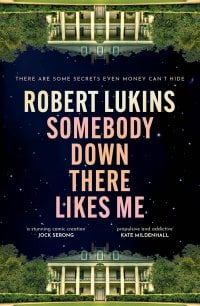
Somebody Down There Likes Me
Robert Lukins’ novel Somebody Down There Likes Me shows there’s no need to eat the rich: left to their own devices, they will eat themselves.
Thanks to their multigenerational, multibillion-dollar family business, the Gulches live a life of obscene wealth and spectacular dysfunction in an exclusive (fictional) Connecticut enclave called Belle Haven. The canny and capable Honey Gulch runs both the family business and the business of family in a manner that ensures she is ubiquitous, efficient and invisible. Her competence leaves her useless husband, Fax Gulch, to potter about the house pursuing his dilettantish interests in between occasional paddles in the indoor pool, with its simulated night-sky ceiling, and regular slides into narcotic unconsciousness. A team of nameless servants are on hand to deliver snacks and clean up messes.
Their kidult son, Lincoln, occupies an office in the business and a mansion across the street from his parents. He plays video games, hangs out with his morally bankrupt old mate Duke, and analyses himself so obsessively that he wonders if his personality is “in danger of being subsumed completely by this great sasquatch of self-awareness”. Lincoln sees the world as a jungle and envisions himself as a gazelle, just one stot ahead of the lions. His sister, Kick, the only family member with a functioning social and political conscience, has been out of the picture for years in self-imposed and penniless exile.
The story begins on a Sunday in 1996 as Kick reluctantly answers the call to return home. Honey and Fax have important news for her and her brother, or, as Fax puts it once they are all together, “Your mother and I have some shit to lay on you…” That shit – major, guilty-as-charged commercial fraud and crime – is about to hit the fan in the form of an imminent raid on the business and family home by the FBI. The Gulches have long been a family at war with themselves: capable at best of tentative and temporary alliances and at worst of thoroughly burying whatever love remains. Now that they can all hear the prison gates squeaking open, the stakes are higher than they’ve ever been. Lincoln and Kick reach for one another’s hands.
Somebody Down There Likes Me unfolds over the nine days between Kick’s return and the anticipated rap on the door. The novel is divided into nine parts, one for each day. Within each part, we drop in on each of the four, and learn that Kick has a dark and tormenting secret of her own. The slow revelation of this secret gives the novel, which frequently tends towards satire and a comedy of manners, the heart of a thriller. If there is any chance for redemption for any of this sad lot, it also rests here.
Lukins is a gifted writer who has somehow managed to write a great American novel from Melbourne, even if bluebottles make a curious, metaphorical appearance. He has a penchant for creating odd but compelling characters and a fictional world full of paradoxical contrasts. Something is described as “so incomplete and final”, memories are “poisoned and sweet”. One of Kick’s two best friends from her school days, Presley, is married to a man who, Kick relates, was “the most collectible and least tolerable” of the “douchebags” they went to school with. Nothing is as it seems, or rather everything and everyone is simultaneously what they seem to be – and the opposite.
The author has made the interesting choice of having Kick and Lincoln narrate their own sections, while using a third-person voice for those of Fax and Honey. It occurred to me this might be partly because Fax’s inner voice, incoherent as it is even to himself, would sorely test both reader and writer. As for Honey, she has so effectively checked out emotionally from her life that her inner voice would probably sound like an external narration in any case.
There’s frequent mention of the events at Chappaquiddick in 1969, when United States senator Ted Kennedy ran his car off a narrow bridge at night, leaving his young female passenger, Mary Jo Kopechne, trapped inside. He returned to the party from which they’d come to work out how he should handle the situation: awkward for him, fatal for her. She perished along with his presidential ambitions and a certain kind of American soi-disant innocence. Fax is obsessed with this story, and particularly the coroner’s findings that Kopechne hadn’t drowned but rather had died over several hours of suffocation while holding herself up “in a consciously assumed position” to take advantage of the small bubble of air that was trapped with her in the sinking car. The phrase “a consciously assumed position” had stayed with Fax, and took on “some inflated proportion in his interior landscape”. Are we all just trying to breathe the air we have left? And is 1996 a numerical anagram for 1969?
The author leaves these questions for us to chew on alongside the relationship between pervasive moral corruption and late capitalism, and the darkly comforting possibility that those who profit most from the unequal distribution of wealth may also suffer most from the unequal distribution of love. If you enjoyed Succession, Yellowstone or even just the legal spectacle of Gina Rinehart being sued by her own children, this may be a novel for you.
Allen & Unwin, 336pp, $32.99
This article was first published in the print edition of The Saturday Paper on February 22, 2025 as "Somebody Down There Likes Me".
For almost a decade, The Saturday Paper has published Australia’s leading writers and thinkers. We have pursued stories that are ignored elsewhere, covering them with sensitivity and depth. We have done this on refugee policy, on government integrity, on robo-debt, on aged care, on climate change, on the pandemic.
All our journalism is fiercely independent. It relies on the support of readers. By subscribing to The Saturday Paper, you are ensuring that we can continue to produce essential, issue-defining coverage, to dig out stories that take time, to doggedly hold to account politicians and the political class.
There are very few titles that have the freedom and the space to produce journalism like this. In a country with a concentration of media ownership unlike anything else in the world, it is vitally important. Your subscription helps make it possible.
Purchase this book
Somebody Down There Likes Me
BUY NOW
When you purchase a book through this link, Schwartz Media earns a commission. This commission does not influence our criticism, which is entirely independent.
Subscriber exclusive
Send this article to a friend for free.
Share this subscriber exclusive article with a friend or family member using share credits.