News
Lawyers have been engaged as Creative Australia and the arts minister both refuse to say what really happened before the dumping of Australia’s representative at the Venice Biennale. By Karen Barlow.
‘It’s despicable’: Creative Australia in crisis after Venice Biennale decision
The nation’s premier arts body, Creative Australia, is in turmoil, now largely shuttered, and, it’s understood, lawyers have been engaged.
After one article in a News Corp newspaper, a set of opposition questions in the Senate and a phone call from Arts Minister Tony Burke, the barely week-old appointment of Lebanese-born Australian artist Khaled Sabsabi and his curator Michael Dagostino to represent Australia at the 2026 Venice Biennale was sensationally rescinded.
Sabsabi, a multimedia and installation artist whom Burke describes as “extraordinary” and “gifted”, was dumped over two works that no museum or gallery has ever had a complaint about.
“It’s awful for Australia,” Elizabeth Ann Macgregor, the former director of the Museum of Contemporary Art Australia (MCA), which owns one of the works, tells The Saturday Paper. “I’m getting phone calls and emails from friends around the world. As you know, I’ve been a huge advocate for Australia, our overseas partnerships for the Tate and all that, and people are going, ‘What? What is going on?’
“We have a reputation for being open-minded and for having amazing artists and for doing incredible work down here, and this treatment, it’s really just... it’s despicable.”
The artist and curator, who had signed a contract to represent Australia, said they were “profoundly” traumatised “personally and professionally”. They have asked for privacy as they process a way forward.
“We were selected through a rigorous process and had already begun meaningful work on this important project,” Sabsabi and Dagostino said in a statement to The Saturday Paper.
“We are grateful for the support from the arts community and the public, and we remain committed to the fundamental principles of artistic expression and cultural dialogue.”
There are missing parts of the timeline, but somewhere between Liberal Senator Claire Chandler’s mid-afternoon Question Time attack on Thursday, February 13, which positioned Sabsabi as “promoting” or “featuring” terrorist leaders in his work, and a statement of a decision by Creative Australia at 9.30pm that same day, the appointments of Sabsabi and Dagostino were rescinded.
A spate of resignations at Creative Australia followed, and many of those involved are bound by confidentiality agreements. The information gap has left those on the outside claiming political interference.
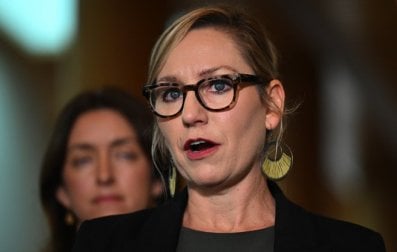
“This reversal is unprecedented and sets a very, very dangerous precedent,” Greens arts spokeswoman Sarah Hanson-Young tells The Saturday Paper.
“It’s not just for the precedent of censoring art and shutting down artistic freedom and expression. I think that if you can do it to art, and if you can censor artistic expression in such a kneejerk, reactive, irrational way, you can do it to anything. And, internationally, Australia now looks like a laughing-stock.”
Minister Burke denies interfering in the decision but admits he called the chief executive of Creative Australia, Adrian Collette, on the Thursday afternoon, straight after what will likely be parliament’s last Question Time before the election.
The call was less than an hour after Chandler, spurred on by a column in The Australian that week and flexing her new opposition arts portfolio, raised Sabsabi’s appointment and his 2007 work depicting the now assassinated Hezbollah leader Hassan Nasrallah.
“With such appalling anti-Semitism in our country, why is the Albanese government allowing a person who highlights a terrorist leader in his artwork to represent Australia on the international stage at the Venice Biennale?” Chandler asked Penny Wong, the government’s Senate leader and foreign affairs minister.
Wong said “any glorification of the Hezbollah leader Nasrallah is inappropriate”, before saying she would seek “further information”.
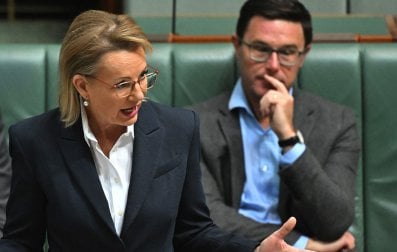
The exchange was quickly transmitted to the House of Representatives chamber. There a “shocked” arts minister and leader of the government in the House was seen conferring with the prime minister before quickly going straight to the source: the head of Creative Australia.
“I contacted one person and one person only as soon as I came out of Question Time, and that was Adrian Collette. He’s the CEO,” Burke told the ABC’s 7.30 program on Monday.
“That particular work had not been raised with me in any of the briefs and was clearly more controversial than anything that had been. So, I was shocked when I saw that it was there, and I rang Adrian to find out what had happened.
“At that point, he had already determined that they were going to have a board meeting that night.”
At the controversy’s centre is the Western Sydney artist’s video installation You, which features manipulated images of Nasrallah, at times with beams of light radiating from his face.
Burke appears more concerned with Sabsabi’s 2006 work Thank you very much, in which there is a frenetic video mashup of the September 11 attack before it ends on then United States president George W. Bush at a press conference saying the title of the work.
“The work in particular, the one that drew on 9/11, is a work which I hadn’t seen,” the minister said. “It’s some 20 years old. It was on his web page. And I understand why Creative Australia took the immediate action that they did.”
The works of Sabsabi, who migrated to Australia from Lebanon in 1978 to escape the civil war, have been acquired by major public and private collections and consistently feature Islamic religion, Arab culture and themes of migration and relocation.
Macgregor was involved in acquiring three of Sabsabi’s works, including the donation of You, which is not currently on display.
It is described in the museum’s notes as “purposefully ambiguous”, with the light beams suggesting “divine illumination”. The notes say the work “plays on western fears of cultural difference” and suggest the “all-pervasiveness of the public news media, and its ability to deify or vilify, and to generate suspicion or panic through the intensive repetition of imagery on our television screens, day in and day out”.
Macgregor insists the artist is against ideology.
“He’s raising the question of ‘who are these leaders?’ They profess to speak on behalf of God,” she said. “I mean, how, dare I say, prophetic is that, given the pronouncements we’ve got coming out of America? You know, that Trump is God-given. So, he’s questioning the ideas that my understanding would be, and let me tell you, this is all about my interpretation of his work – an artist is very rarely going to give you black and white. It’s not propaganda. It’s not saying, ‘I am backing Hezbollah. This is the leader.’ ”
Macgregor tells The Saturday Paper there were many discussions at the MCA about how to deal with a possible controversy over the acquisition and showing of You, but it never transpired.
“You is actually in the MCA collection and has been shown, and we have never had a complaint as such,” she said. “What happens in a gallery often is dialogue. Someone will say, ‘Why is this piece like that?’ And we encourage our staff – and the staff in the galleries are trained to do this – to have a discussion. But we’ve never had any kind of formal complaint about this work, or indeed work of this nature.
“We have antenna. I used to say to my team, ‘Please make sure I know if there’s anything you think that could be contentious, bring it to my attention, so that if I get the phone call out of the blue from the whatever, Daily Telegraph or whoever, I know how to answer it.’ ”
The danger is when the work is taken out of context, according to Macgregor, who is assisting with a community independent campaign in Cowper. She said Creative Australia was fully briefed on the chosen team. “I think there needs to be a long, hard look at the make-up of Creative Australia.”
Burke said he was “very clear” with Collette in his phone call following Question Time but insists he said: “Whatever you decide, I will support you and I will support Creative Australia.”
The Saturday Paper sought an interview with Adrian Collette, but he declined multiple requests.
According to board member and artist Lindy Lee, who stepped down after the decision, the emergency meeting was “fraught and heartbreaking”.
“In no direction was there anywhere to breathe. I am bound by confidentiality, so I cannot speak on these things,” Lee posted to Instagram on Sunday.
“I came away deeply conflicted and realised I had to resign. I could not live with the level of violation I felt against one of my core values – that the artist’s voice must never be silenced.”
The board’s decision was described in the short, late evening media release as “unanimous”, although board member Larissa Behrendt was absent.
“Creative Australia is an advocate for freedom of artistic expression and is not an adjudicator on the interpretation of art. However, the Board believes a prolonged and divisive debate about the 2026 selection outcome poses an unacceptable risk to public support for Australia’s artistic community and could undermine our goal of bringing Australians together through art and creativity,” the statement read.
“Creative Australia will be reviewing the selection process for the Venice Biennale 2026.”
After the release, leading arts figure and banker Simon Mordant immediately resigned as Biennale ambassador and withdrew financial support, saying he could only “assume it was the result of political guidance or direction”.
He said the decision was “outrageous” and a “very dark day for Australia and the arts”, suggesting the Australian pavilion should remain empty next year in solidarity with Sabsabi.
The businessman later issued a clarifying statement, saying he was not involved in the selection or the rescinding of Sabsabi’s commission.
“I don’t want anyone to misinterpret my position here,” he said. “I resigned as an Ambassador to the 2026 Australian presentation at the Venice Biennale and withdrew my financial pledge because of poor process by the Government’s arts body.
“I want to be 100 per cent clear that I would never knowingly support an artist or art that glorifies terrorism, racism or antisemitism or went against my values. I think everybody has to be very careful about the insidious rise of racism and antisemitism which has become particularly prevalent in Australia.”
Mikala Tai, the head of visual arts at Creative Australia, also resigned, as did program manager Tahmina Maskinyar.
The independent peer review selection panel, comprising Dunja Rmandić, Mariko Smith, Wassan Al-Khudhairi, Elaine Chia and Anthony Gardner, say they were blindsided, revealing in a statement that the members found out about the decision through social media and news reports.
The panel noted it was Collette himself who chose Sabsabi and Dagostino from a shortlist of creative teams, based on their advice. The other creative teams released a statement supporting the successful team and condemning Creative Australia’s decision to drop Sabsabi and Dagostino.
Minister Burke insists he is a big supporter of Creative Australia and has “always supported” the actions of the board. The Saturday Paper sought an interview with Burke but his office said he was not available.
Burke did not respond to a series of detailed questions, including whether he had confidence in Collette and Creative Australia’s chair, Robert Morgan.
The Saturday Paper also asked the minister what else he expressed to Collette in the phone call and whether he had a subsequent briefing over the meaning of Sabsabi’s works You and Thank you very much.
A statement from Burke said: “I’ve fought for as long as I’ve had this portfolio to make sure there’s no political interference in Creative Australia.”
This article was first published in the print edition of The Saturday Paper on February 22, 2025 as "Creative Australia in turmoil".
For almost a decade, The Saturday Paper has published Australia’s leading writers and thinkers. We have pursued stories that are ignored elsewhere, covering them with sensitivity and depth. We have done this on refugee policy, on government integrity, on robo-debt, on aged care, on climate change, on the pandemic.
All our journalism is fiercely independent. It relies on the support of readers. By subscribing to The Saturday Paper, you are ensuring that we can continue to produce essential, issue-defining coverage, to dig out stories that take time, to doggedly hold to account politicians and the political class.
There are very few titles that have the freedom and the space to produce journalism like this. In a country with a concentration of media ownership unlike anything else in the world, it is vitally important. Your subscription helps make it possible.
Subscriber exclusive
Send this article to a friend for free.
Share this subscriber exclusive article with a friend or family member using share credits.