World
Two thirds of PNG women experience domestic violence. Cambodia–Thailand clashes kill 14. China trade soars despite tariffs. By Jonathan Pearlman.
Trump urges Zelensky to make concessions on peace deal
Great power rivalry
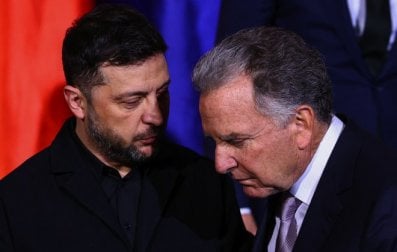
Ukraine: Volodymyr Zelensky, Ukraine’s president, ruled out ceding territory to Russia this week as he prepared to deliver a new peace proposal to Washington amid mounting pressure from Donald Trump to make concessions.
After meeting with European leaders on Monday, Zelensky told reporters Ukraine had no “right”, legally or morally, to give up territory.
“Of course, Russia insists that we give up territories,” he said. “We, of course, do not want to give anything away. That is exactly what we are fighting for.”
Zelensky met in London this week with European and NATO leaders, who have worked with him on preparing a new peace plan in response to an initial United States-backed proposal that heavily favoured Russia.
Trump has expressed a willingness to revise the proposal but has increased pressure on Ukraine, telling Politico this week that Zelensky must make concessions because Russia “has the upper hand”.
“[Zelensky] is going to have to get on the ball and start accepting things – you know, when you’re losing,” Trump said.
Russia has been advancing in eastern Ukraine, though its gains have been slow.
Valery Gerasimov, Russia’s top general, told a group of officers on Tuesday that his forces were advancing along the entire frontline in Ukraine. He said Russia had captured the hard-fought city of Pokrovsk and had encircled Myrnohrad, a nearby town.
Ukraine’s military said it was withdrawing from positions in Pokrovsk that it could no longer defend but denied the city had fallen.
https://www.youtube.com/watch?v=dXOQuCbO5N4
The neighbourhood
Papua New Guinea: Sixty-four per cent of women in Papua New Guinea experienced domestic violence in 2025, according to a new government study that found levels of gender-based violence have been surging.
The study, based on surveys of more than 5000 women, found the number of women experiencing gender-based violence had increased 210 per cent since 1986. In some regions, as many as 90 per cent of women had experienced violence.
The study found 83 per cent of men believe they have a right to hit their wives, up from 78 per cent in 2016. More than 51 per cent of people had seen their father assault their mother.
Papua New Guinea, which has about 10 million residents, has 51 safe houses and its police force has 61 family and sexual violence units. Most cases of violence are not reported and convictions are rare. The most recent police figures, from 2022, found 4 per cent of cases that were reported resulted in arrests and 0.5 per cent resulted in convictions.
According to ABC News, the government will spend $65 million a year as part of a 10-year plan to address gender-based violence, including building at least one safe house in every district, introducing 12-month rehabilitation for first-time offenders, and conducting specialist training for 500 police officers.
Australia’s foreign affairs minister, Penny Wong, last month announced an additional $25 million over five years to support crisis centres and frontline services in nine Pacific countries, including Papua New Guinea.
“Every woman and girl in our region has the right to live free from fear and violence,” she said.
War zone
Cambodia: Clashes between Cambodia and Thailand this week left at least 14 people dead and prompted mass evacuations from border areas, as Washington urged both countries to return to a two-month-old ceasefire deal backed by US President Donald Trump.
On Monday, Thailand launched air strikes and deployed tanks along the border, saying it was responding to fighting that morning in which a soldier was killed and four were wounded.
Cambodia said it had not responded to the attacks, accusing Thailand of “provocative actions for many days”.
Each side accused the other of breaking the ceasefire.
The fighting, which prompted at least 500,000 residents to flee border areas, followed a five-day war in July that left at least 48 people dead.
In October, Trump oversaw the signing in Malaysia of a ceasefire deal between the two countries that involved the withdrawal of heavy weapons from the border and the creation of an observer team. But the deal ended weeks later, when Thailand suspended its involvement after its soldiers were injured by a landmine.
Secretary of State Marco Rubio said this week the US was “concerned” about the renewed fighting and urged both sides to return to the ceasefire deal.
The dispute dates back to the French colonial era, which led to the creation of boundaries in the early 1900s that failed to clearly demarcate the borderlines. Regular clashes have erupted along the 800-kilometre border.
On Tuesday, Suos Yara, an adviser to Cambodian Prime Minister Hun Manet, told Reuters his nation was ready to negotiate but would not initiate the process.
Thai Prime Minister Anutin Charnvirakul ruled out dialogue, telling reporters the government backed the military to “protect our sovereignty”.
“We cannot stop now,” he said.
Spotlight: China trade soars despite tariffs
China’s exports have surged to record levels as Donald Trump’s tariffs reduced trade between the world’s two largest economies but prompted Chinese manufacturers to find new buyers in other countries.
Official data this week showed China’s trade surplus was US$1.1 trillion in the first 11 months of 2025, compared with $1 trillion in the full year in 2024. Exports to the US dropped about 19 per cent but this was offset by increased sales to Asia, Europe, Latin America and Africa.
However, economists said the news was not good for either the US or China.
Trump’s tariffs, which are the highest imposed by the US since 1930, have not dented China’s domination of global trade and have failed to send – as Trump promised – “jobs and factories … roaring back into our country”.
The US has lost about 50,000 manufacturing jobs since January, and many cheap Chinese goods are still entering the US via third countries such as Indonesia and Malaysia. American farmers have been hit by a Chinese boycott imposed as part of the trade war, which prompted Trump on Monday to announce a $12 billion bailout package to support the agricultural sector.
John Gunderson, a South Dakota farmer, told a US radio station this week that Trump’s tariffs “took a weed wacker to agreements that took 50 years to build”.
But China’s trade surplus highlighted its failure to boost demand among domestic consumers, which has left manufacturers dependent on exports rather than local sales.
China’s economy remains sluggish and the manufacturing sector has started to contract due to the lack of local demand.
President Xi Jinping recently told a Communist Party politburo meeting that domestic demand must become “the main driver” of the economy. But a property downturn and high youth unemployment have left Beijing struggling to increase consumer spending.
Analysts say a growing risk for China is that some of its main export markets will, like the US, introduce tariffs and other measures to try to push China to buy goods as well as sell them.
Returning from a trip to Beijing last week, French President Emmanuel Macron told the financial newspaper Les Echos that China’s trade surplus was “untenable” and Europe might impose tariffs on China.
“The [Chinese] are killing their own customers,” he said.
This article was first published in the print edition of The Saturday Paper on December 12, 2025 as "Trump urges Zelensky to make concessions on peace deal".
For almost a decade, The Saturday Paper has published Australia’s leading writers and thinkers. We have pursued stories that are ignored elsewhere, covering them with sensitivity and depth. We have done this on refugee policy, on government integrity, on robo-debt, on aged care, on climate change, on the pandemic.
All our journalism is fiercely independent. It relies on the support of readers. By subscribing to The Saturday Paper, you are ensuring that we can continue to produce essential, issue-defining coverage, to dig out stories that take time, to doggedly hold to account politicians and the political class.
There are very few titles that have the freedom and the space to produce journalism like this. In a country with a concentration of media ownership unlike anything else in the world, it is vitally important. Your subscription helps make it possible.
Subscriber exclusive
Send this article to a friend for free.
Share this subscriber exclusive article with a friend or family member using share credits.