Books
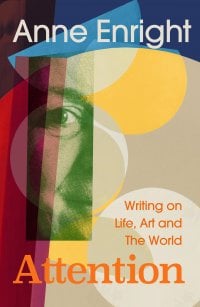
Anne Enright
Attention
“I can resist!” Anne Enright declares as she walks through Dublin, trying desperately not to think about the histories impressed upon the most innocuous corners of her city. When this proclamation appears in Enright’s collection of essays – Attention: Writing on Life, Art and the World – the reader knows this will be a hopeless endeavour. Enright is simply incapable of resisting the pull of the world around her.
Whether catching a ferry to the Aran Islands to watch an Irish translation of Samuel Beckett’s Happy Days staged in a field or sitting perched on an e-bike in the Balkans, Enright is alive with curiosity. “I am in an ecstasy of attention. Sentences whirr, words are unloosened.” A feeling that makes her want to rush to her desk: “I feel I should be back at home writing. But look!” This curiosity has fuelled a hugely productive writing career, including eight novels and countless short stories. During this time, Enright’s nonfiction has been published at a steady clip.
The 24 essays in Attention are grouped into three sections: voices, bodies and time. In the first, “Voices”, Enright plunges into the oeuvres of writers including Toni Morrison, Angela Carter, Maeve Brennan and Helen Garner. She dissects style, sentence structure, censorship. We observe Enright as a reader, from detailing her experience of “mainlining” Ulysses by James Joyce (“It is kind of a strenuous dreaming, very like writing fiction”) to unpacking the legacy of Alice Munro (“Denial makes a great subject for fiction, but a poor mechanism. Some of Munro’s tricks, always lovely, no longer feel entirely honest”).
When she is published in outlets such as The New York Review of Books and London Review of Books, Enright’s cultural criticism is like catnip for writers. But corralled together and placed alongside her writing about sex, abortion reform, medical misogyny and laundries for unmarried mothers, a surprising sense of cautiousness emerges. These essays veer towards the artfully constructed, tightly written and unrevealing.
Enright is her best when writing about bodies and time – from bracing self-assessment (“I am, a middle-aged woman in a weird helmet and cycle shorts so unflattering I hold a bag in front of me to enter a café”) to the slow death of her mother (“Either you know the job of elder care or you cannot imagine it”). You can’t help but pay close attention as Enright masterfully squares life up as frank and true.
Jonathan Cape, 288pp, $36.99
This article was first published in the print edition of The Saturday Paper on December 13, 2025 as "Anne Enright".
For almost a decade, The Saturday Paper has published Australia’s leading writers and thinkers. We have pursued stories that are ignored elsewhere, covering them with sensitivity and depth. We have done this on refugee policy, on government integrity, on robo-debt, on aged care, on climate change, on the pandemic.
All our journalism is fiercely independent. It relies on the support of readers. By subscribing to The Saturday Paper, you are ensuring that we can continue to produce essential, issue-defining coverage, to dig out stories that take time, to doggedly hold to account politicians and the political class.
There are very few titles that have the freedom and the space to produce journalism like this. In a country with a concentration of media ownership unlike anything else in the world, it is vitally important. Your subscription helps make it possible.
Purchase this book
Attention
BUY NOW
When you purchase a book through this link, Schwartz Media earns a commission. This commission does not influence our criticism, which is entirely independent.
Subscriber exclusive
Send this article to a friend for free.
Share this subscriber exclusive article with a friend or family member using share credits.