Books
Rose Michael
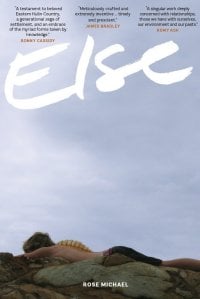
Else
Novels written in prose poetry are not for everyone. It takes a very devoted reader to commit to a whole book comprising devolving sentences, words spaced out like patterns, dialogue merging with description. There can be beautiful, accessible prose poetry – Ocean Vuong has built a career upon it. Prose poetry can open us up to feelings through abstraction that reaches truth – think Madison Godfrey’s Dress Rehearsals. Unfortunately, having spent many days trying to untangle it, I don’t think Rose Michael’s latest novel, Else – written in prose poetry – is for me. And the more I consider it, the harder I find it to imagine who this book is for.
Michael is a senior lecturer in writing and publishing at RMIT. She is the author of two previous novels, The Asking Game and The Art of Navigation, the first of which was runner-up for the Vogel. Clearly, she has a readership. Else is speculative environmental fiction: its two protagonists, mother Leisl and daughter Else, live in a world of environmental collapse. As floods and warming drastically change the landscape, the pair are forced to journey along “the Ninch”, trying to survive in a blasted world destroyed by humans. Nature is clawing her way back, ridding the environment of its human grievances.
The best part of the book is the relationship between mother and daughter. Else is neurodivergent – she does not understand time as others do, she does not converse as is expected, she speaks mostly in puns and non sequiturs. A single parent, Leisl used IVF to conceive Else. She now finds herself oscillating between awestruck admiration for her daughter’s difference and unavoidable frustration as Else refuses to answer any of her questions: “Leisl never knew there was a normal way to do – and say – the smallest thing, until she had a child who didn’t. Couldn’t. Wouldn’t!” But Else’s return to nature is freeing for her and Michael gives us much to ponder in terms of the problematic notion of “progress” and the colonisation of stolen land.
This novel has echoes of the first half of Ali Smith’s Like, in which a single mother who has mysteriously forgotten how to read moves to a rural area with her small, strange, brilliant child. But while Smith uses wordplay as a rhetorical as well as a thematic device, Michael’s puns feel random. There are only so many times a reader can experience lines such as “She is tying herself in a KNOT. Ready? Or not,” without an accompanying eye roll. Else has much potential, but its fruition lies elsewhere.
Spineless Wonders, 250pp, $29.99
This article was first published in the print edition of The Saturday Paper on December 13, 2025 as "Else".
For almost a decade, The Saturday Paper has published Australia’s leading writers and thinkers. We have pursued stories that are ignored elsewhere, covering them with sensitivity and depth. We have done this on refugee policy, on government integrity, on robo-debt, on aged care, on climate change, on the pandemic.
All our journalism is fiercely independent. It relies on the support of readers. By subscribing to The Saturday Paper, you are ensuring that we can continue to produce essential, issue-defining coverage, to dig out stories that take time, to doggedly hold to account politicians and the political class.
There are very few titles that have the freedom and the space to produce journalism like this. In a country with a concentration of media ownership unlike anything else in the world, it is vitally important. Your subscription helps make it possible.
Purchase this book
Else
BUY NOW
When you purchase a book through this link, Schwartz Media earns a commission. This commission does not influence our criticism, which is entirely independent.
Subscriber exclusive
Send this article to a friend for free.
Share this subscriber exclusive article with a friend or family member using share credits.