Books
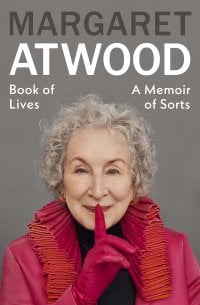
Margaret Atwood
Book of Lives
In the introduction to Book of Lives: A Memoir of Sorts, Margaret Atwood writes that “every writer is at least two beings: the one who lives, and the one who writes” and claims that these two beings have “less idea than you’d think” about what the other “has been up to”. This, she argues, necessarily complicates the idea of a literary memoir. For this reason, she has for years resisted all suggestion she write her memoir – and it is also why she has chosen to focus on tracing “the material” that shaped her as a writer and informed each of her works, knowing all the while it is one’s “life and times” – nothing more, nothing less – that constitute precisely this.
What this means is that while her approach is largely conventional – Book of Lives is linear in structure and strictly chronological in its telling, progressing from portraits of Atwood’s parents to her own childhood and across her adult life to the present day – many of its chapters are named for the events within them that become “the material”.
Often, these are titled after the book Atwood is writing at the time or they are referred to as “the prequel” for a work that comes much later. “Cat’s Eye, the Prequel”, for example, details the intensely psychological childhood bullying inflicted on nine-year-old Atwood by a trio of female friends, which became the subject matter of a novel some 40 years later. This tactic is especially powerful when the prequel is less overtly related to the resulting work, as is the case in “The Handmaid’s Tale, the Prequel” in which Atwood is studying American Puritanism at Harvard and a more imaginative fascination is clearly brewing.
There is much of writerly interest within Atwood’s memoir. She does offer explicit pieces of writerly advice, mostly delivered cheekily, as “morals” or “lessons” at the end of anecdotes (“You can make anything talk, including your sleeve … Novelists do it all the time”). Otherwise it is offered self-deprecatingly, as when Atwood describes an early failed novel. She had painstakingly planned out the structure in advance but couldn’t make it work. “There are methodical writers and then there are improvisers,” she writes. “I now knew for certain which kind I was. I don’t recommend my method.”
Some of the most fascinating material on this front, though, concerns Atwood’s immersion as a young writer in the burgeoning Canadian literary scene. Atwood’s first publications were in the early 1960s, a time when, she writes, any Canadian “serious about being a writer” was advised “to go to London, New York or Paris”, because there was no “respect” for writing and no infrastructure to support it – and because Canadian literature was expected to be “second-rate”. “The Australians,” Atwood adds, “called this whole bundle ‘the colonial cringe’ ” – which is accurate in spirit, if not terminology.
Atwood was part of a generation of writers that “dug in” and began to build what they needed – “not for fun, but out of need” – and Atwood’s detailing of this scrappy agitation and starting-up of publishers and guilds is a valuable historical documentation – and very funny to boot.
Atwood’s charm and wry humour is the animating force of Book of Lives. She is, of course, a natural storyteller, and takes great delight in the absurd, in the witty riposte and in frequent, gentle self-deprecations. Atwood’s narration is exactly what fans of her writing would expect – lively and spirited, and with no small amount of bite. It is also, delightfully, not averse to spite – many of her anecdotes leave their key antagonists unnamed but end with asides such as “I haven’t forgotten” and “I know where you live”. Wonderfully, a story about an unethical journalist ends with the lines “Snotty comment is one thing – you’re reading some right now – but outright lies are another.”
As Atwood’s career intensifies, especially from the 1980s onwards, Book of Lives tracks many of the different opportunities, encounters and even ways of life this opens up. Here, too, Atwood handles their absurdities matter-of-factly and with grace, but these later sections lack some of the energy and dynamism of its earlier chapters. What is compelling here is Atwood’s portrayal of her family and its vibrant domestic life – especially the period where she and her partner, the novelist Graeme Gibson, lived on a small farm. Their animals were both unusual – Gibson once bought Atwood a pair of peacocks for her birthday – and prone to misadventure. Atwood’s narration of these incidents is both tender and wickedly funny.
It’s no surprise Atwood’s memoir is, by and large, a romp – filled with funny, quirky anecdotes and sharp reflections – but it is also a book that’s fascinating for its quiet analyses of cultural moments and shifting mores and for its questioning of what makes a writer and draws them to their particular subject matter, method and style. Atwood’s voice and her keen intelligence are the real pleasures of this book. It is intensely personable and will delight her significant readership.
Chatto & Windus, 624pp, $69.99 (hardback)
This article was first published in the print edition of The Saturday Paper on December 13, 2025 as "Book of Lives".
For almost a decade, The Saturday Paper has published Australia’s leading writers and thinkers. We have pursued stories that are ignored elsewhere, covering them with sensitivity and depth. We have done this on refugee policy, on government integrity, on robo-debt, on aged care, on climate change, on the pandemic.
All our journalism is fiercely independent. It relies on the support of readers. By subscribing to The Saturday Paper, you are ensuring that we can continue to produce essential, issue-defining coverage, to dig out stories that take time, to doggedly hold to account politicians and the political class.
There are very few titles that have the freedom and the space to produce journalism like this. In a country with a concentration of media ownership unlike anything else in the world, it is vitally important. Your subscription helps make it possible.
Purchase this book
Book of Lives
BUY NOW
When you purchase a book through this link, Schwartz Media earns a commission. This commission does not influence our criticism, which is entirely independent.
Subscriber exclusive
Send this article to a friend for free.
Share this subscriber exclusive article with a friend or family member using share credits.