Profile
For Yaron Lifschitz, artistic director of Circa, theatre is an incandescent encounter between performers and their audience. By Kate Holden.
‘We can be multitudes’: Circa artistic director Yaron Lifschitz
“The dirty secret of theatre is that most of it’s boring,” says director Yaron Lifschitz. “For me it has to be real, it has to be authentic, it has to be actual, at some level – it also needs artifice and structure and scaffolding and form, and all those other things – but it has to have impact, and the charge of life.”
He recalls his teenage work experience at Sydney Theatre Company on David Williamson’s Emerald City. “I think I was craving something that wasn’t there necessarily,” he reflects, “but I could sense the potential of this room.” He hadn’t especially loved previous encounters with the stage, but some kind of intuition took this diligent history scholar high-schooler from a not particularly arty suburban family on Sydney’s north shore into the libidinous, thrilling, spangled and sorcerous world of the stage, where he has thrived for 30-odd years. “It came as something of a calling,” he says. “I just knew it was something I needed to do.”
It wasn’t the plays or the performance, or the backstage fervour, but rather their promise. The stage was a place, he suddenly understood, “where people come together to have intense private experiences, which are often very deep and touching”. At UNSW Sydney he studied theatre along with maths and literature, and didn’t do very well; he directed a lot of student plays and disappointed himself.
“I made every mistake that it’s possible to make,” Lifschitz says. “But we got to work with Brecht, Beckett, Milan Kundera, all sorts of different writers; and of course we sat around and drank coffee and talked – opined, I think would be the correct word – with far more confidence than insight.” Then he went to National Institute of Dramatic Art and was the youngest student ever accepted in the directing program. “A trial by fire,” he says. “I knew nothing.”
All the signs were that Lifschitz had what it takes, but a few years of freelancing – opera and plays, physical theatre, puppetry productions, “a brutal and unforgiving existence largely funded by Centrelink” – saw him nearly giving up. The work was thin and the dramas were tedious. He was rescued by the Australian Museum initiating a lively program of theatrical presentations arranged by Lifschitz, who gained more occult skills along the way, including how to work in the turf wars of an institution. It wasn’t quite enough.
“I think what I most noted was the gulf between the thing that I wanted to feel when I saw work onstage and the work that I put onstage,” he says thoughtfully.
Lifschitz speaks quickly, drolly and articulately, even while shifting his laptop from a perch in the company’s costume room to a ledge in a corridor and back again while the ensemble rehearses in the next room. He barely skips a beat. High culture quotes come fluently to hand: it’s no trouble to produce a cogent portrait of his philosophical and cultural history. Smiling under his glasses, he tells it as he sees it. “Plays were this literary form that had been created to bore kids and employ drama teachers. They’re fine, but they weren’t what to me theatre was, this incandescent encounter between people sharing a space where something urgent and fierce and necessary is happening.”
Only a few companies made the kind of work he wanted to pursue. Rock ’n’ Roll Circus in Brisbane, evolved from community theatre and associated with the punk nouveau cirque movement of the 1980s, had an opening for artistic director. Lifschitz got the job. He moved to Brisbane in 1999, changed (controversially) the name and mission of the company to Circa in 2004, “and we’ve been going and growing in most ways ever since”.
Last year, 419 performances; 131 cities in 15 countries; a full-time ensemble of 35 acrobats, plus the crew and collaborators. Circa, based in Fortitude Valley in Brissie, has flown aloft for 20 years, becoming one of Australia’s most esteemed performing arts companies and an international stalwart. They hold residencies at the Barbican in London, they’re regulars in Berlin, they’ve won six Helpmann Awards. More than two million people have seen their shows. They have performed in a Roman amphitheatre, an English cemetery, in tents, in Brooklyn, at the Philharmonie de Paris. A few weeks ago they were in Wollongong.
“I think globally people used to be really surprised: what is this sophisticated circus doing, coming from Australia? We’ve taken circus to places it’s never been before.” The work, he says warmly, has international accessibility. “It’s often not-verbal, it can tour to a wide variety of audiences, play in different spaces, and we pride ourselves on being resourceful and adaptable. We really work around the margins – we can’t afford to be too precious. We treat our art like it’s our business, and our business like it’s our art. How do you make the show rigorous and precise and accountable, and then how do you make the business creative, resourceful and resilient?”
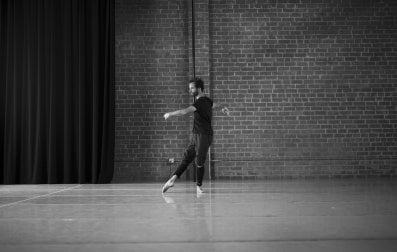
Circa, combining ballet, contemporary dance, circus and drama, whirls and cavorts, it thrusts and jiggles. There are many companies now of this hybrid vigour, so Circa storms onwards. “How do we keep exploring the limits of what this form can do, while taking audiences on that journey?” Lifschitz asks himself often. “Because we could easily disappear up our own self-importance without achieving anything. Circus only exists phenomenologically, so the audience has to be there and they have to experience it. Otherwise it’s not circus, it’s just aesthetic movement with danger, which has no interest to me.”
Fear is our bodies’ way of telling us we need change, he wrote after the terrible year of 2020, reflecting on art and global humanity. “There’s no moment in circus where you’re not in some level of a fear state!” he says. A Kierkegaard quote comes to mind: anxiety is the dizziness created by freedom. “That resonated with me, because it feels like that, when you go in and say, ‘I want to unleash this profound, ecstatic experience in front of an audience and get them to connect with it and incite them to their better selves.’ Of course you’re going to be in a state of fear, because no one can do that regularly, and consistently, and you’re going to fail, and Beckett famously said to be an artist is to try, fail, try again and fail better. We’re pretty good at failing better, but occasionally you see the moments, there are those moments which are sublime when everything comes together. But they’re not that common.”
His father, he says, was a gifted educator, and his family’s Jewish traditions encourage a questing, provocative restlessness. “We have the idea that questions are more important than answers,” he explains. “If I have a creativity, it’s not a big ‘here’s a vision’. It’s much more, ‘I wonder if this could be different’: prodding and poking and tinkering. I’ve always been interested in activating questions. And I don’t stop a lot, I like the idea of keeping going, I like the idea of continually breaking into things.”
Directing operas, working on boutique shows with the Australian Chamber Orchestra, hosting podcasts, overseeing Circa’s extension program: all this and he’s still match fit for his main corner of performing arts, envisioning circus, which must keep bodies and budgets propelled and moving before they fall.
“Circus is a couple of things,” he says. “First, it can’t be performed by muggles. There always has to be something that mortals in the audience think: ‘I can’t do that. I can’t do a handstand on one hand or have three people stand on top of me.’ It always has something exceptional about it. Circus also has this imperative: thou shalt not bore. It has this ferocious desire to impress, excite, thrill, delight its audience which, as an end in itself, is not necessarily crazy helpful: it can be a real double-edged sword. Circus can feel that as a burden. But it’s a pretty good starting point for theatre to say: ‘We will not be boring.’ At the core, you always go back to those elements: it has to be virtuosic and it has to have some element of charge and thrill.”
Life is still suburban, Brisbanian, regular for Lifschitz: he has a wife, three children, a dog. But in the next couple of weeks, he says, he’s off to Melbourne, Berlin, Manchester, London, back to Sydney, Brisbane, and then off again to Melbourne, next it’s Paris… all before Christmas. “One thing circus does is grounds you. It really just grounds you.” No wonder he enjoys pressing out into imagined space, as the acrobats will, planning and envisaging shapes in the void: a frontier on which detonations and adventures can be had without leaving his seat.
“Most theatre-makers are the children of Artaud in the 20th century. We’re all seeking this very powerful transformative experience that feels like it’s some kind of ecstatic revelation that happens communally. When you’re working in circus you’re very close to that, because you’re constantly dealing with jeopardy, with people who have to be at their best, in a group, individually, physically, and go out there and give it everything. That’s the privilege of working in circus.”
Lifschitz acknowledges that it’s not his body out there flexing and leaping, but he’s the intermediary: he tinkers and pokes and asks how things might be done just a bit more interestingly. He brings his high culture education into the room: Circa recently made a show in response to Bach’s Art of Fugue; they’ve writhed to Daphnis and Chloe; mimed the tale of Orpheus and Eurydice to the music of Gluck, and Dido and Aeneas to Purcell. They’ve also just done Shaun the Sheep. “The very thing we add is the vigour,” he says. Vigour of hybrid collisions, of bafflement, of danger and excitement: of using silent bodies to tell eloquent stories of human nature.
The latest, fresh from Wollongong and the Barbican where more than 20,000 people saw it, is Duck Pond, a mash-up of Swan Lake and “The Ugly Duckling” through circus and ballet. The ensemble was drilled by a ballet dramaturg and wear sequined yellow swimming flippers as duck feet as they tumble and soar.
It’s an all-ages delight, Lifschitz says, but doesn’t lack Circa’s characteristic provocation and philosophising. “It takes these two stories, Swan Lake and ‘The Ugly Duckling’ and asks a question: is identity destiny?” Identity discussions, he says, like earnest dramas, get boring quickly, occluding larger dialogues about powerlessness and oppression. These two old fables, on the other hand, “encourage you: there’s no reason you can’t be a black swan or a white swan; there’s no reason you can’t discover you’re something different, mid-flight, as you’re about to throw yourself into swans to end your shabby duckling life, as you figure out you fly in a completely different way. Those things are much more resonant than they’re usually given credence for in a very identity-trained context. We can be multitudes.”
Under Lifschitz’s direction, Circa insists on a vagabond questing, a flexion of forms within the taut frame of agile bodies, disciplined stagecraft, dramatic lighting and the rigour of a touring schedule. A tough balance to find? “There are all levels of revolution and confrontation and at different times, different things work. I don’t know what works here. I just know you get a room with a group of people and do something you love with great energy and passion and dedication and try and make good stuff, and stay in business long enough to keep doing that.”
The creative work is continuous. “It’s Frankensteinian, it’s Promethean, it’s a Golem,” he says. “We’re invoking some kind of spirit to animate the material, to give it a life force, and that’s absurdly hubristic and ridiculously presumptuous to think you can do that. But there are moments where it feels like it’s possible.”
This article was first published in the print edition of The Saturday Paper on December 13, 2025 as "Greatest showman".
For almost a decade, The Saturday Paper has published Australia’s leading writers and thinkers. We have pursued stories that are ignored elsewhere, covering them with sensitivity and depth. We have done this on refugee policy, on government integrity, on robo-debt, on aged care, on climate change, on the pandemic.
All our journalism is fiercely independent. It relies on the support of readers. By subscribing to The Saturday Paper, you are ensuring that we can continue to produce essential, issue-defining coverage, to dig out stories that take time, to doggedly hold to account politicians and the political class.
There are very few titles that have the freedom and the space to produce journalism like this. In a country with a concentration of media ownership unlike anything else in the world, it is vitally important. Your subscription helps make it possible.
Subscriber exclusive
Send this article to a friend for free.
Share this subscriber exclusive article with a friend or family member using share credits.