Life
As the average life span extends ever closer to 100 years, and possibly more in the not too distant future, what are we to do with this extra time on Earth? By Wendy Harmer.
The comforts and conundrums of ageing
There’s something special, even profound, about a birthday that ends in a “zero”.
The ever-growing number of candles on the cake become milestones and an invitation for contemplation. Where we’ve come from. Where we’re going. How far to go and how we mean to get there. And, is there a “there” there?
Even before I had a nought to my name, I loved A. A. Milne’s poem from Now We Are Six.
When I was One,
I had just begun.
When I was Two,
I was nearly new.
When I was Three
I was hardly me.
When I was Four,
I was not much more.
When I was Five,
I was just alive.
But now I am Six,
I’m as clever as clever,
So I think I’ll be six now for ever and ever.
These few, insightful words perfectly capture the childish wish that we might, through sheer force of will, command time to stop still. I’ve engaged with this magical thinking – that there’s a perfect age and that I’d like to remain there for ever and ever.
Would I be an ambitious, single 30-something? In my 40s before the birth of my children – or after? In my settled 50s? After that?
Even if it were possible, there’s not an age I’d choose to relive. Every decade comes with its own singular, immutable character. Its achievements, joys, trials and tribulations.
These days, I can add another stanza to A. A. Milne’s poem... “Now We Are Seventy”.
It’s one of our species’ most remarkable achievements that in the century between 1900 and 2000, we have increased our life expectancy by almost 30 years. For the first time in human history, most children born now can expect to live to 90 or older. Developed nations lead the way but others are not far behind.
For the economists and planners, it’s cause for alarm. Shrinking workforces; increased healthcare costs; lack of aged care facilities; lower consumption and the prospect of slowed growth. This older cohort is often spoken of as a “burden”. Environmentalists lament the growing impost on the natural world, which we are already consuming at an unsustainable rate. So far, so bad.
For the “wellness” juggernaut, however, it’s a boon. How to age “gracefully” and “mindfully”. In partnership with the pharmaceutical industry, another chance to cash in with preventive and anti-ageing products, hormone replacement, sleep-aids and the rest. The “wellness” marketplace is estimated to be worth US$2 trillion worldwide.
The “longevists” continue the push for even more years of life, through cryonics, gene therapy and artificial organ transplants, presumably until “Now We Are Eleventy One” – the grand age Bilbo Baggins was celebrating in the opening scene of The Lord of the Rings. For the tech bros it’s the promise of digital eternity through AI. “Now We Are Immortal”.
What we are to do with this extra time on Earth is the question we are only now beginning to consider. Another three decades to contemplate the meaning of it all. Sigh.
By now, most of us are familiar with the theory that “happiness is U-shaped”. From the age of about 20, the theory goes, we gradually become less happy, bottoming out in our miserable 40s, until our contentment levels begin to rise in our fabulous 50s and climb steadily through our scintillating 60s, 70s and 80s and into our positively euphoric 90s.
Yes, well. This theory is hotly contested by academics, who argue that, for many, old age is rather a time of declining wealth, housing instability and reduced access to affordable healthcare. Certainly, the U-shape cannot be universally applied.
Despite these caveats, many studies agree that it’s our attitude to ageing that is the biggest indicator as to how well we navigate our later years. Even given the physical travails of ageing – our creaking bones and accumulating illnesses – a positive mindset can triumph to bring us increasing happiness and contentment.
It’s argued, however, that “ageism”, ingrained in our Western culture, isn’t helping.
I’d wager there’s barely a conference, podcast, newspaper op-ed, radio segment or United Nations report that hasn’t tackled the subject. Although said to be “highly preventable”, I suspect “ageism” will be just as difficult to tackle as “lookism” – that tyranny identified in the 1990s, written about by Naomi Wolf in The Beauty Myth, which has got us precisely nowhere. The beauty industry is estimated to be worth US$677 billion this year, and growing.
Humans have been around for millennia and have always prized youthful beauty. We’re hardwired that way. According to the science of “neoteny”, we’re attracted to baby-faced features. Big eyes, small noses and pinchable cheeks, even into adulthood. See: Australian supermodel Miranda Kerr. These features speak to us of fertility, even unconsciously. With more than eight billion of us on the planet, it’s been a successful evolutionary strategy. Now, not so much – with access to family planning; reduced child mortality; higher education for women resulting in fewer children.
It’s also suggested that, over time, our wonderfully plastic brains can be retrained. If we live in an ageing world, is it possible our ideals of desirability and value will change, too? That, increasingly, we’ll come to reward wrinkles and wisdom?
Addressing the pernicious and persisting myths of ageing is necessary work. It will involve recalibrating our perspective to acknowledge the enormous contribution of the older generation to our economy and society through paid and unpaid work. Also, that cognitive decline is not a given. Understanding this is now an economic imperative.
The more negative messages we receive about ageing, about being a “burden”, the more we are inclined to feel we’re in our dotage. Just plain old decrepit and useless. Again, there’s that attitude thing. It’s this feedback loop we have to disrupt.
For me, one bright spot is a Stanford Business School study of the “shifting nature of happiness”. The researchers examined emotions as reported across 12 million personal blogs and, alongside laboratory experiments and surveys, found perceptions of what brings us joy are not fixed. They evolve with us along the way.
The younger we are, the more likely we’ll equate our happiness with “excitement”, “ecstasy” and “elation”. As we get older, it’s being “peaceful”, “relaxed” or even “relieved”.
I have an abiding memory from my 30s. You could say it was a time capsule I purposely laid down for the older me. There I was, in some scuzzy nightclub, dancing at 3am, off my head on something. Feeling that this was a truly transcendental moment, I said aloud: “Remember this, Wendy! One day you won’t be doing this.”
I’ve often revisited that moment of clarity. That younger me was right. It’s 40 years now since that night when I spent an hour on the footpath trying to attract the attention of my sister’s hairdresser’s friend to let me in the front door, paid five bucks for a warm Corona with a bit of lemon stuck in it, swallowed something that was probably a horse tranquilliser, flirted with a mirror tile and lost my car keys down a grate.
These days, sitting with my husband after a home-cooked meal, watching Grand Designs on TV and the hapless couple whose high-tech Danish thermal windows haven’t arrived before it starts pissing down on the Welsh coast, counts for excellent entertainment.
It’s also comforting to see your cohort ageing at the same time as you, even if every candle lights a flame for loved ones lost. If there’s a “burden” to be carried, it’s of bereavement. Every death we hear of is a moment when we tot up how many Christmases we have left. When we think of those who haven’t attained the age we are, we do not, for a moment, take that for granted.
Just as we complain no one told us how hard it would be to be parents, we say that no one really tells you what it’s like to be old. On both counts, they did; we weren’t paying attention.
Happily, after only brief conversation, the years fall away, and friends and family remain as clever, funny and beautiful as the day you first met. Age is not in the eye of the beholder.
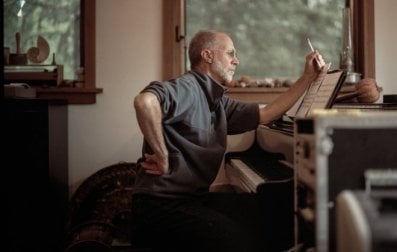
As my dear, old friend Paul Kelly said on the release of his new album, Seventy: “I feel lucky to reach 70. Everything else after this is just extra.”
“Now We Are Extra”. I’m going with that.
This article was first published in the print edition of The Saturday Paper on November 29, 2025 as "Now we are extra".
For almost a decade, The Saturday Paper has published Australia’s leading writers and thinkers. We have pursued stories that are ignored elsewhere, covering them with sensitivity and depth. We have done this on refugee policy, on government integrity, on robo-debt, on aged care, on climate change, on the pandemic.
All our journalism is fiercely independent. It relies on the support of readers. By subscribing to The Saturday Paper, you are ensuring that we can continue to produce essential, issue-defining coverage, to dig out stories that take time, to doggedly hold to account politicians and the political class.
There are very few titles that have the freedom and the space to produce journalism like this. In a country with a concentration of media ownership unlike anything else in the world, it is vitally important. Your subscription helps make it possible.
Subscriber exclusive
Send this article to a friend for free.
Share this subscriber exclusive article with a friend or family member using share credits.