News
As the latest figures show Australia will struggle to meet its new emissions reduction target, the climate change minister explains how he will manage his role in next year’s UN summit. By Karen Barlow.
Chris Bowen shrugs off dual role criticism
Chris Bowen is not sweating the extra responsibility he will take on as president of negotiations for next year’s United Nations climate summit, despite the Coalition’s insistent jibes he is a “part-time minister”.
In an interview with The Saturday Paper this week, the climate change and energy minister dismissed the opposition’s take on his new role – the compromise he accepted for conceding Australia’s COP31 hosting bid to Türkiye.
“I find the part-time stuff just hilarious, because anyone who knows me knows that actually the opposite is the case,” Bowen says.
“I’m not a perfect human being, but I do know how to work hard … if you can’t ride two horses, you shouldn’t be in the circus.”
Bowen takes on the year-long role as the world’s top climate negotiator, pulling threads on the pledges of nearly 200 nations, in addition to his oversight of Australia’s energy transition. The complexity of that domestic task is underscored by the release this week of emissions projections showing Australia is on track for a 48 per cent reduction on 2005 levels by 2035, well behind its target of 62-70 per cent.
In an unusual arrangement to settle a deadlock with Türkiye, the next global climate change conference, COP31, will be held in the resort city of Antalya, with Bowen guiding its negotiations. A Pacific nation will host a major pre-COP event, with support from Australia.
It was a significant concession after years of hard campaigning for the summit to come to Adelaide.
“There will be no such thing as a quiet or insignificant COP,” a senior government source tells The Saturday Paper. “It would have been the worst thing if Türkiye had made good on their commitment to take the brinkmanship all the way. If the whole enterprise had fallen into a hole for a year and reverted to Bonn without an active presidency, that would have been terrible.”
The Coalition sees an opportunity to distract from its potentially damaging decision last week to drop its commitment to net zero .
The shadow minister for energy and emissions reduction, Dan Tehan, describes the unfulfilled 2022 Labor election promise of a $275 cut in power bills as a “betrayal” and says the cost of the energy transition is causing “real human suffering”.
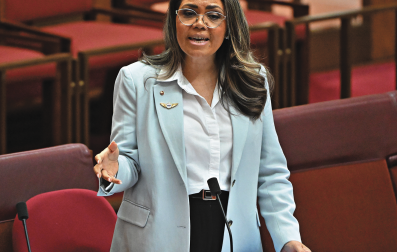
“How many days of parliament will the part-time minister miss in 2026 and what will be the cost to Australian taxpayers of the minister’s full-time presidential duties?” Opposition Leader Sussan Ley asked in parliament on Tuesday.
In a later Sky News interview, she got to the point: “Clearly, he has got his focus elsewhere, and the prime minister has too.”
The Coalition also wants to deflect from the deal struck on Thursday to overhaul the Environment Protection and Biodiversity Conservation Act. After months of courting the opposition’s cooperation on a set of proposals to improve legislation that all sides agreed was broken, including measures to fast-track project approvals, the government opted to work with the Greens.
Fuming about the government’s deal, Ley shifted to criticism of Bowen: “This is what happens when you have a part-time energy minister managing a part-time energy grid.”
Bowen rejects the characterisation. “If it was a full-time presidency, they’d be right. They’d be 100 per cent right. You can’t be a minister and a full-time president.
“It’s not true. There is a full-time official handling international climate negotiations. It’s called the Executive Secretary of the UNFCCC (United Nations Framework Convention on Climate Change). His name is Simon Stiell. He was here this year. That’s the full-time job. The presidency is designed to be held by a cabinet minister of a country.”
Indeed, of the past 10 COP presidents leading negotiations, seven were ministers. One – Fiji’s Frank Bainimarama – was a prime minister, and one – Brazil’s André Corrêa do Lago – a diplomat. British minister Alok Sharma became a full-time president overseeing a Covid-delayed Glasgow summit in 2021.
“I think it’s overreach, not unlike ‘T-shirt-gate’ and ‘Rudd-gate’, where the leader of the opposition says something which isn’t true,” Bowen says.
Bowen regards the COP31 duties as a “remarkable opportunity” for Australia even though the original aim, embedded in an election promise, was to win hosting rights for Adelaide and co-hosting roles for Pacific nations.
The purported cost of $1 billion to $2 billion was never confirmed but the opposition was building the case that the expense was untenable in a cost-of-living crisis.
In Question Time this week Bowen countered the Coalition’s criticism of his new role with accusations of division and “cultural cringe”.
“How unpatriotic can you be?” the minister shouted over the din. “Why don’t you want your country to have a bigger role in the world? Why are you so anti-Australian? Why can’t you be proud that your country can play a leading role in international negotiations.”
As for the actual cost and time required for his presidency, Bowen says it is too soon to confirm.
The international schedule for the COP31 is still being organised, Bowen the minister says. He rejects a report in The Australian that Coalition pressure is stopping him from attending an inaugural conference in the Colombian coal port city of Santa Marta in April to discuss the phasing out of fossil fuels. The conference would advance a declaration signed at this month’s COP in Brazil by 24 nations, including Australia and Pacific islands.
The energy minister tells The Saturday Paper that the Colombia summit was “never contemplated”. He says he won’t attend all COP-related meetings in person.
“I’ll look at the schedule early in the year and say, ‘Well, I can go to that one, I can’t go to that one, I can go to that one, I can’t go to that one,” the minister says. “By and large, the result will be the same, that I’ll go to some and not all. The difference is, when I’m there, I’ll be the president of negotiations as well as the Australian minister, and I’ll be representing Australia’s interest with more influence.
“I own an iPad. I’ve got Teams. I will be going overseas, but I’ll also be doing a lot of engagement online,” Bowen says. “It’s what I do now anyway. I mean, if they think that I don’t engage internationally now, they’ve missed something.
“I’ve got the numbers of most climate change ministers in my phone with WhatsApp and Signal.”’
Prime Minister Anthony Albanese pointed out this week that the “crunch points” of negotiations come towards the end of the year and while the conference is under way.
Bowen will have the authority to get assistance for negotiations “as necessary” from other nations’ ministers.
“Every COP president does that,” he says. “I’ve done it now four years in a row, so I’ve been asked by the existing COP president to run a stream of the negotiations. That’s standard business. So yes, it is asking for help, but that’s always the way it works.
“The convention is, you appoint one from a developing country and one from a developed country, and they jointly consult with the rest of the world. So, you don’t have to do all that yourself because it’s impossible.”
Journalist and author Niki Savva raised the possibility on the ABC’s Insiders program of Bowen’s cabinet position transferring at some point to another minister, such as junior backbencher Andrew Charlton.
The opposition has seized on the idea, with one Liberal shouting, “Won’t be long, Charlton!” while Bowen was speaking this week.
Bowen rejects speculation that a replacement is being actively contemplated.
“I’ll be minister for energy for I suspect longer than Sussan Ley will be leading the Liberal Party,” he says.
A government source tells The Saturday Paper that while Bowen will be the “tip and the spear” in the COP negotiations, he will be backed in the presidency by a team of “incredibly talented, hard-working” public servants who are “literally doing that all day, every day”.
Domestically, the minister also has the assistant minister, Josh Wilson, and the special envoy for climate change adaptation and resilience, Kate Thwaites. Wilson was at Belém for the first week of the three-week COP30, while Thwaites was at the Pre-COP in Brasília.
Turning to the latest annual emissions data, Bowen says they reflect the “biggest financial year reduction in emissions in history, with the exception of the lockdowns”.
The updated figure for the 2024/25 year was 28.5 per cent below 2005 levels, or 437.5 million tonnes of carbon dioxide equivalent emissions, largely due to renewable solar and wind energy generation and industrial decarbonisation driven by the safeguard mechanism. However, transport emissions from road freight and domestic plane travel continued to rise.
Australia has five years to achieve another 14.5 per cent reduction in emissions to meet Australia’s 2030 net zero goal of 43 per cent above 2005 levels.
The current projection – that emissions are tracking at 42 per cent below 2005 levels – is described by the minister as “within reach”.
The 2035 target of a 62-70 per cent reduction is challenging and will depend on as yet unknown policies. Currently, emissions are projected to be 48 per cent below 2005 levels. The Climate Change Authority says “increased effort” is required.
“It’s good. Policies are starting to work,” the minister says.
“Lot of work to do here on 2035. Like, the projections for 2035 aren’t great, but that’s to be understood, because the projections are also done before we announced the policies that back the target. Those policies don’t get us to 62 per cent either, but they help.”
The minister says the results show that any disruption to Australia’s electricity transition would disrupt progress on net zero.
The question neither side of politics can answer is when power prices are going to come down.
The opposition’s “technology neutral” energy policy includes the expensive option of “sweating” (extending the life of) ageing and increasingly unreliable coal-fired power stations. At the same time, the government’s renewable energy transition is costly, burdened by regulation and has hit elements of community opposition, particularly in the regions.
The record number of Australian households – one in three – that have embraced solar, including an increasing number with batteries, are already experiencing significantly lower power prices, however.
For others, Bowen says the power bills are “much higher” than he would like them to be. Wholesale prices have come down, but the reductions are yet to flow through to retail prices.
He can’t give a guarantee about when and by how much prices will fall, nor whether government energy relief will be extended after it runs out next month. He is, however, convinced the government is on the right path.
“The federal election isn’t ancient history. It’s, what, six months ago. The result was pretty clear, and cost of living and energy was right up there as the issue,” Bowen says. “And the Australian people told us, ‘Get on with it. Okay, it’s challenging … Keep going.’ ”
This article was first published in the print edition of The Saturday Paper on November 29, 2025 as "Another string to the Bowen".
For almost a decade, The Saturday Paper has published Australia’s leading writers and thinkers. We have pursued stories that are ignored elsewhere, covering them with sensitivity and depth. We have done this on refugee policy, on government integrity, on robo-debt, on aged care, on climate change, on the pandemic.
All our journalism is fiercely independent. It relies on the support of readers. By subscribing to The Saturday Paper, you are ensuring that we can continue to produce essential, issue-defining coverage, to dig out stories that take time, to doggedly hold to account politicians and the political class.
There are very few titles that have the freedom and the space to produce journalism like this. In a country with a concentration of media ownership unlike anything else in the world, it is vitally important. Your subscription helps make it possible.
Subscriber exclusive
Send this article to a friend for free.
Share this subscriber exclusive article with a friend or family member using share credits.