Theatre
Belvoir’s minimalist King Lear features Colin Friels as a curiously energetic lead in a production propped up by captivating performances. By Patrick Lau.
Colin Friels injects Belvoir’s King Lear with silver-fox energy
King Lear is a difficult play to stage, to perform and sometimes to watch. This version at Belvoir St Theatre clocks in at more than three hours, for a start, and ran long on opening night (albeit with two intervals).
King Lear’s Britain is a Boomerocracy, with a few hungry young things from the next generation who are eager to change that. Lear is getting on a bit and prepares to act as the bank-of-dad for his three daughters. Meanwhile, the two children of the Earl of Gloucester provide a B-plot in the form of an inheritance squabble. Unsurprisingly, things go badly for everyone. It’s a straightforward enough story but comes with enough changes of perspective and narrative twists to muddy questions of culpability.
Eamon Flack directs a somewhat confusing production, held up by captivating performances. Everyone is given plenty of opportunity to provide their viewpoints and demonstrate their motives, although inevitably Lear (here played by Colin Friels) is central. Lear as written is an octogenarian, more powered by vinegar than vigour. He was once capable of great things and thinks he still is.
The drama of the play comes largely from interior struggles. There’s the process of mortality, the indignity of decline and the regression to a childish dependency. The struggle to perceive and know oneself and others through habits and reflexes that accrete over decades. Relationships are dominated by masking, blinding and concealing, in words and actions, as well as simple solipsism. Whether those struggles are noble or humiliating is a question Lear is afraid to ask himself. “I pray you, father,” Regan tells him, “being weak, seem so.”
Friels injects the role with a caffeinated silver-fox energy. His Lear is an early retiree with time on his hands and plenty to fill it: he’s just got to sort out all this inheritance nonsense first. This Lear probably goes surfing a lot, or maybe pulls on the lycra and goes cycling. The limits of his capacities in this staging are not defined by the character or the inevitability of ageing and the human condition but are imposed upon him by his surroundings. Lear prowls the stage and his kingdom, looking out at the audience like a carnivore through the bars of a cage. He does more roaring than sulking.
At several points Lear pauses to curse and threaten, in response to slights real or imagined. For many stagings, these are “old man yells at cloud” memes – ultimately impotent moments of resentment. When Friels spits venom, you believe he’s going to do something about it – he’s bitter and he’s going to make it your problem, not his. Friels is “every inch a king” but without the irony that line usually contains. He’s in command of his senses, giving rein to his emotions rather than being reigned by them, and his polemics seem more appropriate for a man of action and consequence than one in decline.
It’s for that reason that Friels is perhaps least convincing when he prevaricates, or when he’s exhausted and defeated. After three long hours of tempest and torment, armies locked in battle and kingdoms in disarray, his Lear still seems capable of sorting it all out in a fatherly way. When he lies down and dies of grief, it seems more like he’s having a quick nap.
Peter Carroll as the Fool is impressively energetic, making a lie of his age with his cavorting. He groans when getting down on one knee but only for comic effect. Brandon McClelland as the Earl of Kent makes it a large role, well-inhabited and commanding. Alison Whyte as a gender-swapped Gloucester and Tom Conroy as her legitimate son Edgar get some of the schlockier moments and give them plenty of welly, leaning in to the eye-gouging and insanity. Raj Labade as the bastard Edmund has an oily charm.
Lear’s daughters Goneril (Charlotte Friels) and Regan (Jana Zvedeniuk) do good service in making their villains sympathetic, interesting if not likeable. They’re mean and conniving, but they’re kind of fun. The cast as a whole gives strong performances: strong enough to carry the production, albeit slightly skewed, as if transplanted from a different play.
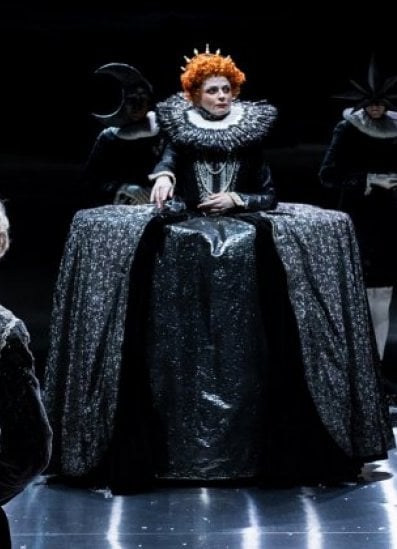
It wouldn’t be Shakespeare without a few characters going mad, a couple of buckets of blood and a big death-scene medley to finish it all off. That’s a difficult balancing act for Flack, who’s chosen minimalism, paring back costumes and set and adding a few musicians. The design work is deliberately unobtrusive, fading into the background without making a big deal of it. Bob Cousins’ set is limited to bare boards, a few folding chairs, a chalk circle and not much else. Costumes by James Stibilj are in the same vein: contemporary upper-middle class, leaning towards beige. There’s a sense of a dress rehearsal, a performance stripped of frippery. The pivotal storm sequence features impressive lighting from Morgan Moroney that gives the effect without overdoing it. But things get shouty here and much of the scene is unintelligible.
The addition of a band (Hilary Geddes, Jess Green, Arjunan Puveendran) is probably the biggest misstep. The score (sound designer and co-composer Steve Francis and Puveendran) is fine and the musicians are capable, but the intermittent soundtrack is confusing and distracting. It may be historically accurate to perform Shakespeare with accompaniment, but that doesn’t seem to be the point here.
The core of this play, and this production in particular, is in line delivery, stance and gesture, and Flack gives the text and his actors space to do their work without loading too much spectacle on top of them.
They’re equal to the task, and the question of whether Lear is a man “more sinned against than sinning” is enough in itself to hold an audience’s attention. Shakespeare and Friels manage to make grievance captivating: never before has listening to an old man list his irritations and complaints been so interesting.
It would be too on-the-nose to make an overt reference to housing affordability or senility in the White House. If you’re after an adaptation that contemporises, Succession might hit the mark. Belvoir has elected to use the title The True History of the Life and Death of King Lear & His Three Daughters, so the eternal family drama is very much central to this production.
But this play, while timeless, is also inescapably of the moment. Questions of nature and nurture in character, of manipulation and sincerity in politics and of intergenerational equity – what’s owed from one to another and who should decide – run throughout the text. When this production is at its best, it allows the audience to explore that. When it’s most over-directed, it becomes a little more difficult. There’s no grand proclamation to end things, no satisfaction in the denouement. The play, like King Lear himself, deflates and trails off, and that seems right.
The True History of the Life and Death of King Lear & His Three Daughters plays at Belvoir St Theatre, Sydney, until January 4.
This article was first published in the print edition of The Saturday Paper on November 29, 2025 as "Boomer angst".
For almost a decade, The Saturday Paper has published Australia’s leading writers and thinkers. We have pursued stories that are ignored elsewhere, covering them with sensitivity and depth. We have done this on refugee policy, on government integrity, on robo-debt, on aged care, on climate change, on the pandemic.
All our journalism is fiercely independent. It relies on the support of readers. By subscribing to The Saturday Paper, you are ensuring that we can continue to produce essential, issue-defining coverage, to dig out stories that take time, to doggedly hold to account politicians and the political class.
There are very few titles that have the freedom and the space to produce journalism like this. In a country with a concentration of media ownership unlike anything else in the world, it is vitally important. Your subscription helps make it possible.
Subscriber exclusive
Send this article to a friend for free.
Share this subscriber exclusive article with a friend or family member using share credits.