Gardening
The winter gardener rejects textbook directives to withdraw and attend to her tools, and instead nurtures the tiny perfection of the garden to come. By Margaret Simons.
A contemplative case for winter gardening
I have been contemplating the differences between brassica seedlings.
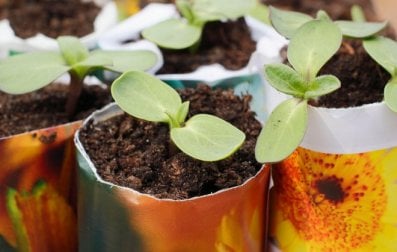
First, there is my purple kale, which is one of the successes of my mission to buy fewer seedlings in plastic punnets and instead germinate my own. I intended to create half a dozen plants. Instead, I have a couple of dozen and have given as many away.
The plants are tiny, and growing slowly through the winter weather. Yet they are so distinctive.
The leaves are somewhere between pink and grey, and serrated. If you were asked to measure their fringes, it would be impossible to do. Kale leaves are like snowflakes, the coast of Norway or the feet of geckos. Each indent contains more indents. A close-up look (and I have been spending time leaning over the kale seedlings, squinting, fetching my reading glasses and even a magnifying glass) reveals more indentations, then more – a pattern of irregularity. I think the correct term is a fractal curve. The infinite contained in the tiny.
How wonderful it seems that such a thing should have been sprouted by me, with just a little seed, a little soil and a drip or two of water. We are taught, in various ways by all the world’s religions, that we live in a broken world. Imperfect people, imperfect institutions, imperfect selves. Damage, damage, damage. The mission is surely to maintain one’s integrity, aspiration and hope despite a desperate and constant not-quite-rightness.
I have been feeling all that, lately. But when I look at my kale seedlings, I feel wonder at the rightness of it all. How can something as perfect as a kale seedling even be?
Then there is sprouting broccoli. These, too, remain tiny but quite different from their kale cousins. The leaves are only slightly crenellated, and heart-shaped. The flower heads, which are the parts we eat, are nowhere to be seen. Things go to flower and then to seed in spring, and so it will be many weeks before I have a harvest.
The brussels sprouts, on the other hand, betray their eventual purpose early in their lives. These seedlings are taller than the other brassicas and have only a topknot of leaves. It’s all about the stalk and the buds that will form along its length.
I have also grown a punnet of leeks. The onion family is a consistent miracle. The seed is fine as dust. The shoots come up as a narrow green spear that unfolds like a crane or a pocketknife, to become twice as tall overnight.
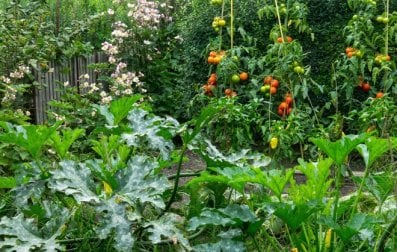
I have been gardening pretty intensely over the past six weeks, despite this being the season in which most gardening books struggle to find lists of real-life tasks, instead telling you to sharpen and oil your tools, which I have never done and never seen anyone else do, except on Gardening Australia.
The intensity is because last summer I was travelling a lot, and then dealing with bereavement and trouble, and the garden suffered. Now I am luxuriating in being a homebody. Great swaths of chickweed have been plucked out of the beds and the pots. I got a paintbrush and coated the onion weed that grows in the crack between my brick fence and the pavement.
I plan to sprinkle poppy seeds in that crack, come spring.
Now the garden is looking pretty fine, aided by the cold keeping the weeds in check.
My close contemplation of seedlings has been made easier by my birthday present to myself – two self-watering planter boxes, made to order to fit in the narrow sunlit space on my back verandah. They are waist height. I can sit outside with a cup of tea and go cross-eyed staring at seedlings without bending.
I have been meaning to acquire such boxes for a very long while and have read many blogs and watched many YouTube videos on how to construct them.
It looked easy, but there were Facebook communities devoted to what to do and what not to do – how big the reservoir, how to handle stinky water and so on and so forth. It was all a bit overwhelming.
The thing that challenged me most was the precise location of the drainage hole in a wicking bed, and how to drill it through timber. There is a thing called a hole saw. I have never used one, do not own one and would have had to go to Bunnings.
I had a stressful week just before my birthday. I needed to garden but had run out of space. One evening, mobile phone in hand, I took the plunge. I ordered the boxes to be ready-made to my measurements and delivered, complete with scoria, liner and quality potting mix. An extravagance, and a delight. Not an impulse buy but a fulfilment of long-term desire.
The new planter boxes are now my premium growing space. In one, I have blueberry bushes that I will have to net against the possums come spring. I dream of picking the fruit for my breakfast.
In the other, the much-contemplated brassicas.
The original idea was that I would junk the other miscellaneous boxes and pots that live on the verandah once I had my beautiful new boxes, but I decided to keep them all. The planter boxes fit the space so perfectly that it hardly feels more crowded than it did before.
So, in less than three square metres I have a box of spring onions, the capsicum plant that keeps fruiting – now in its third year, despite the season and the fact it is meant to be an annual – two boxes of lettuce, a chilli plant and a Vietnamese mint that is sulking in the cold.
Meanwhile, I have planted some of the kale and broccoli in the narrow strip of dirt that divides the front of my house from the pavement. Already growing there were self-seeded radishes, the product of last summer’s neglect, in which the roots went woody and the plants to seed. Likewise, a flush of rocket plants that are already large enough to decorate a winter salad but not to provide its substance.
The final delight of the winter garden is my worm farm. After Christmas, I made the mistake of dumping a welter of leftover cake in there and was predictably rewarded with an outbreak of slaters and mealy bugs. They would turn the worm farm acid, the gardening blogs informed me. The worms would die or flee. I should throw it all out and start again.
Sometimes, neglect brings rewards. It was weeks before I had enough time to obey the injunctions and, when I went to do the job, I found the cake had been digested, the vegetable peelings were once again dominant and – wonders – the worms were back.
Now, I lift the lid and there they are, doing their thing despite the cold. The bottom of the farm is a rich bed of worm poo, broken up only by the seeds and shells of avocados, which never seem to decay.
The first of the four noble truths in Buddhism is translated as “life is suffering”, although that is a mistranslation. The word the teacher supposedly used – dukkha – means anything that is temporary, including suffering, but also happiness.
Great success is dukkha, and so is ignominious failure and humiliation. Quite comforting, really, to think of it like that. I guess compost is dukkha too. Even the avocado seeds.
And so I have traversed the bottom of the year and will begin to climb up into spring. The days will get longer before the weather gets warmer, and we will see what a difference daylight brings. The bulbs will sprout. Soon there will be daffodils and garlic shoots, and I can eat the kale.
This article was first published in the print edition of The Saturday Paper on June 29, 2024 as "Bold as brassicas".
For almost a decade, The Saturday Paper has published Australia’s leading writers and thinkers. We have pursued stories that are ignored elsewhere, covering them with sensitivity and depth. We have done this on refugee policy, on government integrity, on robo-debt, on aged care, on climate change, on the pandemic.
All our journalism is fiercely independent. It relies on the support of readers. By subscribing to The Saturday Paper, you are ensuring that we can continue to produce essential, issue-defining coverage, to dig out stories that take time, to doggedly hold to account politicians and the political class.
There are very few titles that have the freedom and the space to produce journalism like this. In a country with a concentration of media ownership unlike anything else in the world, it is vitally important. Your subscription helps make it possible.
Subscriber exclusive
Send this article to a friend for free.
Share this subscriber exclusive article with a friend or family member using share credits.