Letters
Letters to
the editor
No peace in sight
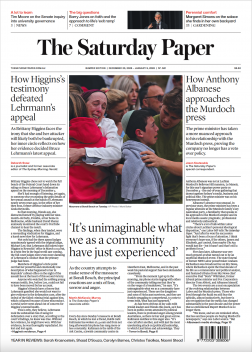
The anger and fear experienced by the Jewish community following recent events is palpable, poignant and evocative (Martin McKenzie-Murray, “ ‘It’s unimaginable what we as a community have just experienced’ ”, December 20–January 9). Many complications exist in achieving solutions. First, it is difficult to conceive an effective solution given the nature of terrorists who come out of the shadows, without warning. Second, Albanese’s five-point plan is unlikely to provide cover in the short term, and the proposed solutions will be challenged in court. Third, terrorism is fuelled by the situation in Gaza, with both sides claiming moral legitimacy, but terrorism and war destroy any claim of moral rectitude. Both Jews and Arabs have a legitimate claim to the land, and failure to address this with international consensus means the problem of war and terrorism will continue.
– David Wilson, Rothwell, Qld
Moral threshold
In the aftermath of anti-Semitic violence, a familiar reflex now dominates some public commentary: to explain attacks on Jews by reference to Israel. However cautiously phrased, this framing performs a moral sleight of hand. It shifts attention away from those who choose to target Jews and towards a distant government, as though Jewish safety were contingent on geopolitical approval or having the right ideological framework. No other minority is treated this way by the “progressive” side of politics. When Syrians, Congolese, Ukrainians or Uighurs are attacked, their suffering is not parsed through the conduct of a foreign state. This is not nuance; it is displacement. It recasts anti-Semitic violence as a response rather than an act of hatred. In doing so, it quietly lowers the moral threshold for violence against Jews. Criticism of Israel’s government is legitimate and often necessary, but when that criticism is invoked at the moment Jewish blood is spilt, it ceases to be analysis and becomes justification by proxy. The distinction matters, because words do not remain words. They shape what violence comes to feel explicable, even inevitable. No community’s safety should be conditional.
– Simon Tedeschi, Newtown, NSW
Early intervention
The article about the new National Children’s Commissioner, Deb Tsorbaris, is timely given the new harsh laws relating to youth crime (Gina McColl, “Youth crime ‘is not in a crisis’ ”, December 20–January 9). On economic grounds alone, the idea of locking children up makes no sense. The cost of incarcerating a child is about $1 million a year! How many social workers could you employ for that amount of money and how many families could be supported? As an Albury City councillor, I worked with staff to set up the Albury Project, based on a similar program in Geelong, which identifies children at risk of leaving school before Year 9. Children who do this are much more likely to get involved with crime. School absenteeism, failure to complete assignments and antisocial behaviour are some of the signs used to identify those at risk.
– David Thurley, Lavington, NSW
Exit strategy
Humble thanks and respect are due to Barry Jones for his article on faith, written from respite care after a fall (“On faith and the exit ramp”, December 20–January 9). May the Australian government’s double-whammy rationing of respite care and home care not conspire, as it continues to do for so many Australians, to enforce entry into the residential system Barry Jones referred to in a previous Saturday Paper article as having “major, even criminal, deficiencies”. Karen Barlow’s “A low-hanging fruitful year” (December 20–January 9) on the Albanese government’s performance in 2025 gives a hint of why – the mandated changes of the bipartisan response to the aged care royal commission’s recommendations are about keeping providers in business. The Australian government’s tacit excuse is the underlying discriminatory premise that aged care is just an exit ramp.
– Ruth Farr, Blackburn South, Vic
Nature’s medicine
As Margaret Simons wisely acknowledges, we keep being by grounding ourselves (“How to keep being”, December 20–January 9). In a world of terrorism, armed conflict, misinformation, societal polarisation and climate change‑fuelled extreme weather, nature offers a steadying hand. Bob Brown describes time in nature as preventive medicine. The Japanese call it shinrin-yoku or forest bathing; others call it earthing, green time, or simply touching the world again. In 2026, humanity could move forward by reconnecting with the natural world, focusing less on screens and more on green.
– Amy Hiller, Kew, Vic
Letters are welcome: [email protected]
Please include your full name and address and a daytime telephone number.
Letters may be edited for length and content, and may be published in print and online. Letters should not exceed 150 words.
This article was first published in the print edition of The Saturday Paper on January 9, 2026.
For almost a decade, The Saturday Paper has published Australia’s leading writers and thinkers. We have pursued stories that are ignored elsewhere, covering them with sensitivity and depth. We have done this on refugee policy, on government integrity, on robo-debt, on aged care, on climate change, on the pandemic.
All our journalism is fiercely independent. It relies on the support of readers. By subscribing to The Saturday Paper, you are ensuring that we can continue to produce essential, issue-defining coverage, to dig out stories that take time, to doggedly hold to account politicians and the political class.
There are very few titles that have the freedom and the space to produce journalism like this. In a country with a concentration of media ownership unlike anything else in the world, it is vitally important. Your subscription helps make it possible.