News
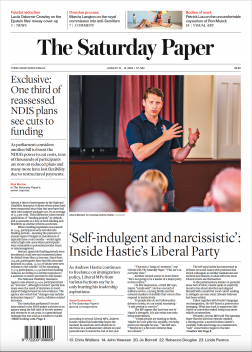
As parliament considers another bill to boost the NDIA’s power to cut costs, tens of thousands of participants are now on reduced plans and many more have lost flexibility due to restructured payments. By Rick Morton.
Exclusive: One third of reassessed NDIS plans see cuts to funding
Almost a third of participants in the National Disability Insurance Scheme whose plans have been reassessed since May last year have had their total support packages cut, by an average of 22.5 per cent. This follows the controversial application of “funding periods” by default, and so amounts to a loss of both funding and flexibility as scheme reforms accelerate.
When enabling legislation was passed in 2024, participants were told discrete funding periods – meaning the payment of annual support budgets in instalments of typically three or six months – would apply only in high-risk cases where participants were vulnerable to potential provider fraud or mismanagement.
Instead, quarterly funding periods were introduced on all new and reassessed plans by default from May 19 last year. Since then, 104,964 participants have had this structure imposed on a plan, 33,750 of whom were new entrants to the scheme. Of the remaining 71,214 participants, 21,056 had their funding reduced, according to a written response to a question on notice provided to the Senate.
The National Disability Insurance Agency says almost 50,000 participants had an “increase”, although it doesn’t specify how many were the result of decisions to boost support budgets based on new evidence. The agency also noted that “changes may include indexation impacts” – that is, inflation-related increases.
The Australian parliament’s recent data related to the NDIS paints a picture of an agency using the full suite of its new powers and resources to cut costs, in a generational redesign that was sold as a mission to tackle fraud, but which has clamped down heavily on participant support. Costs will continue to increase, of course, but by tipping the balance ever more in favour of savings, the government hopes to slash tens of billions of dollars from the scheme over the next decade.
Many of the agency’s new powers, including the ability to mandate funding periods in annual support budgets, were granted under legislation passed in 2024, when Bill Shorten was still NDIS minister. The schedule for reform remains unfinished, however.
A second bill, introduced in late November, is currently before the parliament. It consists mainly of the anti-fraud and provider sanction powers promised at the outset of the NDIS overhaul, when Labor engaged pollsters RedBridge Group to test messaging that could best sell the biggest planned changes to the scheme. That messaging suggested a focus on fraud and rorting could increase “tolerance” to other changes.
The bill also includes, however, a subtle change that explicitly gives the agency chief executive the power to decrease support plans without the need for a new assessment. The bill’s explanatory memorandum says this simply codifies existing practice “for the avoidance of doubt”, but advocates will argue before an inquiry that the new provision could be used in harmful ways, or have unintended consequences.
“I think it is fair to say that at every step of this now years-long reform process we have been told not to worry about one change or another, only to find out in practice that we did have to worry about it,” one disability rights organisation advocate, who does not have permission to speak on the record, tells The Saturday Paper.
“Funding periods are a great example, but we also warned about the new amendments being linked to debt-raising provisions, the ‘robo-planning’ which is now entering the final straight before it begins, the heavy-handedness of the agency itself in using or misusing the powers it already has. I’m seeing it every day in my work.”
Among the most significant of the amendments, enabled by the first round of legislation and beginning in July, is the move to a mandatory Support Needs Assessment. It is largely based on an off-the-shelf questionnaire and tool supplied by the University of Melbourne and the Centre for Disability Studies, called the I-CAN version 6.
The Saturday Paper revealed in October that these assessments will produce scores to be fed into an algorithm. Last month, Guardian Australia published information from an internal briefing that confirmed new plans would be “computer-generated”, with minimal input from planners.
The NDIA has declared the new planning framework a win for participants.
“It really puts greater flexibility in participants’ plans, but it also allows the opportunity to do a new assessment to really understand the support needs of the participant,” agency deputy chief executive Aaron Verlin told participant and advocate Dr George Taleporos on his Summer Foundation podcast Reasonable and Necessary last month.
Verlin confirmed the new assessment will not accept evidence from treating professionals and other practitioners in developing an NDIS budget. He said this was “costly and time-consuming” to participants and led to inequity. “Our starting position with the Support Needs Assessment is that we do not require evidence to understand your broad support needs. We really don’t want individuals feeling like they need to bring a whole lot of new reports to that.”
As it stands, the way the new assessment tool is being rolled out will dramatically limit the rights of disabled people to appeal against their outcomes. Currently, NDIS participants who are unhappy with the amount of support for which they have been funded can ask for an internal review and argue the line-by-line case on merit. If this decision remains unchanged, they can take their case to the Administrative Review Tribunal – an imperfect system that entails considerable stress and cost, but which can make orders for funding and support items to be included in a plan.
For years, the NDIA has been one of the worst performers at the ART and its predecessor, the Administrative Appeals Tribunal, with thousands of decisions overturned, remade or settled before a substantive hearing. For some time now, though, the agency has been ignoring the appeal body. Data provided in response to a budget estimates question on notice shows that in 2024/25 the agency reassessed 837 participant plans within 12 months of a tribunal decision, but in 372 of those cases “plans were approved at a lower value than what the ART had determined”. The NDIA declined to elaborate on why it had disregarded the tribunal orders.
And recent data confirms that the agency has become less likely to yield in disputed cases. In the two years to mid 2024, the NDIA upheld its original decision in planning disputes initiated by a participant only about half of the time. Following the new legislation, in 2024/25 the agency did so in 70 per cent of cases; a significant boost in its ability to clamp down on costs.
In any case, from July, internal agency reviewers and tribunal members will have no ability to intervene other than to organise another assessment, using the same Support Needs Assessment tool that produced the first decision.
“So everyone out there may be hearing a bit of criticism from advocates around this being a closed loop, because you’re stuck with using the same tool again and again,” Intrepidus Law founder and disability rights lawyer Belinda Kochanowska told Dr Taleporos in a video posted online late last month.
“Now, there is provision in the Act for the agency that they ‘may’ ask for further information. It’s not a positive obligation. So what people are going to find very jarring, very different, is that when plan review time comes along – we’re all very used to providing our own evidence, our own reports, our own lived experience statement, or carer impact statements – it appears that that’s going to be very different with new framework plans. And it’s going to be much more driven by the agency and this tool.”
A Department of Health, Disability and Ageing spokesperson said consultation on the new framework plan rules enabled by the legislation will open later this month. But the department has not released an exposure draft of the rules themselves, and declined to say that it would. Participants, families and advocates remain in the dark about how this latest reform will work.
“Like previous consultations on the rules, the Department of Health, Disability and Ageing will release a range of products to support the consultation and will invite feedback and submissions from the public,” the spokesperson said in a statement.
In its midyear fiscal update last month, the government announced that “[c]hanges in the amending Act and subsequent amendments to NDIS rules and other legislative instruments have begun to moderate growth in Scheme expenditure”.
“Further moderation is expected from the implementation of new framework planning, which will determine Scheme participant plan budgets more consistently based on participant need.”
This document reveals scheme costs are expected to grow at 7.6 per cent each year over the next decade, less than the 8.1 per cent forecast just months earlier in the pre-election fiscal and economic update. Health and Disability Minister Mark Butler wants this figure to come down to 5 or 6 per cent at least.
To do that, the agency is using every lever at its disposal.
When he announced tens of thousands of children with what he called “mild to moderate autism” would be moved from the scheme, onto a program named Thriving Kids, Butler said NDIS eligibility criteria would be changed when the new $2 billion initiative had been in place for a year. The program is due to begin in July and changes to reduce the number of children joining the NDIS are expected in July 2027.
Butler did not say, however, if there would be any change to the existing arrangements for eligibility reassessments. As The Saturday Paper has previously revealed, the NDIA has added more staff to accelerate these reassessments – which are checks to determine whether selected participants should remain on the NDIS – and most apply to children.
New data shows that in the first quarter of 2024/25, the agency completed 11,460 reassessments, and about the same in the following quarter. In the first quarter of 2025/26, however, the number of reassessments almost doubled, to 21,189. Roughly half of these ended with a decision to revoke eligibility.
Last month, a parliamentary inquiry released a report recommending the Thriving Kids project goes ahead, with some light checks and balances – namely that it be “implemented in phases and that the [suggested] Thriving Kids Advisory Group consider appropriate safeguards to prevent loss of supports for children”.
Intended to divert children from the NDIS into lower-cost mainstream and community support models, Thriving Kids is based on a program called Inklings, which the NDIA has trialled at small scale for several years.
The agency told parliament via a written response to a question on notice that the planned three phases of evaluation of Inklings, including “data on outcomes for families and children” will not be finalised nor available until the end of 2027 – that’s 18 months after Thriving Kids is expected to launch.
Already though, community legal centre lawyers, advocates and participants say they are witnessing a nadir of scheme reform as dozens of elements implemented since 2022 lock together to start producing what the government ministers and scheme executives have long predicted: billions of dollars in budget savings.
This article was first published in the print edition of The Saturday Paper on January 10, 2026 as "Exclusive: One third of reassessed NDIS plans see cuts to funding".
For almost a decade, The Saturday Paper has published Australia’s leading writers and thinkers. We have pursued stories that are ignored elsewhere, covering them with sensitivity and depth. We have done this on refugee policy, on government integrity, on robo-debt, on aged care, on climate change, on the pandemic.
All our journalism is fiercely independent. It relies on the support of readers. By subscribing to The Saturday Paper, you are ensuring that we can continue to produce essential, issue-defining coverage, to dig out stories that take time, to doggedly hold to account politicians and the political class.
There are very few titles that have the freedom and the space to produce journalism like this. In a country with a concentration of media ownership unlike anything else in the world, it is vitally important. Your subscription helps make it possible.
Subscriber exclusive
Send this article to a friend for free.
Share this subscriber exclusive article with a friend or family member using share credits.