Comment
John Hewson
Has Trump learnt nothing from George W. Bush’s disaster in Iraq?
The new year opens on an explosion of global uncertainty, with Donald Trump yet again at the epicentre. Why this extraordinary invasion of Venezuela, and where will it lead?
First, it is important to look at the context in which this action was taken, and the global response. It is somewhat surprising that the United States president actually followed through on his recent rhetoric about wanting to oust Venezuelan president Nicolás Maduro, with the US State Department having identified him as a “narco-terrorist” leader. That said, Trump has reportedly spoken of invading Venezuela since the early days of his first term – when he was dissuaded by his senior administration officials. No one is taking any such steps to check his wildest ideas now.
The bigger surprise has been the muted reaction and responses of other world leaders, especially given the significance of this breach of international law and the global rules-based order. The most disappointing statement came from British Prime Minister Keir Starmer, who posted on social media that Maduro was an “illegitimate president” and “we shed no tears about the end of his regime”. His example was that of a leader preferring the hard politics of wanting to do business with the Trump administration and keep onside with Trump himself. The same could be said of the evasive official posts from the French and German leaders, and the European Union’s top diplomat, Kaja Kallas, who expressed vain hopes that international law would be respected. Sadly, these leaders seem willing to let Trump do to the global community what he has been doing to the American people – they are allowing him to exert control, just as he has exerted it over the Republican Party. I doubt they counted on a new imperial America as a demonstration of greatness.
This parallel is particularly significant, given the timing. Domestically, Trump has been losing control of the narrative – even key elements of his MAGA base. Formerly strident supporters, such as the congresswomen Marjorie Taylor Greene and Lauren Boebert, dug in their heels for the release of the Epstein files as Trump’s relationship with the convicted sex trafficker and paedophile became a bigger focus. Most importantly, this year’s midterm elections pose a threat for Trump – whose disapproval ratings, according to the latest results from the most reliable surveys, have surged to a range of 50-62 per cent. His preferred candidates have received drubbings in recent statewide elections, including in Virginia, Georgia and New Jersey. I have expressed my concerns previously in this column that Trump may try to create the circumstances to delay or even cancel the midterms. He would need an acceptable “excuse”, such as the nation being at war or some other contrivance.
Political observers have long debated what drives the US president’s erratic foreign policy initiatives, including how much influence strongman leaders such as Russian President Vladimir Putin and Israeli Prime Minister Benjamin Netanyahu have on his thinking. It is generally recognised that revenge is a driving force in his actions, as is personal enrichment. The world has witnessed his lack of respect or concern for past alliances, the global rules-based order, territorial integrity, national sovereignty and humanitarian consequences.
To explain the invasion, Trump has so far claimed, without evidence, that Venezuela is facilitating illegal migration and shipping drugs, including fentanyl, to the US. This has been his justification for the illegal actions of blowing up boats in international waters, with significant loss of life – striking at least 32 vessels and killing about 115 people. This is raw meat for his MAGA base, feeding the expectation of armed conflict with the drug cartels, even though United Nations data suggest that most drugs imported to the US originate in Colombia, and most of the fentanyl comes from Mexico, using Chinese imports. At worst, Venezuela operates as a transit country.
Maduro has accused Trump of trying to drive him out of power so he can seize Venezuela’s oil reserves. Indeed, Trump made clear in announcing the attack that accessing Venezuela’s oil for American companies was a part of the plan. “We’re going to have our very large United States oil companies, the biggest anywhere in the world, go in, spend billions of dollars, fix the badly broken infrastructure, and start making money for the country,” he said in a press conference at the weekend. Whether the Venezuelan people will benefit is greatly in doubt.
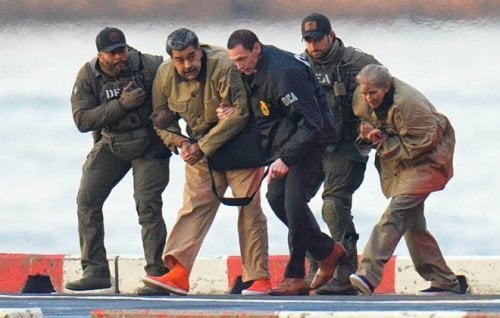
Following Trump’s forced removal of Maduro and his wife, Cilia Flores, to a jail in New York, Venezuela’s long-term vice-president, Delcy Rodríguez, was sworn in as president and it appears the Trump administration is willing to work with her if she agrees to its demands. “If she doesn’t do what’s right, she is going to pay a very big price, probably bigger than Maduro,” Trump said.
There can be no doubt that Maduro was a brutal, authoritarian leader who drove the economy into the ground and clung to power with a fraudulent election in 2024. He had been expanding his military capability, including encouraging citizens to join a rapidly expanding militia. Frankly, though, the world is full of dictators, among them leaders Trump professes to admire, and this seemingly ad hoc approach to regime change is fraught with danger.
Has Trump learnt nothing from George W. Bush’s disaster in Iraq? We know from journalist Bob Woodward that then secretary of state Colin Powell warned Bush at the time, “You break it, you own it” – a concept known as the Pottery Barn rule. Trump risks a very costly military engagement, with no plan for how to ensure a functioning democracy, having rejected the option of empowering the opposition that may well have defeated Maduro at the last election.
And what of Trump’s “America First” agenda – one that was widely interpreted as a distinct lack of appetite to involve the country in international affairs, and to focus instead on domestic challenges? Those difficulties – rising inflation, slowing growth, the persistent threat of more Epstein-related scandal – may be proving too challenging. The US president’s quest for the Nobel Peace Prize has already entangled him in conflicts in the Middle East, between the Democratic Republic of the Congo and Rwanda, and in Nigeria in defence of Christians. Where next?
While the situation in Venezuela unfolds, Trump continues to make strong statements about annexing Greenland, which he sees as important to America’s “national security”. The US already has a military base in Greenland and a satellite surveillance facility to keep a watchful eye on both Chinese and Russian shipping in the Arctic. Greenland is, however, potentially very wealthy with unexploited mining opportunities for oil, gas and critical minerals. As tempting as these resources might appear, they have been protected by an ice sheet that averages more than a mile thick. Ironically for Trump, who has ditched climate change as a “hoax”, the faster than expected climate-driven melting of the Arctic ice cap is facilitating the possibility of mining.
Greenland was formally integrated into the Kingdom of Denmark in 1953 and has fought hard for more self-governance over the years. In 1979 it was granted home rule, and three decades later the parliament achieved greater authority over its natural resources and foreign policy. Denmark retains control over defence and monetary policy, offers annual financial support and, most importantly, is a North Atlantic Treaty Organization member. If Trump pushes ahead with his threat – he has not ruled out military action to take control of Greenland – he risks a serious conflict with NATO. Such conflict could easily widen depending on the reactions of an emboldened Putin, as Russia has long wanted a larger foothold in the region, including in Finland. China could also be concerned about a greater US presence in the Arctic. In this sense, Trump’s baying about national security risks creating a more severe national security issue.
As it stands, the ripples from Trump’s action in Venezuela will be felt across the globe, as he has given every dictator the right to assert their authority. It will further embolden Putin in respect of Ukraine and China’s President Xi Jinping with his ambitions for Taiwan. Trump’s actions belittle a basic tenet of the global rules-based order, namely the protection of sovereignty and territory.
Sadly, the much more dangerous and challenging global economic and geopolitical circumstances that we face in 2026 are due to Trump’s ego. His imperialism is a childish vision. Cowboys and Indians, Big Macs and Coke in an America feared by the world. The carefully crafted nuances of effective diplomacy have no place in his world. He has no patience for them, nor any understanding. Trump wants instant gratification; the “oh shit” moment comes later and can always be someone else’s fault. Donald Trump Jr recently claimed that his father’s greatest strength was his unpredictability. Hang the global cost.
This article was first published in the print edition of The Saturday Paper on January 10, 2026 as "Don conquistador".
For almost a decade, The Saturday Paper has published Australia’s leading writers and thinkers. We have pursued stories that are ignored elsewhere, covering them with sensitivity and depth. We have done this on refugee policy, on government integrity, on robo-debt, on aged care, on climate change, on the pandemic.
All our journalism is fiercely independent. It relies on the support of readers. By subscribing to The Saturday Paper, you are ensuring that we can continue to produce essential, issue-defining coverage, to dig out stories that take time, to doggedly hold to account politicians and the political class.
There are very few titles that have the freedom and the space to produce journalism like this. In a country with a concentration of media ownership unlike anything else in the world, it is vitally important. Your subscription helps make it possible.
Subscriber exclusive
Send this article to a friend for free.
Share this subscriber exclusive article with a friend or family member using share credits.