Dance
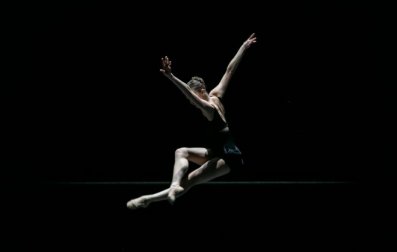
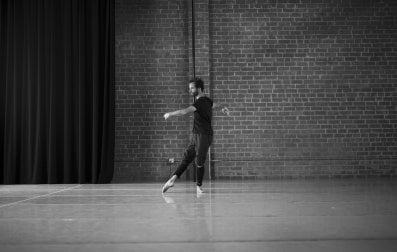
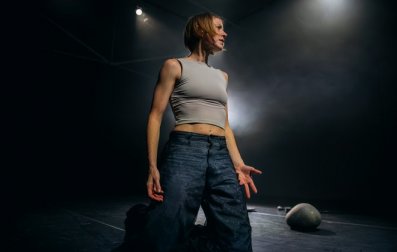
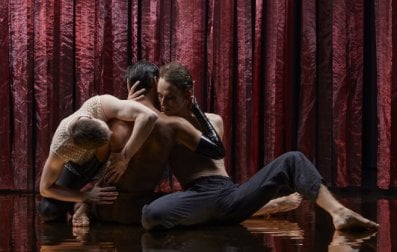
James Batchelor’s Resonance, a work in dialogue with Tanja Liedtke’s dance archive, elicits both the thrill of the new and the blaze of familiarity. By Chris Boyd.
James Batchelor’s Resonance
As I write, the calendar has just ticked over to October 6. It would have been Tanja Liedtke’s 48th birthday. At the age of 29 – out of a field of more than 50 applicants – Liedtke was chosen to be the new artistic director of Sydney Dance Company, a company older than Liedtke herself. Retiring co-directors Graeme Murphy and Janet Vernon were at the helm of the company when Liedtke was born in Germany in 1977.
It’s hard to overstate the excitement that news of the appointment generated in the autumn of 2007. Liedtke was a daring choice. She had star qualities as a dancer with Australian Dance Theatre and DV8 and as a choreographer – vision, taste, strength, leadership – but only one of her full-length works (Twelfth Floor) had been staged in Australia. Her second, Construct, premiered at the Southbank Centre in London in May 2007, the month Liedtke’s appointment was announced.
Alas, Liedtke died in a road accident before she could take up the directorship at Sydney Dance. The following year, Liedtke’s family created the Tanja Liedtke Foundation, which gives young dancers travel and training opportunities, creates and fosters exchanges between European and Australian artists and organisations and assists in the development of dance and dance theatre projects.
The foundation approached James Batchelor at the end of 2022 and this new work, Resonance, which I saw at Melbourne’s Substation, is the result. Though Batchelor had the good fortune to see Twelfth Floor before its 2006 national tour as a young teen, he has no direct connection to Liedtke and clearly agonised over accepting the commission.
Batchelor’s description of Resonance is a careful one. It’s a work in dialogue with the Tanja Liedtke archive. It combines three generations of dancers in a “celebration of memory, connection and reinvention”.
The first of the generations includes artists who worked closely with Liedtke creating Twelfth Floor and Construct, and one who trained at the same schools: Elmhurst Ballet School in Surrey, and Rambert School of Ballet and Contemporary Dance in London.
The second generation includes Batchelor and his contemporaries, who are in their early 30s.
The third generation, for the Melbourne season at least, is a squad of about 10 dancers from the Victorian College of the Arts. For the Canberra season this weekend, the core performers will be joined by dancers from QL2 Dance’s Quantum Leap Ensemble, of which James Batchelor was once a member.
Resonance is a reverent piece, combining anecdotes from the first generation about Liedtke and her work – most were new to me – and accounts from members of the second generation about encountering Liedtke’s work for the first time.
The piece begins, perhaps counterintuitively, with the voices of the second generation. “We dig deep into our own bodies and [deep] into the archive,” says Batchelor. Chloe Chignell describes Liedtke’s videoed choreography – “balletic, precise ... a little frantic” – and the uncanny experience of hearing Liedtke’s voice from behind the camera as she coached her dancers.
Chignell is currently based in Belgium but made her mark on the Melbourne indie dance circuit with performances that redefined our expectations of what endurance might look like in a dancer. She emulsifies serenity and severity: one part Eirene, one part Medusa. Here she wonders aloud, microphone in hand: “What is legacy, anyway?” Not dismissively but with genuine curiosity. For individuals, it is to live in hearts we leave behind. But for an artist such as Liedtke, it is to live in the bodies of future generations. Which, of course, is the point of this commission.
The first- and second-generation speakers thread their way through the auditorium idly, handing off the microphone each to each, but it is their words rather than their ambling that eventually conjures the dance, like a rain-making prayer.
Theo Clinkard’s personal contributions to Resonance are pivotal. The bearded Clinkard – in shorts and blue shirt – strides onto the stage looking as if he’s just knocked off work after a day delivering mail. It will come as no surprise to learn that at 19 he joined Matthew Bourne’s mighty production of Swan Lake, in which all the swans were barefooted and bare-chested blokes in shaggy shorts. Clinkard reads from a letter Liedtke wrote him in 2004 about the pressure of time. The urgency of the words seems to manifest in Morgan Hickinbotham’s score. A low synthesiser throb rises like a helicopter.
In a trice, 17 performers are freestyling through the space with arms and hands curved. Mostly, they curve downwards in a swimming stroke. Occasionally they curve upwards, oratorically. The performers are in casual clothes that heighten the reality and corporeality of the individual dancers. All are draped in diaphanous capes, a pale golden yellow or shimmering green.
The evenness of the movement is reminiscent of the perpetual motion of Sufi dervishes – courtly and joyous – but we’re watching atoms forming, or spiral galaxies. Each dancer leads with their left hand. Bodies gather momentarily but never quite combine. The dancers influence each other – some lead, some follow – until the gravitational connection fades and breaks. The dance is like life. Like love. Like play. But the beat continues to escalate. The throb becomes a thunder, like vast Japanese drums. It’s a harrowing – even menacing – noise.
Despite the emphatic presence of Kristina Chan, the mononymous Anton, and Amelia McQueen – three of Liedtke’s close collaborators – there is little in Resonance that can readily be identified as Liedtke-esque. There’s none of Liedtke’s barmy Mary Leunig-like tragicomedy, none of her veiled brutality, none of the theatrics and acrobatics that were her signature style.
All of the second-generation dancers have qualities Liedtke would have prized and exploited, but I reckon only Leah Marojević could have stepped straight into roles in Twelfth Floor (the “matron”, say) or in Construct (Liedtke’s own role).
Resonance is at its best when it abandons the eulogistic reverence and chases what it finds. There’s a haunting scene started by Chignell and taken up by Marojević in which the relative merits of the premiere and the long season are debated. We’re simultaneously talking about new work and new love. First night and first fuck. The thrill of the new versus the blaze of familiarity.
The other element in the piece that works subtly but brilliantly is a certain avoidance of touch. Proximity is desired but avoided. Longed for but fatal. Throughout the piece, palms brush against palms, and that’s the extent of it.
Resonance climaxes with the youngest dancers performing discrete little phrases of treated ballet with hands low and wide. They’re like Martha Graham dervishes… the phantoms of an overheated mind extinguished too soon.
Resonance is playing at the Canberra Theatre Centre until October 11.
This article was first published in the print edition of The Saturday Paper on October 11, 2025 as "Phantom thread".
For almost a decade, The Saturday Paper has published Australia’s leading writers and thinkers. We have pursued stories that are ignored elsewhere, covering them with sensitivity and depth. We have done this on refugee policy, on government integrity, on robo-debt, on aged care, on climate change, on the pandemic.
All our journalism is fiercely independent. It relies on the support of readers. By subscribing to The Saturday Paper, you are ensuring that we can continue to produce essential, issue-defining coverage, to dig out stories that take time, to doggedly hold to account politicians and the political class.
There are very few titles that have the freedom and the space to produce journalism like this. In a country with a concentration of media ownership unlike anything else in the world, it is vitally important. Your subscription helps make it possible.
Subscriber exclusive
Send this article to a friend for free.
Share this subscriber exclusive article with a friend or family member using share credits.