Profile
Choreographer and former Bangarra dancer Yolande Brown is bringing all her senses and a deep knowledge of time to her debut work for Queensland Ballet. By Ben Abbatangelo.
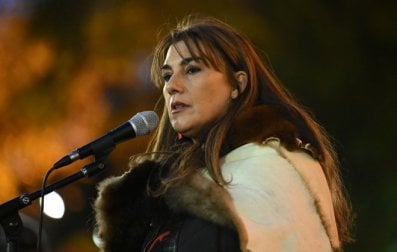
Choreographer Yolande Brown
A Bidjara woman and multidimensional artist in the truest essence of the word, Yolande Brown is a living embodiment of yesteryear, the here and now, and the future: everywhere and everything, altogether and all at once.
Brown sprawled with me ahead of last week’s Queensland Ballet premiere, Nhamgan Ngali Nyin, we all see you, as part of Queensland Ballet’s Bespoke season of new work, and talked of deep time and knowledge. “Sometimes I feel as though I’m being stretched through a portal,” she muses. “You know when you see those sci-fi movies and you see people jumping through time and they’re being stretched? Like, I just feel as though we’ve got the capacity to do that.”
Brown, a choreographer, singer, dancer and pianist, is talking to me before rehearsals a fortnight ahead of the opening night of Nhamgan Ngali Nyin, we all see you. It’s a major milestone for an already accomplished artist, whose best work still feels very much ahead of her. “It’s like a shifting sand dune,” she says, reflecting on the final stage of preparing for a show. “You can’t really control where it’s going, but you can see the shape that it’s trying to find. And I’m trying to help encourage that because there’s a lot of bodies.
“Sometimes as a choreographer, you have to hand over that control and that sense of direction to the artists themselves and give them the responsibility to finesse what that is, because they also have their own sense of artistry. And if something’s not working, sometimes it’s just because the artists need more time to emulate, to digest it and process it. So you can’t rush to change things. You have to let things also find themselves, and you have to be responsive to the artists.”
Brown’s extensive résumé, which includes 16 years as a senior artist with Bangarra Dance Theatre, co-choreographing the acclaimed Dark Emu in 2018 and creating Imprint in 2013, means that she’s worked under the watchful eye of masterful tutors, building a rich archive of lessons along the way.
She reflects on her time with the critically acclaimed choreographer and former artistic director of Bangarra Stephen Page and his uncanny ability to maintain a lightness and a sense of play, “which always helped counter the clock ticking in the background and kept the imagination flowing”. She says Wesley Enoch’s ability to maintain a high company morale and his gameplay, “knowing when and how to make people feel really good”, is like no other. Frances Rings, a former dance peer of Brown’s who succeeded Page as artistic director of Bangarra, didn’t only show Brown how to navigate motherhood as an artist but also opened her mind to different research methodologies that unlock “different ways of seeing Country”.
“I feel really fortunate,” she says. “Everyone I work with leaves some sort of imprint.”
Brown has been exposed to a plethora of different environments and experiences. One of those was when she did backing vocals for David Leha performing as Radical Son. “It was amazing because I got to experience another type of performing, where you’re dancing with the audience, who were up against the stage,” she says. “And you actually feel like you’re directly looking at them and connecting with them, as opposed to being on stage, where you’re in the story and you’re with the dancers – but not breaking that fourth wall.”
When I ask how she will know when her work with Queensland Ballet is complete, Brown says it’s all about feeling. She says choreography is similar to a painter and their canvas. Both have their confines. And both could “go over it, over it and over it”.
“I think it’s the sense of the story,” she says. “You’ve got to listen to the story and you’ve got to listen to see if the story feels as though it’s reached its conclusion. Though it doesn’t mean there won’t be another book,” she adds, with a wry smile.
Throughout our conversation I couldn’t help but think about how much Brown has to teach the world – how relevant and replicable her insights and perspectives are, not only for other artists but for punters of all persuasions. Brown possesses tenacity and is fuelled by a raging inner fire, but there is nothing forceful about her. So it’s no surprise to me when she says her artistic practice is about “facilitating stories to share themselves”.
“I don’t want to be overly prescriptive,” she says. “I go in with ideas, but I do a lot of listening. And I feel very fortunate that as a First Nations person, I’m able to continually learn about Country and place and people and what’s important from the perspectives of the past and the present and the future. This timeline, this continuum, everything that I do, it’s a big learning journey for me.”
Brown’s choreographic debut with Queensland Ballet has been a long time coming. It also represents a full circle moment with Butchulla artist and cultural custodian of K’gari (Fraser Island) Fred Leone.
“I thought that I only met him for the first time last year when we performed at Taronga Zoo for Jane Goodall,” she says. “But he reminded me that we’d actually met earlier at a G20 summit when Bangarra performed for Putin and President Bush. So we go from, you know, Putin and Bush and I don’t know who it was from Australia, then someone else, and then Jane Goodall. So, when the Queensland Ballet invited me to do this work, I really wanted it to have a deep connection and I just knew that it had to be in collaboration with Fred.”
Drawing on the ecological, spiritual and ancestral significance of Leone’s traditional lands, Nhamgan Ngali Nyin, we all see you pays homage to the natural wonder of K’gari. “You know, I hadn’t been to K’gari before,” she says. “I was just so honoured to be able to go to that very special, pristine, beautiful place with Fred and have him share it through his eyes. There’s nothing like being on Country for the first time with somebody who understands the depth of the place.
“I mean, K’gari is the biggest sand island in the world. It has some of the purest water in the world.” She then educates me on how the ecosystem’s interaction with its living species helped to create the semi-permeable membranes that hold the water in the sand, creating perched lakes that sit above the surrounding landscape. “Because of the leaf litter and the decaying organic matter and the coffee rock, it’s able to have all these perched lakes,” she says. “It’s got more than half the world’s perched lakes, I believe. There’s a certain degree of magic in that and I guess I want people to be able to experience that through a custodial lens.”
I broach the subject of what it’s like being a Blackfulla working within very traditional settings such as Queensland Ballet – not to poke the bear but to understand how First Nations practices square with these eminent institutions.
“I feel as though I’m a pretty flexible person and if I need to stretch around the corner, I can,” she says. “But you know, it’s just great to be a creative vehicle … to tap into all of these modalities of creating. I love being in the studio with these beautiful Queensland Ballet dancers who are so highly trained in a particular way of moving. It’s so different to the highly trained Bangarra dancers’ way of moving and so different again to the highly trained actors’ and singers’ way.”
The magnitude of having Blackfulla stories grace the Queensland Ballet stage is a motivating force for Brown. So, too, is the opportunity to collaborate so closely with Leone. “It’s really beautiful that Fred Leone’s voice will be able to resonate through the Queensland Ballet theatre. And for the mob, to let the ancestors hear story, hear the language, hear the melody. That continuum of time, deep time, what that means and how it’s not linear, how it spirals. So it’s honouring the past while honouring the future, while honouring the present.
“It’s a joy to be able to share space with [Leone]. Just as a person, he wears his heart on his sleeve. I admire his strength to, through his artistry, to hold space for that. But he’s got this deep, deep kindness and generosity where he really wants to help people learn and connect. And I think that’s his way of helping people find peace as well. You know, you can find peace when you can find understanding. And that’s what he is, a vessel for peace and understanding.”
My sense from our sprawl was that this body of work is also a vessel for Brown to nurture her inner peace. We spoke about the brain food that keeps Brown stimulated, vitalised and always learning – or stretching, as she calls it.
The book Songspirals, written by a Gay’wu Group of Women from North East Arnhem, moves the conversation, like a shifting sand dune, to Brown’s grandmother, who was born in 1921. It’s here that Brown’s voice slows and then breaks.
“She had a really tough life. As she got really old, I remember her sitting in the chair. She spent the last six years of her life, kind of sitting in a chair most of the time, but she would keen... and she would do that on her own. And I wondered what it was. And then when I read this book [Songspirals], I was like, that’s what Grandma was doing.”
The Gay’wu Group of Women explain keening as “an ancient song, an ancient poem, a map, a ceremony and a guide”. Called milkarri in Yolŋu, the authors say “it comes from deep inside us. We feel the song and let it flow. Milkarri is a chant, a soft tremulous voice deep with emotion, sometimes grief, sometimes joy, pierced with loss and pain, often all of these and more.”
The image that Brown has painted of her ageing grandmother sitting in her chair lives vividly in Brown’s mind. She is now crying, apologising. And on the inside, so am I.
“Not being able to celebrate who she was as a Black woman, and me seeing the consequences of that embodied by her – and I feel as though a lot of my work gives voice to her,” she says. “I feel like she needed to feel proud of herself, so I hope through me she gets to strengthen her footsteps, wherever she is.”
When Brown speaks of her grandparents and the formative years that she was able to share with them, the pieces of who this woman is – this everywhen – continues to fall into place. She says that the early years of being in South Australia, connecting to the ocean with and through her grandparents, are some of the beautiful memories that she holds and lessons that she keeps.
“We’d go for long walks along the beach. He’d [Brown’s grandfather] always say, ‘Don’t rush past things. Stop and look. When you stop and look, you’ll see all these things that you would miss if you just kept moving. You don’t always have to just keep moving. You can just stop.’ It’s just so human to be out walking, walking to get stuff, it’s not so sedentary. We spend a lot of time inside boxes and we’re the only species that has done that to ourselves. And I feel as though a part of our health in general relies upon us being in nature.
“We just get so much out of having these experiences, it awakens feelings. We are feeling creatures, you know, we are sensory. We’re meant to be engaged with stimulation of sounds, of smells, of scents, of stories, of colours.”
Asked about what she’s seeking to evoke through her art, Brown’s answer is simple – “connection”. “Sometimes as an artist, you’re like the stone that’s thrown in the water and you don’t get to see the ripple.
“But if each little work of art is like a pebble being dropped in a pond and has its ripples, the pond of the great universe, you know, on this continuum, backwards and forwards, anything’s possible.”
This article was first published in the print edition of The Saturday Paper on August 9, 2025 as "Steps in time".
For almost a decade, The Saturday Paper has published Australia’s leading writers and thinkers. We have pursued stories that are ignored elsewhere, covering them with sensitivity and depth. We have done this on refugee policy, on government integrity, on robo-debt, on aged care, on climate change, on the pandemic.
All our journalism is fiercely independent. It relies on the support of readers. By subscribing to The Saturday Paper, you are ensuring that we can continue to produce essential, issue-defining coverage, to dig out stories that take time, to doggedly hold to account politicians and the political class.
There are very few titles that have the freedom and the space to produce journalism like this. In a country with a concentration of media ownership unlike anything else in the world, it is vitally important. Your subscription helps make it possible.
Subscriber exclusive
Send this article to a friend for free.
Share this subscriber exclusive article with a friend or family member using share credits.