Dance
Dance becomes a way of thinking and opening new possibility in Jo Lloyd’s Agitato and Rhiannon Newton’s Long Sentences. By Philipa Rothfield.
Thinking in motion
The space is empty and then it isn’t. Suddenly, it is filled with the passion and power of Fanny Mendelssohn’s Allegro molto agitato in D minor (1823), played in full. Then silence.
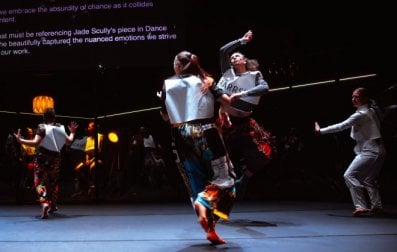
Thomas Woodman enters, executing a short series of moves: through a downward dog and towards an upside-down lean against the wall. This is his signature move, something we see again and again. Three more dancers enter the space, performing their own particular phrases.
Jo Lloyd is fast, light on her feet, off-centre. Harrison Ritchie-Jones is risky, energetic and capable. Lee Serle is elegant, long and smooth. With Woodman, they are four components working together in space, each focused upon their own agendas. The four sets of movements create a vocabulary that is open repetition on the part of the dancer and subsequent recognition on the part of the audience.
The dancers are dressed in black costumes designed by Lloyd’s long-time collaborator, Andrew Treloar. The floor, walls and curtains are also black, a single-colour palette emphasising both uniformity and nuanced difference. Mendelssohn’s vigorous composition is, over the course of Agitato, taken apart every which way by Duane Morrison. It is as if a piano has been dismembered, wires plucked, phrases extended and contracted. Although the musicality of the work is wholly deconstructed, there is a sense that we are inside a single, sonorous field.
The dancers move like boxers, never quite committing their weight. The choreography is intricate, clearly created for each dancer. Everyone has their own task. Collective moments of stillness are found throughout: a pause for thought, whose mutual timing reminds us that these individuals are in fact working together. One has the impression that they are the moving parts of those watches whose mechanism is revealed under glass.
Lloyd and Woodman curve backwards in an arc more than once. Time is not linear. It marches forwards, backwards, pauses, foundering on repeat; the dancers move in unison, shifting weight from one leg to another. Taking their time, they repeatedly oscillate between left and right, inching towards the edge of the space. This is not a walk as such, rather a bipedal form of motion. Serle reaches a set of stairs, bobbing against the step. He is robotic, inhuman.
Over time the dancers connect, occasionally taking weight, sliding to the floor, whispering into an ear. Nothing comes of this, no relationships are built beyond the precise togetherness of the performance. The dancers do not look at us. As dancers, they must have agency, but their role is not to supply a human narrative. It is, rather, to give life to Lloyd’s compelling choreography.
You could say that Agitato is an abstract work, one whose premise is a choreographic treatment of a sound score. As such, it teases out the threads of Mendelssohn’s music and renders them in movement, an intricate and elaborate proposition.
And yet, live performance is never entirely abstract. We see effort, breath and intention. The costumes, though plain, are decidedly human: polo shirt, work pants and runners. The movement is authored, firstly by Lloyd, the choreographer, and then re-authored by the dancers in performance. The treatment of the music and sound similarly fluctuates between an authorial musical creation and an abstracted soundscape. In each case, there is a play between the human and the non-human, each depending upon the other for its existence.
Apart from the beauty of Allegro molto agitato in D minor, the beauty of the choreography and that of the dancing, the achievement of this piece lies in its ability to take a piece of music and then to take it apart in dance. Agitato engages its intellectual challenges in aesthetic terms. It differs from conceptual dance in that it is an experiment whose depth is found within the work of Lloyd’s choreography and Morrison’s treatment of sound.
Rhiannon Newton’s Long Sentences is an entirely different proposition, a meditation of sorts on Newton’s part, expressed and pursued in real time. Newton takes us on a journey, her journey. Our witnessing that journey is part of the work since it consists of an extended form of audience address. She begins under dim lights, bodily impulses extending through her limbs as she speaks quietly, declaring her field of interest – the long sentence.
Long Sentences is less about language – as an underlying system of meaning – than speech. Speech is performative. It exists in the moment of its articulation. Newton plays with this: uttering, remarking, creating the string of words that form her performance. She chooses to locate herself within the flow of words, naming their beginning and their middle, which she inevitably occupies. She understands that time spools through her words and movements, implicating a future through a present that progressively becomes past.
Our own experience of Long Sentences relies on the past in the form of memory: we draw upon our memories of the performance in order to make sense of the whole. We make sense of Newton’s sense-making. This is the work’s future being.
Long Sentences is simultaneously spoken and danced, the body and speech together. The movement is persistent, pulsating, a considered thinking in motion. Not content to remain within its initial remit, the text addresses the body, Newton’s body, the body of the earth, the land, Indigenous land, rock, drilling down to the bedrock of our being. The breath that forms speech does not begin within any of us but is inhaled from the world. The passage of breath between the world and its sentient beings links us all, calling into question the distinction between self and other.
Through this a gentle rumble of sound grows, in a score by Peter Lenaerts. Newton locates herself on a disc, which she spins. The ongoing spinning of the disc becomes a powerful visual mantra, centrestage under a pool of light, created by lighting designer Karen Norris. The sound of the spinning joins Newton’s words, which become a multiplicity of voices. The growing drama is overwhelmed by the sound that has become a deafening rumble, an auditory takeover. The cacophony recedes; a hiatus of movement quietens, allowing us to reflect as the work ebbs away.
Long Sentences is a play on and with words, one thought leading to another. Its intensification through the spinning, the multiple voices and thunderous soundscape raises questions as to the status of the disruption. Is that excessive and destabilising power ever-present in our trains of thought and action? Does it stand for the mortality that brings the long sentence to an end? These matters are unresolved, left for another day, as Newton returns to the quietude of her meditation.
Agitato and Long Sentences opened Melbourne’s Dancehouse, Season Two, 2025.
This article was first published in the print edition of The Saturday Paper on August 9, 2025 as "Thinking in motion".
For almost a decade, The Saturday Paper has published Australia’s leading writers and thinkers. We have pursued stories that are ignored elsewhere, covering them with sensitivity and depth. We have done this on refugee policy, on government integrity, on robo-debt, on aged care, on climate change, on the pandemic.
All our journalism is fiercely independent. It relies on the support of readers. By subscribing to The Saturday Paper, you are ensuring that we can continue to produce essential, issue-defining coverage, to dig out stories that take time, to doggedly hold to account politicians and the political class.
There are very few titles that have the freedom and the space to produce journalism like this. In a country with a concentration of media ownership unlike anything else in the world, it is vitally important. Your subscription helps make it possible.
Subscriber exclusive
Send this article to a friend for free.
Share this subscriber exclusive article with a friend or family member using share credits.