Dance
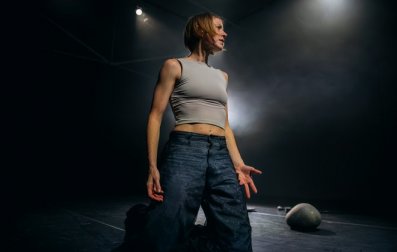
Alisdair Macindoe’s new dance work, Plagiary, investigates the artistic possibilities of a collaboration between artificial intelligence and the human body. By Philipa Rothfield.
Alisdair Macindoe’s Plagiary melds the human with AI
According to French philosopher Bruno Latour, nothing we do is entirely of our own making. There is no such thing as a purely human act – everything we do is inevitably a combination of human and non-human factors. Alisdair Macindoe’s Plagiary embraces Latour’s challenge to our human-centred sense of self by creating a work wholly focused upon the non-human, in the form of artificial intelligence. A reflection of our current preoccupation with AI, Plagiary is a dance work of our time.
Macindoe has a longstanding interest in using digital technology to disrupt the choreographer–dancer dyad. In 2019, he developed a computer program, A.I.D., which generates real-time choreographic instructions. Plagiary empowers such non-human forms of agency by explicitly assigning to AI the roles of choreographer and playwright. This translates as a series of directives given live to 10 dancers (“the choreography”) and an extensive set of texts (“the play”) to be delivered by two performers.
These matters are made apparent from the start. A time code begins and we are told about the makings of the work, its dependence on AI and the unpredictable and unique nature of each performance. The dressing room is equally on show. We watch the dancers warm up, stretch and chat behind a transparent wall, which encloses a long rail of colourful costumes by Andrew Treloar.
Ten dancers emerge, poised for action, and are given a fast-evolving set of movement instructions. If we want, we can watch and/or listen to these directives. They are fast and furious, the dancers barely given enough time to address each task. Who – or what – decided the speed of these instructions, which have little bearing on what it takes for a body to comply? Some are imaginative forms of supposition, some absurdly metaphysical and others surprisingly concrete. The audience’s attention is divided between reading the mercurial text, listening to its instructions and watching the 10 performers grapple with the task at hand.
There are moments of calm in these eddies of compliance where the group is able to settle into an action to gather its collective self or to perform a simple task. In general though, the action is relentless. We can appreciate the skilful dedication of the performers, including the marked differences between their attempts to satisfy the various commands. There is, it seems, no resistance to this set-up. While AI is often posed as a servant of the human, Plagiary puts the human at the service of AI. This human agency is reactive, responsive, eager to please.
Partway through the performance, Geoffrey Watson begins an extensive commentary on culture and society, philosophy and performativity. Some big names are cited, with pithy summaries of their ideas – some accurate, some really not. Does this matter? Does it matter that AI depends upon the internet as grist for its mill? In any case, the density and speed of articulation gives little opportunity for real-time reflection or critique, which morphs into a fireside chat between Watson and Rachel Coulson as they retreat to a coffee table and chairs in the visible dressing room.
Twentieth century choreographer Martha Graham is introduced into the conversation with an imaginary work entitled Prism. Watson and Coulson are enlisted to perform Graham-type movements. The ensuing moves are not particularly accurate, their interpretation dependent upon verbal description rather than historical precedent.
Plagiary veers away from notions of authenticity and accuracy in its cultural commentary and dalliance with Graham. Cultural theorist Jean Baudrillard claims there is no underlying social reality beyond its representation in the public sphere. The very speed of Plagiary’s recirculation of ideas and culture suggests a similarly cavalier rejection of the real. The AI sampling of culture through the dedicated coding of Chris Chua, Sam Mcgilp and Alisdair Macindoe can only concern itself with what the internet makes available. It is both limited and virtuosic in its ability to source and suggest.
As Watson and Coulson evoke an imaginary dance work, a rich tapestry of mutating images (Sam Mcgilp) joins the flow. The images are beautiful and unreal, combining beguiling motifs of past civilisations and imaginary landscapes. Their hallucinatory character lends weight to Baudrillard’s rejection of reality.
Inevitably, the time code counts down. An hour has passed. The dancers stop, the imagery ceases, the text grinds to a halt.
Plagiary is a collaboration of human and AI elements. Although the instructions and text emanate from AI, the conditions and mise en scène of the work stem from Macindoe’s creative choices. Macindoe selected the dancers, enlisted their compliance and fostered an atmosphere of camaraderie typical of his works. He developed the stage design, with its transparent dressing-room and coffee table set-up, made the movement instructions and text available to the audience, and possibly set the rate of change of the incoming materials.
Speed is a key element. Plagiary would have been quite different if its instructions were issued at half or quarter the pace. There would have been space for thought, reflection and stillness. As it is, this is a busy work. The timing of the instructions calls for immediate responses on the part of the dancers. Sometimes comical, the emerging gestures rely upon their embodied intelligence. A dancer’s embodied intelligence arises in the studio, village or desert floor, through performing and according to the nuances of kinaesthetic culture. It is a bodily artefact, as distinct from AI’s virtual know-how.
Dancers bring their histories to the choreographic table. Their skill, experience, taste and movement style form a habitual go-to manner of movement that emerges almost automatically, certainly in the context of this fast-moving work. These factors speak through the body of the performer. In other words, there are two histories at work here: one embodied, the other virtual.
Plagiary is a duet between task – on the part of AI – and the dancers’ response, between the virtual and the corporeal. The joy of the work exists in the dancers’ willingness to submit to a regime of instruction. The chance provocations elicit a lively and comic range of actions.
What of the less tangible influence of AI on creative endeavour? Performance artists such as Stelarc have long been willing to open their agency to alien forms of impulse. Macindoe takes these questions into the choreographic domain.
Will there come a time when AI more subtly enters the field of art, proof positive of Latour’s claim that our lives are a mix of the human and non-human? If Latour is correct, the human and the non-human work together in the field of human endeavour. The same can be said of AI: that the work of programming and coding suggests the human is an inextricable component of its operations.
Through foregrounding and empowering AI, Plagiary tilts the axis towards the non-human. Whether this detracts from our sense of the artist as the creative force behind the work is another matter.
Plagiary will be performed in the Studio, Sydney Opera House, September 12-14.
This article was first published in the print edition of The Saturday Paper on September 7, 2024 as "Algorithm methods".
For almost a decade, The Saturday Paper has published Australia’s leading writers and thinkers. We have pursued stories that are ignored elsewhere, covering them with sensitivity and depth. We have done this on refugee policy, on government integrity, on robo-debt, on aged care, on climate change, on the pandemic.
All our journalism is fiercely independent. It relies on the support of readers. By subscribing to The Saturday Paper, you are ensuring that we can continue to produce essential, issue-defining coverage, to dig out stories that take time, to doggedly hold to account politicians and the political class.
There are very few titles that have the freedom and the space to produce journalism like this. In a country with a concentration of media ownership unlike anything else in the world, it is vitally important. Your subscription helps make it possible.
Subscriber exclusive
Send this article to a friend for free.
Share this subscriber exclusive article with a friend or family member using share credits.