Architecture
The new Sydney Metro City line is one of the biggest infrastructure projects in Australia – and it has moments of the sublime. By Naomi Stead.
Sydney Metro City line on track for greatness
The best show in Sydney just now is not at the Opera House or the art gallery. It’s at the front of the leading carriage on any Metro train. They’re automatic, so there’s no driver to get in the way. Muscle your way through the schoolkids and trainspotters to the front-and-centre picture window and behold a mesmerising journey – flying along the sinuous, diving rails, the tunnel lit only by a string of safety lights casting a weak glow in the murk, the walls strung with stanchions and pipes and emergency boltholes. The inexorability of it! The onrush! Like you’re part of a smooth torrent of space and time pouring forth, like existence, like experience itself.
I’m not the first to get carried away. There have been many hyperboles flung about in discussion of the new Sydney Metro City line – which comprises six new stations along with new platforms at Central and Sydenham, all connected by a pair of new tunnels under the harbour. Routinely described as a game-changing, city-shaping, once-in-a-generation transformation, it has certainly occasioned some excitement.
It has also met a need: anyone who’s been wedged in a stranger’s armpit on a crowded City Circle train or queued for an escalator at Town Hall will agree that Sydney’s heavy rail system was jam-packed. When I visited about 10 days after it opened, Metro City had already carried a staggering two million passengers. No doubt many of these were joyriding lolligaggers like me – there were certainly a lot of folk wandering around looking, taking photographs and being unusually chatty: engaging with one another like people at a carnival.
One Sydney insider told me that with Metro City “the real success has been unlocking proper budgets for transport – CityRail has a long history of using very average architects on shoestring budgets … it’s almost like someone looked at what’s going into the WestConnex projects and sought some level of parity”. Around the country, the current crop of “big dig” civic infrastructure projects have indeed been notably well endowed. The Sydney Metro City and Southwest Line was originally forecast to cost $12 billion, revised last year to north of $20 billion. Even if the proportion set aside for the architecture and visual art components was comparatively minuscule, it is still mammoth by arts industry standards.
Metro stations are highly technical public buildings that also happen to be underground. Getting passengers on and off trains is in some ways the easy bit – what users will hopefully never see are the layers of emergency provisions, fail-safes, smoke extraction stacks and other services invisible to the casual eye. There are two ways to make a subterranean station: by tunnelling in and hollowing out a space underground, or by open-cut mining a big hole and covering it over with a concrete lid – known respectively as “cavern” and “cut and cover” methods. Sydney Metro has both kinds, each built by massive multidisciplinary teams integrating construction, engineering and design, contracted across multiple stages.
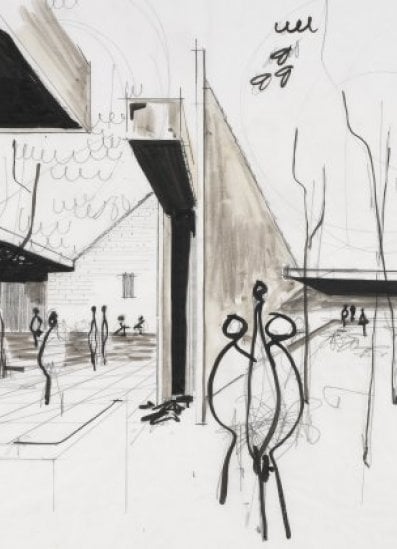
The entangled nature of this process means it doesn’t make much sense to ascribe architectural authorship in any singular way. Foster + Partners and Architectus developed the initial schematic designs for five of the new stations, each taken up by a different second-stage design team. They all have different parameters – some are binocular with two separate platforms, while others have one wide platform with tracks on either side. Crows Nest is suburban, while Barangaroo is more of an event station, catering for tourists and the yearly surge at New Year’s Eve, and Victoria Cross is a hub for new food venues. The inner-city Gadigal and Martin Place stations are scaled for massive volumes of peak-hour foot traffic, while Waterloo anticipates future crowds, when its mixed-use precinct redevelopment is complete.
A special case is the new Metro platform at Central – designed by Woods Bagot and John McAslan + Partners – because it was added beneath the existing railway station, complementing the grand new intercity train concourse that opened last year. I was surprised by how much I liked this Metro, its platform slid under the original heritage sandstone building. The way the light washes down the fibre-cement panel walls makes them look upholstered, undulating in pillowy bulges. Rose Nolan’s artwork All Alongside of Each Other makes a joyful contribution to the space.
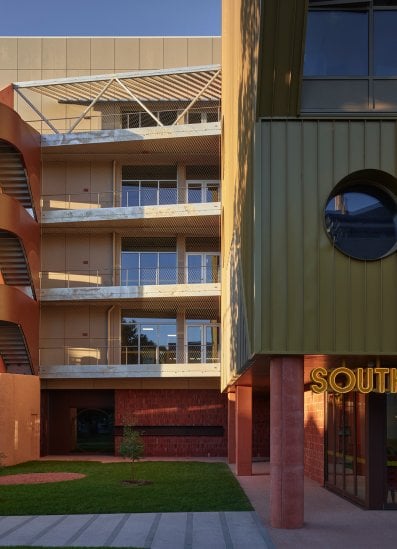
It is the material qualities that really distinguish the various stations, from the split-face natural sandstone of Barangaroo – designed by Foster + Partners with Architectus – to the articulated brick of Woods Bagot’s Crows Nest, and the elegant brass and granite of Grimshaw’s Martin Place. In some ways they can be seen as interior fit-out projects: the lining and skinning of an engineered concrete shell.
Victoria Cross by Cox Architecture has a distinctly Star Wars feel, partly because of its tubular tunnels and sweeping curves, but also its shiny white surfaces. It’s like walking around the Death Star – someone behind me started energetically humming the Darth Vader refrain. It’s all kinda theatrical and fun, but also has a thin, tinny, plastic feel. In contrast Gadigal station, by Foster + Partners and Cox, has a similarly spacey colour palette and futuristic vibe but a much greater sense of substance and finesse. With its palette of corrugated fibre-cement and pale terrazzo, it also has significant hardwood timber joinery – amazing to see in an underground mass-transit environment.
Martin Place is the largest of the new stations, with the civic grandeur and stylish sobriety that comes only from serious money. Two towers soar above as part of an integrated above-site development. At present the retail levels are empty, the place feeling dim and quiescent – which led to an almighty shock when I shifted over to the adjacent rail station. Holy moly, what a descent: into a cluttered mishmash of signage and furniture under brutally harsh lighting, the ceiling oppressively low, a thin covering of grime over everything and a blaring cacophony of advertising making the whole thing deeply unpleasant. The train line itself was a yawning, unscreened deathtrap at the edge of the narrow platform. Once you’ve tasted the future, it’s hard to go back to the infrastructure of the past.
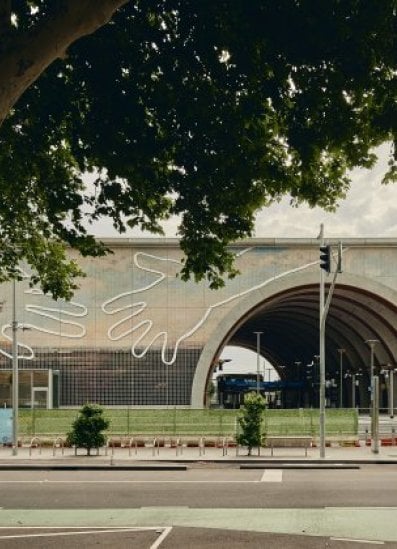
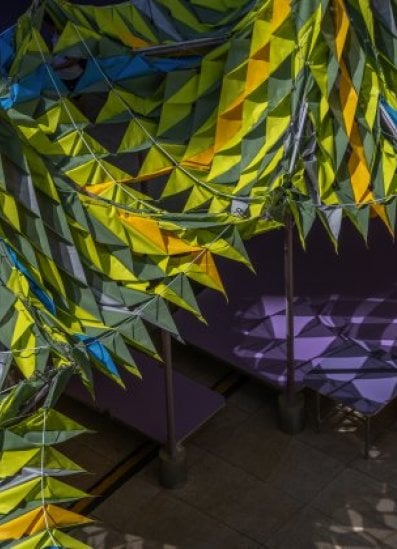
Firms such as Foster, Grimshaw and McAslan, with their global transport expertise, bring an exceptional level of design refinement to projects like this: the drawback is the feeling they could be anywhere. This is where the public art program is meant to come in, bringing identity and character to anchor each station to its place. In fact, I have my reservations about Transport Art as both a concept and a genre. But the Sydney Metro art commissions are actually universally great. At Gadigal, Callum Morton’s The Underneath has been particularly well received for its heroic scale and illusory qualities, intense ceramic colour, and bold presence in a very prominent spot.
Some of the works even achieve the genuinely meaningful connection to place they’re tasked with: Esther Stewart’s Ceramic Wall Relief at Crows Nest is an affectionate riff on the colours and details of local domestic architecture, while at Waterloo station a suite of three pieces by Nicole Monks powerfully reflects the language and stories of the local Gadigal community. The Waterloo station building – designed by John McAslan + Partners – might also be the pick of the bunch for architects, who will admire its disciplined rationality, the scale and proportion of its grand concourse and its tough but generous interface to the street.
At the end of my visit I sat for a while on the platform at Victoria Cross, gathering thoughts and writing notes. The trains came and went with a soft electric chiming. The weird inflection of the station announcer’s machine-generated voice reminded us all, with seemingly infinite sadness, to hold our children’s hands on the platform. Eventually, I noticed a curious phenomenon: well in advance of a train’s arrival it was heralded by a steady rush of air, pushed far ahead through the tunnel. By some accident of construction, the effect was a ghostly kind of tonal music.
The wind was playing the architecture like an instrument, an abstract shift through tones from a deep thrumming hum to a high trill. It was transfixing: tuneful but strangely melancholy, an airy music of the spheres, a fluting of ancient harmonics reaching across time. I didn’t expect to encounter the sublime on a Metro platform. But if you’re attentive, in the right place at the right time, there it is.
ARTS DIARY
EXHIBITION Beings
ACMI, Naarm/Melbourne, until October 6
THEATRE Dear Brother
Bille Brown Theatre, Meanjin/Brisbane, until September 28
CULTURE William Yang’s Mardi Gras
National Library of Australia, Ngambri and Ngunnawal Country/Canberra, until December 1
VISUAL ART Tom Phillips: Running on empty
Art Gallery of South Australia, Kaurna Yarta/Adelaide, until October 31
DANCE Momentum Unveiled
Studio Underground, Whadjuk Noongar Country/Perth, September 11-15
LAST CHANCE
MULTIMEDIA Sydney Contemporary 2024
Carriageworks, Gadigal Country/Sydney, until September 8
This article was first published in the print edition of The Saturday Paper on September 4, 2024 as "The Sydney Metro City line is the best show in town".
For almost a decade, The Saturday Paper has published Australia’s leading writers and thinkers. We have pursued stories that are ignored elsewhere, covering them with sensitivity and depth. We have done this on refugee policy, on government integrity, on robo-debt, on aged care, on climate change, on the pandemic.
All our journalism is fiercely independent. It relies on the support of readers. By subscribing to The Saturday Paper, you are ensuring that we can continue to produce essential, issue-defining coverage, to dig out stories that take time, to doggedly hold to account politicians and the political class.
There are very few titles that have the freedom and the space to produce journalism like this. In a country with a concentration of media ownership unlike anything else in the world, it is vitally important. Your subscription helps make it possible.
Subscriber exclusive
Send this article to a friend for free.
Share this subscriber exclusive article with a friend or family member using share credits.