News
ANALYSIS: Australia’s new treaty appears to seal a commitment to a close strategic relationship with PNG and to its defence, but that’s not what the deal will deliver. By Hugh White.
The illusion of the PNG treaty
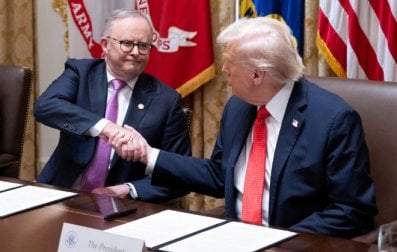
On Monday, after an embarrassing hiccup in Port Moresby last month, Prime Minister Anthony Albanese and his Papua New Guinean counterpart, James Marape, signed a new Mutual Defence Treaty between Australia and PNG. Its key clause, Article 4(3), goes further in committing Australia to another country’s defence than anything this nation has signed since the ANZUS Treaty in 1951. Indeed, the language of that article has been lifted almost word for word from the ANZUS text. It says that an attack on either country would be dangerous to both, and commits each side to “act to meet the common danger”.
In the cautious phraseology of security treaties, this is pretty strong stuff. The new treaty therefore looks like a big step for Australia to take and the questions naturally arise: Why are we taking it? What is the Albanese government trying to achieve? Will it work?
There is no obvious or pressing need to enshrine our commitment to defend Papua New Guinea in a formal treaty. A glance at the map provides all the assurance anyone – friend or foe – could need that Australia would always regard an attack on PNG as a direct threat to this country and respond accordingly. By contrast, the ANZUS Treaty has been critical to Australia’s alliance with the United States because the map provides no such assurance about Australia’s importance to a very distant America. Without the ANZUS Treaty, there would be no reason to think we mattered much to Washington one way or the other.
These brute facts of geography ensure its nearest neighbour will always be vital to Australia’s security. This is because control of PNG’s territory would provide an aggressor with the best possible access to bases close to these shores from which to launch attacks on this continent. It did not take Japan’s devastating intrusion in 1942 to tell us that. It was clear long before, indeed from the very dawn of modern Australia’s strategic thinking.
In 1883 the leaders of the then separate colonies united to urge London to forestall German colonisation of northern New Guinea, for fear of the threat a strong German presence could pose to their security. London’s lofty dismissal of these fears gave the first decisive nudge to the idea of Federation.
These fears drove Australia’s early engagement with PNG and provided the primary rationale for Australia’s role as the colonial power up until independence in 1975. The same fears did not go away after independence. No one in Canberra’s defence establishment has ever doubted for a moment that Australia would always be willing to defend PNG from external aggression. One might ask, then, why Australia didn’t long ago sign a treaty like the one agreed this week? It was not just that its commitment to PNG’s security has always seemed so obvious. It was also because Canberra didn’t want Port Moresby to take Australia’s military commitment too much for granted. There was worry that if it was too sure of Australian support, Port Moresby might recklessly provoke Jakarta by supporting separatists across the PNG-Indonesia border in West Papua. The prospect of Australia being drawn into a conflict with Indonesia was a major preoccupation of Canberra defence planners throughout the 1980s.
Australia’s cautious approach was deftly expressed by Kim Beazley when, on his first visit to Jakarta as defence minister in 1986, he sat down with his Indonesian counterpart, the wily and formidable Benny Moerdani. In a provocative sally, Moerdani asked Beazley point-blank whether Australia would intervene to support PNG in a border clash with Indonesia. Beazley didn’t miss a beat. “Absolutely,” he replied in a flash. “But we will never tell Port Moresby that!”
In fact, the following year Beazley did go some way towards formally reassuring PNG about Australia’s strategic commitment. At his insistence, the 1987 Joint Declaration of Principles between Canberra and Port Moresby, drawn up to clarify and consolidate the post-independence relationship between the two countries, included a clause committing them to consult one another in the event of an external attack on either of them, “to consider what measures should be taken” in relation to that attack.
This formulation was lifted from the 1971 Five Power Defence Arrangements, under which Australia committed itself to help defend Malaysia and Singapore. It is not as strong as the language from ANZUS, embodied in the new treaty, but it nonetheless constituted a serious statement of strategic intent.
In 2000 the Howard government went even further. Its Defence white paper of that year spelt out bluntly and very deliberately a bold interpretation of what the cautious wording of the 1987 joint declaration commitment really meant. It reflected “the expectation that Australia would be prepared to commit forces to resist external aggression against Papua New Guinea”. One could hardly be clearer than that. Nonetheless, this was just a unilateral statement of policy from Canberra, made without consultation with Port Moresby. It was not a formally negotiated bilateral treaty between the two countries.
So what precisely is the Albanese government now trying to achieve? Why should Australia decide to formalise its commitment to PNG in this way? The answer, of course, is China. It is an old story, really: Australia’s engagement with PNG has always been driven by its determination to keep other countries out of the neighbourhood, and China poses the most formidable challenge Australia has faced in that regard.
What worries Canberra now is not that China will secure military bases in PNG by invading the country. It is that PNG’s growing relationship with China as a major economic partner and aid donor, and as an increasingly influential regional power, might lead to an invitation for China to establish a military presence there. That is why, for Canberra, the most important clause in the new treaty is not Article 4(3), but a subsequent clause, Article 5(4), obviously directed at China. It reads:
The parties agree they shall not put in place activities, agreements or arrangements with third parties that would compromise their ability to implement this treaty.
This is what the treaty is really about. In return for Australia’s promise to defend it, PNG promises not to allow China to establish a military or security presence on its territory. This is not the first time Canberra has tried to impose this constraint on PNG’s foreign policy. The gift of $600 million to fund a PNG team in the NRL is subject to the same condition. It is there also in the 2023 agreement with Tuvalu granting special pathways for its people to immigrate to Australia.
This is a big, contentious step for Australia to take. Imagine how this country would respond if a neighbour tried to impose similar constraints on Australia’s freedom to reach whatever defence arrangements it wanted with third countries – if that neighbour sought to veto any move by Australia to invite Singapore, Japan or America to locate forces here?
It is not surprising that influential figures in PNG have denounced the treaty as eroding PNG’s sovereignty. It is also far from clear that it will work. How, after all, would we respond if Port Moresby did, for example, invite China to base maritime patrol aircraft in PNG to help protect its fisheries? Would we really withdraw our commitment to PNG’s defence? Could we credibly do so, given what the map tells us?
Seen in this light, the treaty makes little strategic sense. In fact, it embodies precisely the illusion that plagues Australia’s wider approach to the immense and revolutionary challenge posed by the rise of China.
Australian policy rests on the hope that, with the support of other countries in Asia and the Pacific, the US can resist China’s challenge, remain the leading power in Asia and be Australia’s guardian. Ultimately, this new treaty is Australia’s attempt to enlist PNG to this cause, having it choose to side with the US and Australia in the campaign to contain China.
It will not work, however, because for all its big talk the US is not serious about defending its regional strategic role against China’s challenge, and our Asia-Pacific neighbours are not serious about supporting it. Nor, despite the treaty’s wording, is PNG.
The only credible basis for Australian policy today is to accept that the long era of US regional primacy is coming swiftly to a close, and to start preparing to make our way in the complex multipolar Asia-Pacific region that is emerging to take its place – a new order in which China, whether we like it or not, will play a much bigger role. In that region, a close strategic relationship with PNG and a clear commitment to its defence will make perfect sense for Australia. Alas, that is not what this new treaty – steeped as it is in the old illusions and framed to try to preserve the old regional order – will deliver.
This article was first published in the print edition of The Saturday Paper on October 11, 2025 as "The alliance illusion".
For almost a decade, The Saturday Paper has published Australia’s leading writers and thinkers. We have pursued stories that are ignored elsewhere, covering them with sensitivity and depth. We have done this on refugee policy, on government integrity, on robo-debt, on aged care, on climate change, on the pandemic.
All our journalism is fiercely independent. It relies on the support of readers. By subscribing to The Saturday Paper, you are ensuring that we can continue to produce essential, issue-defining coverage, to dig out stories that take time, to doggedly hold to account politicians and the political class.
There are very few titles that have the freedom and the space to produce journalism like this. In a country with a concentration of media ownership unlike anything else in the world, it is vitally important. Your subscription helps make it possible.
Subscriber exclusive
Send this article to a friend for free.
Share this subscriber exclusive article with a friend or family member using share credits.