News
As the Nationals announce they will no longer support net zero, some moderate Liberals are pushing to dissolve the Coalition agreement. By Karen Barlow.
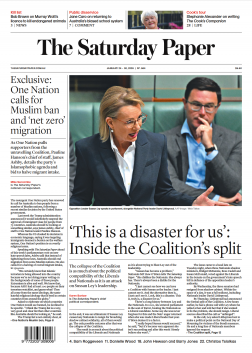
Inside the Coalition split: ‘Like washing the bear without getting its fur wet’
A sense of panic has set in inside the Liberal Party.
The Nationals’ decision to dump their commitment to net zero could see the Coalition dissolve and is also threatening the leadership of Sussan Ley. Compounding this is the worst ever Newspoll for the opposition, with a primary vote of 24 per cent.
“People are running around like they’re surprised and they’re saying things like, ‘Well, I want to keep in the tent, because it’s political suicide if we don’t, but now we might have to break up with the Nationals. Oh my God! We can’t do that!’ ” a senior Liberal source tells The Saturday Paper.
“That was always going to be the case. How could you not construct your arguments accordingly?”
Earlier this week, another Liberal told The Australian that breaking up the Coalition was a viable option after the Nationals announced their position on net zero. “They are terrorists,” the MP said. “The first rule of being a parasite is not to kill your host.”
Ley, who reminded the joint party room this week that she is a “firm coalitionist”, is under intense pressure to find an acceptable internal position on Australia’s Paris climate commitment to achieve net zero greenhouse emissions by 2050.
After a six-month process, running separately to the Nationals, the Liberal Party is expected to gather within days to settle its net zero position. Wherever the party lands, there is a strong tip the term “net zero” will be dropped.
“It would be much easier to reach that sort of a policy if we’re doing it as a Coalition, rather than the Nationals’ policies announced and released, and the websites designed and the marketing materials produced, and then where, inevitably, that becomes the anchor point, and we need to respond to that,” a moderate Liberal tells The Saturday Paper.
“The Nationals’ plan has got this sort of denialist element to it, which is very problematic for us…
“I think people hear it as ‘We don’t care about climate change. We couldn’t give a stuff. That’s not our problem.’ That’s very damaging for us across Australia, in voters under 45 and metropolitan electorates and everything else.”
Insiders say the Liberals’ policy is settling around energy prices and energy security. The party intends to continue its criticism of how Labor is handling the renewable transition, with Liberal backbencher Jane Hume referring to Labor’s energy transition as “economic sabotage” this week.
“Based on our research, support for the renewable energy transition is definitely softening,” former Liberal strategist Tony Barry tells The Saturday Paper. “There is overwhelming support in electorates for a move to renewable energy, but there are emerging and developing hesitations and concerns about that process. So, there is an opportunity for the Coalition to have a debate about that.
“But it’s going to be very difficult to win that debate when you’ve got the likes of Barnaby Joyce holding the microphone. Even if you’re on the right side of the conversation, voters will perceive you to be on the wrong side if Barnaby is singing from the same song sheet.”
Labor, he says, is trying to have a separate conversation about climate change and net zero rather than focusing on retail prices and when they will come down. “I think there’s a very big difference between the politics of energy and the physics of energy.”
Asked about the assertiveness of the Nationals on net zero and the effect that has on the Coalition, Nationals backbencher Llew O’Brien says: “I don’t care.”
The former deputy speaker, who represents Wide Bay in Queensland, says: “This is a decision I’m making, and I’ve been pursuing it and campaigning within the party for it, because it’s the right decision. Now, if the Liberals can’t do that, that’s their problem.
“Can’t follow or feel like we’re forcing them? We were forced by industry, by big organisations that we’re still going to have to deal with, like the NFF [National Farmers’ Federation].”
O’Brien says he backs coal as an energy source more than he does nuclear power but realises it will come to a point when “coal is not going to be able to be used or we run out of coal and it appears that nuclear will be the baseload power that we can lean into for generations and generations to come”.
Referring to the Liberals, he says: “I think they need to present a real alternative. And I don’t think they’re going to get back into government. I think they could disappear. I really do. The Liberals and the Nationals, if you don’t do it right.”
Another Nationals MP told The Saturday Paper that Scott Morrison held a “gun to the Nationals’ head four years ago” to support net zero. Deputy Senate leader Anne Ruston reportedly used the same language last week, when she told the Liberal leadership group, “We have a gun to our head again.”
Speaking anonymously, the Nationals MP said it was the Nationals’ turn to call the shots on net zero.
Some Liberals want Ley to stand up for the senior Coalition party, as she did the first time the Nationals tried to leave the Coalition immediately after she was elected.
“If that’s the test for policy, by holding the Coalition together, well, then you will abdicate every serious decision to the Nationals, because they will pull that card every time,” the senior Liberal source says.
“Like, are the Nationals now to dictate migration? Are the Nationals now to dictate industry policy? Are the Nationals now to dictate tax?
“If you would never, ever contemplate breaking again, well then you’ve shown your weak hand in a negotiation, in perpetuity.”
Another moderate Liberal source hopes there are ways to keep the Coalition together and keep pressure on Labor.
“There are ways that we could have attacked the government,” the Liberal tells The Saturday Paper, “but we’ve chosen instead just to go back to the sort of arguments of 10 years ago.”
Tony Barry sees this as a fight for the soul of the party. He says that’s not a bad thing, but there are pitfalls.
“Getting the politics of energy right is very difficult, and your communication strategy needs to be better than anything that the Coalition have shown in the last 10 years, especially in the last term where a lot of them confidently predicted they could sell nuclear and they failed miserably,” he says.
“I’m not sure what makes them so confident that they can properly execute this message regardless of who the lead singer is. It is a bit like washing the bear without getting its fur wet.”
Joyce, sitting outside the Nationals party room as a protest against the Nationals leader, David Littleproud, is elated that he has dragged the Coalition to this point on net zero. He says he is thinking of his home base before anyone else.
“Don’t give a stuff. Irrelevant. It’s looking after your people at home. That’s what you do,” Joyce told reporters this week, while confirming he’s still voluntarily on the outer and toying with joining One Nation.
“The position is, ‘I still believe in net zero.’ It hasn’t resolved. I’m going to keep all my cards close to my chest. That’s what’s got me here.”
A senior Nationals source tells The Saturday Paper they are enjoying seeing moderate Liberals “losing their minds”. They also point to Liberals who support the dumping of net zero, such as Andrew Hastie, Jacinta Nampijinpa Price and Rick Wilson.
Yet the fact remains there is no pathway back to government for the Coalition without the inner-city seats lost to the teal independents.
“This just makes it a lot harder, a lot harder,” a senior Liberal source says. “I think now about messaging, not policy.
“I think energy prices are central to this, but you’ve got to really undermine that headline that renewables are the cheapest form of power, because, whether that’s true or not, enough people believe it, and so you’ve got to attack that.”
For Liberal voters who turned their back on the party at the May 3 election, climate action is a core issue, alongside cost of living and housing.
YouGov polling of just over 5000 people, conducted in July for the Liberal-aligned think tank Blueprint Institute, found 52 per cent of former Coalition voters will only consider a party ready to govern if they have credible policies to address climate change and its impacts.
A similar proportion of former Coalition voters felt the Coalition did not align with their own priorities when it came to climate change.
RedBridge Group polling in September showed just 18 per cent of Gen Z voters would give first preference votes to the Coalition, while 26 per cent of Millennials would do the same.
Liberals backing the net zero commitment include Andrew Bragg, Jane Hume, Maria Kovacic, Andrew McLachlan, Tim Wilson and Dave Sharma.
Wilson has asserted that the Liberals are not “National Party-lite” and “to decarbonise is so important”. Meanwhile, Bragg has warned of Australia becoming a “pariah state” if it is seen as backing out of the Paris Agreement.
There are also a number of Liberals pondering a possible Coalition split over the issue.
“We’re always the ones, the adults sort of mopping up after them. I don’t think it’s sustainable,” the moderate Liberal MP says.
“I mean, they’re the size of One Nation. There’s four National senators. There’s four One Nation senators. If you look at their primary votes, they’re similar. They’re competing for the same group of people. And if we go down that path, that’s a recipe for us to be a fringe political movement.”
While the Liberals were routed by Labor on May 3, the Nationals held their lower house seats but lost deputy leader Perin Davey in the upper house.
They did not make further gains.
Labor retained Bendigo despite a 9.8 per cent swing to the Nationals, while the rural party did not take back Calare in New South Wales from the now independent Andrew Gee.
Price’s defection to the Liberals, as part of an anaemic leadership tilt with Angus Taylor, also took another number away from the Nationals.
A split would have its own problems, however.
The Nationals pulled that cord six months ago, formally splitting from the Coalition for the first time since the 1980s, only to sign up again after getting a number of policy gains over nuclear power, divestiture powers, telecommunications and a $20 billion regional future fund.
“It is my very, very strong preference that we remain in coalition, because we cannot form government without being in coalition with the National Party,” Liberal frontbencher James Paterson told the ABC on Wednesday.
The Nationals source suspects an unspecified number of Liberals would leave their party if the Coalition dissolved. Perhaps, they said, they would “do a Barnaby” and sit outside the party room or even further on the cross bench.
They also warned Liberals and Nationals not to ignore grassroots members who want net zero dropped. “Who will support the party to get elected?” they ask. “We don’t have the party machine that Labor has.”
For Llew O’Brien, the pathway back to government involves focusing on criticising Labor and being authentic.
“We’ve got to start telling the truth,” he says. “We’re not going to win any seats by selling a product we don’t believe in.
“I think that the percentage of people who would vote to stay with a commitment to net zero by 2050, who don’t believe in it, would be very high. And with that, you’re never going to get back to government, selling something you don’t believe in. That’s the reality of it. We’ve got to come to a position where we are united behind a policy position.”
He says this is particularly pressing for the Liberals.
“They believe in smaller governments, free markets. We have to regulate everything to reach net zero, whether it’s to do with reporting on emissions or achieving reductions, it is a massive increase. Now they want to present as an alternative to Labor, and that’s the way to get back into government.”
This article was first published in the print edition of The Saturday Paper on November 8, 2025 as "Inside the Coalition split: ‘Like washing the bear without getting its fur wet’".
For almost a decade, The Saturday Paper has published Australia’s leading writers and thinkers. We have pursued stories that are ignored elsewhere, covering them with sensitivity and depth. We have done this on refugee policy, on government integrity, on robo-debt, on aged care, on climate change, on the pandemic.
All our journalism is fiercely independent. It relies on the support of readers. By subscribing to The Saturday Paper, you are ensuring that we can continue to produce essential, issue-defining coverage, to dig out stories that take time, to doggedly hold to account politicians and the political class.
There are very few titles that have the freedom and the space to produce journalism like this. In a country with a concentration of media ownership unlike anything else in the world, it is vitally important. Your subscription helps make it possible.
Subscriber exclusive
Send this article to a friend for free.
Share this subscriber exclusive article with a friend or family member using share credits.