Comment
Paul Bongiorno
An Australian coup: Reflecting on Whitlam’s dismissal
It is not true that Australia has never experienced a revolution. Fifty years ago, the nation saw a bloodless coup where the underpinning conventions of our parliamentary democracy were overthrown. The outrage of the Dismissal established dangerous precedents, and in the intervening years we have failed to put in place safeguards that would prevent it happening again.
The 1999 republic referendum, while it would have made our head of state “one of us”, nevertheless left untouched the so-called “reserve powers” that Sir John Kerr used to dismiss the Whitlam government. Until that fateful November day, they had fallen into disuse, a vestige of absolute monarchy discarded in Westminster itself.
In London, the parliament has long established its precedence over the Crown. It needs only to pass legislation rather than go to referendum to even determine the monarchy’s continued existence.
The Australian parliament has no such ability. It is constrained by the legacy of our colonial past, which we have proved unwilling to modernise. We are left to accept whatever accident of birth a British family of the Anglican faith presents us as our head of state.
In 1911 and 1949, the British parliament curtailed the upper house’s ability to block supply. It can delay money bills but not defeat or amend them. There could be no dismissal in Britain such as we saw here in 1975.
Former Liberal prime minister and republic advocate Malcolm Turnbull says it would have been better for Anthony Albanese to keep open the prospect of revisiting the issue rather than ruling it out for the rest of his prime ministership.
That was certainly the impression Albanese gave after visiting King Charles at Balmoral Castle in September. He said on Insiders he had made it clear he wanted to hold one referendum while he was prime minister, “and we did that”.
Albanese avoided answering whether that meant “the entire time you are prime minister”. There was good reason for that: The Saturday Paper understands this is not his thinking. He still supports “an Australian as our head of state”, and he says the king knows that, but his priority is “concentrating on cost of living and on making a real, practical difference to people’s lives”.
Beyond the next election, there is nothing locked in either way.
Historian Jenny Hocking is hoping Albanese might then open up the conversation to addressing the weaknesses in the Constitution that allowed Kerr to act contrary to the spirit of our constitutional monarchy. If Kerr could get away with it, like-minded successors in the role can also.
Up in smoke are the principles spelt out in the 19th century classic The English Constitution by Walter Bagehot.
David Pallister, writing in The Guardian, said Bagehot’s work was based on the Magna Carta (1215), the Bill of Rights (1689) and the Act of Settlement (1701), all of which curtailed the power of the Crown and concluded the monarch had three rights: “to be consulted, to encourage and to warn”. He also advised reticence.
Kerr studiously avoided the first three principles but applied the fourth by remaining schtum in Gough Whitlam’s regard.
The governor-general deceitfully handled the political crisis engineered by the opposition, which was refusing supply in the Senate to force an election they were very confident of winning.
At no stage did Kerr warn Whitlam he was seriously considering terminating his commission. According to John Menadue, who was secretary of the Department of the Prime Minister and Cabinet at the time, Kerr told Whitlam the opinion of then shadow attorney-general Bob Ellicott, that he should sack the prime minister, was “bullshit”.
This was of a piece with his deception of Whitlam that he was a “Labor man”.
Hocking’s research of the archives uncovered an unpublished Kerr manuscript with the delusional title “Triumph of the Constitution”, where he wrote that as the years passed he became “more conservative”. He went on to say that although he did not join the Liberal Party, “I supported that party and not the Labor Party within which Whitlam was growing in power”. He thought Whitlam was “too much of a political smart alec”.
Kerr smashed the convention that the constitutional monarch or their substitutes in the realms take formal advice from their principal adviser, the democratically elected prime minister who has the confidence of the House of Representatives.
Kerr instead looked to the queen’s private secretary, Sir Martin Charteris, in voluminous correspondence, who did nothing to encourage him to act as he knew the queen herself was obliged to act and heed the advice of his prime minister.
Kerr ignored the separation of powers and looked to two High Court judges, Sir Anthony Mason and chief justice Sir Garfield Barwick, who improperly usurped Whitlam’s prerogatives and encouraged the governor-general in his course of action.
In Mason’s case, he even advised Kerr to ignore the speaker of the house, who came to advise him that the newly installed Fraser government lacked the confidence of the House of Representatives.
This leaves a dangerous precedent unchecked. Are governments not to be formed by the leader with majority support in the lower house if the unelected occupant of Government House, acting like a tyrant, doesn’t like that leader?
Kerr refused to recognise that Whitlam, with the confidence of the House, should have at least gone to the election as prime minister.
Four days after this constitutional earthquake, Whitlam travelled to Wollongong to fulfil a planned attendance at a multicultural event in the town hall. I was assigned by my editor at WIN Television news to cover the event.
After I’d introduced myself, the sacked prime minister agreed to an interview and began by declaring: “There has been a coup d’état. You know, in Italian: a colpo di Stato.” He went on to speak of an illegitimate seizure of power.
At that point Whitlam was buoyed by the opinion polls, which found the Fraser opposition’s year-long lead over the Labor government had evaporated the longer the supply crisis played out. The judgement of the people was against Malcolm Fraser’s opportunistic disruption of the machinery of government. Once that crisis was resolved, however, the Whitlam government’s chaos, forced ministerial resignations and the loans affair, all amplified by media hostility, took their toll.
Many missed this two-step play, thinking the Fraser landslide legitimised Kerr’s outrageous deception and disruption.
Fraser was recklessly impatient and never recovered personally from the way he took power in 1975. Had he waited, there would have been no cloud over what was shaping as a handsome victory at the next election.
Blocking supply has rightly become a political taboo, but not for everyone. Pauline Hanson and her three colleagues in the Senate sought to move an amendment to the government’s Appropriation Bills during this sitting fortnight, blocking supply until “all funding for net zero measures and the administration of net zero measures” is removed. Apart from 24 abstaining Coalition senators, everyone else in the Senate voted down this irresponsible stunt.
Former prime minister Paul Keating, at a forum on Monday discussing Troy Bramston’s newly released biography of Gough Whitlam, observed any new push for a republic that improves our Constitution can only come if a prime minister puts it back on the agenda.
At the time of the 1999 referendum, then Liberal treasurer Peter Costello was of the opinion that only a Liberal prime minister could achieve such a constitutional change. John Howard was handed that chance on a plate by his Labor predecessor, Keating. Instead of seizing it, Howard took it as an opportunity to stymie the project indefinitely. He asked a loaded question, says Keating. He, like former opposition leader Kim Beazley, believed the 1999 republic “was in the hands of its enemies”.
Howard, unlike Costello and other Liberal republicans, saw Keating’s republican campaign as a cynical partisan exercise to divide his side of politics. Instead, what it did was to reveal how deep the sentiment is in this country for our own head of state across party lines.
Malcolm Turnbull, along with former New South Wales premier Neville Wran and others, co-founded the Australian Republican Movement in 1991. It is now called the Australian Republic Movement, to ensure no confusion with Donald Trump and his Republican Party.
Keating turned to Turnbull in 1993 to chair a Republic Advisory Committee, to examine the different models for a republic and advise accordingly. After nationwide focus groups and consultation, they came up with a parliament-appointed president. They had not counted on those in favour of a directly elected president not only being unhappy but playing an actively disruptive campaign against it on the naive presumption a second referendum would be held within a few years to suit their preference.
Turnbull now thinks the best way forward is still the one outlined in his autobiography, A Bigger Picture. Before the next referendum there should be a plebiscite that offers a choice between direct election and parliamentary appointment. Once that is resolved, the constitutional amendment to be put in a referendum would incorporate the mode of election chosen in the plebiscite.
Turnbull says that’s the best chance “of ensuring our head of state is, at last, one of us”.
It certainly gives Albanese something to think about after the next election.
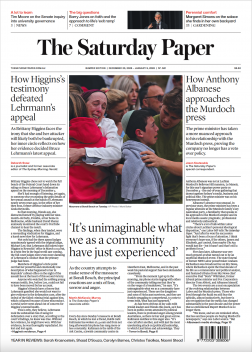
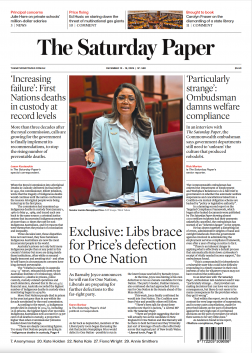
This article was first published in the print edition of The Saturday Paper on November 7, 2025 as "A coup on the steps of parliament".
For almost a decade, The Saturday Paper has published Australia’s leading writers and thinkers. We have pursued stories that are ignored elsewhere, covering them with sensitivity and depth. We have done this on refugee policy, on government integrity, on robo-debt, on aged care, on climate change, on the pandemic.
All our journalism is fiercely independent. It relies on the support of readers. By subscribing to The Saturday Paper, you are ensuring that we can continue to produce essential, issue-defining coverage, to dig out stories that take time, to doggedly hold to account politicians and the political class.
There are very few titles that have the freedom and the space to produce journalism like this. In a country with a concentration of media ownership unlike anything else in the world, it is vitally important. Your subscription helps make it possible.
Subscriber exclusive
Send this article to a friend for free.
Share this subscriber exclusive article with a friend or family member using share credits.