Film
James Sweeney’s second film, Twinless, is a joy – its unexpected twists revealing a dazzlingly assured filmmaker. By Christos Tsiolkas.
Twinless buzzes with comic energy and tension
Watching James Sweeney’s sophomore feature film, Twinless, is akin to gazing up at a tightrope walker, your heart in your mouth, as they dare to take more and more precarious and remarkable risks. As soon as this taut, economical film finished, at just under 100 minutes – which itself seems miraculous in today’s bloated Hollywood and Hollywood-adjacent cinema – the audience burst into spontaneous, warm applause.
The roller-coaster energy of the film comes from Sweeney’s teasing of the audience, first making us think we are in for a gentle slice-of-life indie drama before adeptly, puckishly, leading us into much darker terrain. What initially seems to be a queer romantic comedy or a good-natured buddy movie of a friendship between a straight man and a gay man suddenly turns into a film about the corrosiveness of obsession. When the rug is pulled from under us, it is a powerful, visceral shock.
The dissonance set up from the very beginning of Twinless – the conflict within perception, the difference between what we see and what we hear – is key to the film’s success. So much of its pleasure comes from its unexpected turns, the leaps it makes between narrative and point of view, that it would be churlish to give away too much of the plot.
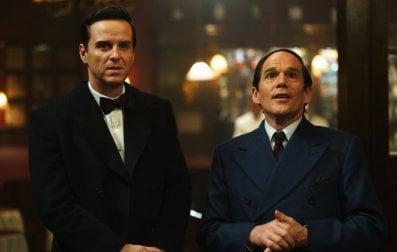
The film starts with a car accident, which we hear off-screen, and very quickly we learn the pedestrian killed in that accident was Rocky, the twin brother of Roman. (Both parts are played by Dylan O’Brien.) The distraught Roman, who is rootless and prone to depression, joins a support group for twins whose siblings have died. There he meets Dennis, played by Sweeney, who has also lost his brother. The men are both shy and awkward in social situations and they very quickly form a friendship. Though Roman is straight and Dennis is gay, the bond formed through their mutual grief lures each of them into making the other the centre of their world. We begin to wonder: who is falling in love with whom?
Apart from directing the film and acting in it, Sweeney also wrote the screenplay. It’s smart and confident, unafraid to both interrogate and poke fun at contemporary sexual and gender morality. Sweeney’s assuredness is also evident in his seemingly offhand nods to Alfred Hitchcock’s Vertigo and Brian De Palma’s Sisters. As the film continued and I became more engrossed in the narrative shifts and turns, it became apparent that Sweeney’s choices are far from accidental.
The tension in the developing friendship between the men, countered by our increasing awareness of the betrayals and deceits undergirding their relationship, is acutely gripping. Like Hitchcock and De Palma, Sweeney has a vivid talent for the blending of comedy and suspense. And like them, Sweeney has a perverse sensibility and is unafraid of revealing the sinister shadows that underlie sexual fixation. As with James Stewart in Vertigo or Margot Kidder in Sisters, we come to understand that those characters who appear the most innocently likeable can become monstrous when desire becomes obsession.
The writing and directing in Twinless is dazzlingly self-possessed. However, Sweeney’s performance as Dennis sometimes feels inexpert. He has a winning geniality in his early scenes, but his playing of the role risks seeming a little one-note as the story becomes darker and more emotionally intricate. Yet even here, Sweeney reveals the aptness of his filmmaking intuition. He frames Dennis in shots that suggest mirroring – even the magical giddiness of optical illusions – and reinforce the film’s playing with the themes of twins and submerging of identities. He and his editor, Nikola Boyanov, are skilful and judicious in the reaction shots they use to convey Dennis’s state of mind. This makes our attention on Dennis almost forensic and the increasing isolation of the character mitigates the clumsiness of the performance.
Sweeney’s not an amateur when it comes to his talent in directing actors. Lauren Graham, who plays Lisa, Rocky and Roman’s mother, is in only a few scenes, but she is given the space to fully inhabit her character. Her portrayal of a working-class woman wearied by life and now by the burden of grief is unsentimental, prickly. She has real presence. As has Aisling Franciosi as Marcie, Dennis’s work colleague and Roman’s girlfriend. Marcie’s sweetness never becomes cloying. Franciosi makes us believe in a core of toughness to her character.
Sweeney’s attentiveness is evident in the directing of even the smallest role. Cree Cicchino is outstanding in one scene where in the support group she gives vent to the anger of grief, and also to the resentment and derision twins sometimes feel towards those of us who are not twins. That scene felt shockingly new, an expression of an emotional state rarely revealed in cinema.
The stand-out performance is by Dylan O’Brien. Roman is emotionally charged yet largely inarticulate. O’Brien makes us sense the rage of his anguish at losing his twin, and also the weight of responsibility and guilt that attends any unexpected death. There’s no flashiness in his portrayal of the surviving twin, no unnecessary emoting. We also see him as Rocky in flashbacks, and in a few, sharp scenes he also manages to paint a vivid portrait of a subtly different man. Rocky is educated and more sociable and vainer than his twin. O’Brien also makes us believe the intricate bond between the brothers, conveying their estrangement and convincing us of their love.
There are two upsetting moments of violence in Twinless. The first unsettles us because we desire it as a response to ugly homophobia. The second moment comes from the film’s most sympathetic character, and the violence reveals his failures. As with everything in this intelligent, intricate film, the twinning of these two scenes is no accident. By the end we are left in no doubt about the ugliness of violence, yet Sweeney also challenges us to see how lies and acts of manipulation have their own equivalent brutal consequences.
There’s so much comic energy in Twinless that the underlying seriousness with which the filmmakers deal with the intricacies of human relationships continues to resonate with me long after I left the screening. It’s brave writing and brave filmmaking.
I also think it brave of the director to essay a queer character who can be destructive and morally suspect. Sweeney, who is gay, knows that in Hitchcock’s and De Palma’s films, queerness was often aligned with malevolence. I don’t mean this as an attack on the work of either of those filmmakers. One of the delights of watching Hitchcock’s Rope or Strangers on a Train, or De Palma’s Sisters or Dressed To Kill, is appreciating how those filmmakers hid their queer characters in plain sight and how often these characters had the most potency and vividness.
Sweeney, who is only 35 years old, is of a generation that doesn’t need the subterfuges of evasion and secret codes to explore the complexity of our emotional and sexual lives. That which is malign in Hitchcock and De Palma remains so in Twinless, but it is no longer the sole defining feature of a character. There’s something bracing in Sweeney being unafraid to deal with the often tortuous and hostile ways in which a gay man reacts to his awareness that he is falling in love with a straight man. This is especially so when the two share so much else in common: they might very well be “twins” in every way except in how they experience desire. This is difficult, unexplored terrain. That Sweeney deals with it without earnestness, with wit, graciousness and clarity, makes the film a joy to watch.
The sensibility at work in Twinless feels so unique that the impulse is to assume it is autobiographical. I think that would be a mistake. Its playful gentleness with genre, the conviction and humour in the writing, suggests Sweeney’s originality is not a one-off. The film is always surprising, sometimes disturbing and never less than dazzling. He’s got talent and he’s got imagination. I can’t wait to see what Sweeney does next. That goes for O’Brien as well.
Twinless is screening in cinemas nationally.
ARTS DIARY
VISUAL ART Artists with Conviction – Jail Birds
Good Grief Studios, nipaluna/Hobart, until November 20
EXHIBITION Paola Pivi – I Don’t Like It, I Love It
Art Gallery of Western Australia, Whadjuk Noongar Country/Perth, until April 26
CULTURE Our Story: Aboriginal–Chinese People in Australia
National Museum of Australia, Ngambri/Canberra, until January 27
SCULPTURE Yasmin Smith: Elemental Life
Museum of Contemporary Art, Gadigal Country/Sydney, until June 8
THEATRE Dying: A Memoir
Fairfax Studio, Naarm/Melbourne, until November 29
LAST CHANCE
FESTIVAL Melt Festival
Venues throughout Meanjin/Brisbane, until November 9
This article was first published in the print edition of The Saturday Paper on November 8, 2025 as "Double trouble".
For almost a decade, The Saturday Paper has published Australia’s leading writers and thinkers. We have pursued stories that are ignored elsewhere, covering them with sensitivity and depth. We have done this on refugee policy, on government integrity, on robo-debt, on aged care, on climate change, on the pandemic.
All our journalism is fiercely independent. It relies on the support of readers. By subscribing to The Saturday Paper, you are ensuring that we can continue to produce essential, issue-defining coverage, to dig out stories that take time, to doggedly hold to account politicians and the political class.
There are very few titles that have the freedom and the space to produce journalism like this. In a country with a concentration of media ownership unlike anything else in the world, it is vitally important. Your subscription helps make it possible.
Subscriber exclusive
Send this article to a friend for free.
Share this subscriber exclusive article with a friend or family member using share credits.