Books
Katherine Brabon
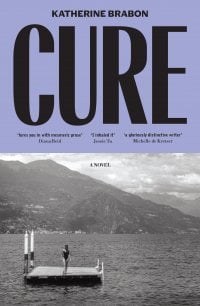
Cure
The human is an imperfect creature. We are stuck with bodies that are vulnerable to time, prone to all kinds of confusing desires and assailed by illness and fallibility. With the technology of social media, however, we can imagine ourselves – or have ourselves imagined – otherwise: with the unblemished skin of a Kardashian; with the dietary discipline of a paleo influencer; with our domestic lives curated into Instagram perfection. This is the premise behind Australian writer Katherine Brabon’s fascinating fourth novel, Cure.
Brabon’s novel switches between the perspectives of two characters. The first is Vera, who works in online marketing, constructing the kind of fantasy identities that shape consumer desires. While that job might be assumed to give her some kind of immunity, Vera is entirely consumed by the virtual, relying on the internet for advice when it comes to falling pregnant, bringing up her child and managing an autoimmune disease. “She was an educated woman, she believed in science, she valued rationality. Yet there was a question of how strong those qualities really were when squared up against one’s desperation and our desires.”
The second character is Vera’s teenage daughter, Thea, who also has an autoimmune disease and who has been brought to Italy by her mother to seek a cure from a faith-healer. While Vera attempts to manage Thea’s body as if it were her own, Thea keeps a journal in which she imagines a life free of her mother’s control. Both mother and daughter, albeit separately, fantasise about the possibility that “a person could be simply a beautiful idea, an attractive story, no matter how real or false the flesh”.
Vera and Thea are like doubles of each other. They are also twinned with virtual selves: in Vera’s case, an online blogger; in Thea’s, a romanticised teenage self. Their ghostliness is emphasised in other ways too, including by the distinctive analytical distance of the third-person narration. The characters haunt a historic house in Italy’s lake district, sometimes in nightgowns, as they wait for the promised trip to the faith-healer.
Because of this stalling – between ill-health and cure, between the messy reality of life and the perfect illusion of it – the novel lacks a propulsive plot. However, it more than makes up for it in the brilliant meditation on the self that it offers. Brabon’s Cure is an eminently “relatable” novel, representing how many of us understand our lives through online simulacra, but it is also a novel of ideas, offering a philosophical antidote for the condition it diagnoses.
Ultimo, 256pp, $34.99
This article was first published in the print edition of The Saturday Paper on July 5, 2025 as "Cure".
For almost a decade, The Saturday Paper has published Australia’s leading writers and thinkers. We have pursued stories that are ignored elsewhere, covering them with sensitivity and depth. We have done this on refugee policy, on government integrity, on robo-debt, on aged care, on climate change, on the pandemic.
All our journalism is fiercely independent. It relies on the support of readers. By subscribing to The Saturday Paper, you are ensuring that we can continue to produce essential, issue-defining coverage, to dig out stories that take time, to doggedly hold to account politicians and the political class.
There are very few titles that have the freedom and the space to produce journalism like this. In a country with a concentration of media ownership unlike anything else in the world, it is vitally important. Your subscription helps make it possible.
Purchase this book
Cure
BUY NOW
When you purchase a book through this link, Schwartz Media earns a commission. This commission does not influence our criticism, which is entirely independent.
Subscriber exclusive
Send this article to a friend for free.
Share this subscriber exclusive article with a friend or family member using share credits.