News
The focus on a PM meeting with the US president ignores the realities of his chaotic stance on trade and greatly overstates its significance, insiders say. By Karen Barlow.
‘Pissed uncle at Christmas’: Inside Trump’s trade push
The inside joke of the recent gathering of G7 nations in Canada was that it was a summit of the “group of six plus one”.
“So, the world is just engaging, getting on with things. And then there’s this other guy who, you know, is like the uncle at Christmas time who’s arrived pissed, and you don’t know what they’ll do, because they’re erratic,” a senior Australian government source tells The Saturday Paper.
Donald Trump’s early departure from the international summit was a particular inconvenience for Australia last month, as it meant the cancellation of Prime Minister Anthony Albanese’s planned meeting – his first face-to-face encounter with the re-elected United States president. High on Albanese’s list of discussion topics was a case for waiving tariffs on Australian goods and confirmation of a commitment to the AUKUS nuclear-powered submarines deal.
Six months into the second Trump administration, which has so far upended global trade and security relations with the US, the media and opposition have made much of the prime minister’s struggle to secure an audience with the president, beyond three phone calls. Those with insight into relations with the US say Albanese is taking the realities in his stride.
“It is what it is. Donald Trump is unpredictable. You can come to agreements. He’ll change them a day later,” a senior government source says. They point out that the impact on Australia of Trump’s tariffs has been minimal – the US is not Australia’s top trading partner – and out of proportion to the immense focus on the relationship with Trump himself.
“Out there punters just think, ‘Yep, he’s a weirdo.’ Some [are] thinking he’s crazy. No one particularly likes him and, like, it is what it is.”
As Trade Minister Don Farrell pointed out to The Saturday Paper last month, the pressure is on the US to strike deals with all its trading partners before Trump’s full round of tariffs – which have attracted much concern from US businesses, economists and in financial markets – are supposed to take effect. The deadline Trump set for “90 deals in 90 days” is July 9, and so far only the United Kingdom and Vietnam have announced agreements. Having already postponed the higher levies once, the US president says he is not thinking of extending the July 9 deadline.
“The rest of the world is just sort of moving around it [and has] factored it in: ‘Well, there’s this thing happening and we can’t do much about it, so we’ll just keep going,’ ” the senior government source says.
That appears to be the only option for the Australian government as it navigates a changed relationship with its most powerful ally. The case for an exemption from the 10 per cent tariff on all Australian exports and a 50 per cent tariff on steel and aluminium – which rests on our decades-long free trade agreement and large trade deficit with the US – is yet to have any impact. It’s in part because the channels that officials are trying to ply are very much altered under Trump’s second administration.
The official channels to the White House, the National Security Council and the State Department are ministers and the embassy, led by current ambassador and former prime minister Kevin Rudd.
Potentially more influential, however, is the close coterie that Trump relies on: friends, donors and Florida-based golfing greats such as Greg Norman. Tabs need to be kept on who is currently in and who is out of the sphere of influence.
“The Australian system has to adapt to the new world we’re in under Trump 2.0,” former Australian ambassador to the US Arthur Sinodinos tells The Saturday Paper.
“Which means that some of the norms of statecraft in terms of how things get done, how we establish meetings and such, has to be done in newer, more creative ways to gain the president’s attention.”
Already this administration is experiencing a marked increase in churn in places such as the National Security Council, and not all positions have been filled in the departments that Australian officials deal with. Moreover, Trump and his administration have been operating at warp speed since his January 20 inauguration.
An in-person meeting with Albanese has not so far made his list of priorities. The US president skipped the planned meeting on the sidelines of the G7, saying he was returning to Washington to deal with the Middle East crisis.
An update on a rescheduled meeting between the two leaders was hoped for from this week’s bilateral discussions between US Secretary of State Marco Rubio and Australian Foreign Affairs Minister Penny Wong in the US capital. So far the status is still at “we’re working on it”.
“I was very grateful that the secretary again expressed his regret” over the missed meeting, Wong told reporters.
“I explained to him we perfectly understood why the president had to leave given the circumstances and we agreed that we will reschedule this meeting, and we both look forward to the leaders meeting.”
There’s been a “massive over-read of everything” amid wars and other strife, according to the senior government source.
“Trump hasn’t snubbed Australia or snubbed the prime minister,” the source says. “As if Trump’s getting up in the morning and going, ‘Okay, now, what will we do with Australia today?’ It’s just absurd.
“Everyone’s just adjusting to the new world.”
One diplomatic source is reminded of a line from Henry Kissinger in the 1990s, when the former US secretary of state told Australian reporters, “When I’m shaving in the morning, I’m not thinking about Australia’s foreign policy.”
Nevertheless, the source says, public expectations of the handling of the Australia–US alliance must be carefully managed.
“Public perceptions get moulded by media. They get moulded by the commentary that others make, and then what’s happening at the moment is people are putting it together with some of our ambivalence around defence spending. It took a day for a statement to come out on the US strikes on the Iranian nuclear sites,” the diplomatic source says.
“I mean, yeah, sure, people can over-read things. On the other hand, they’re putting it all together and saying, ‘Well, how much energy or urgency are we putting in at the prime ministerial level in getting this done?’”
Much has been made about the importance of face time with Trump, given his emphasis on personal relationships. The UK prime minister, Keir Starmer, appears to have had relative success. Starmer was the first leader to strike a trade deal with the US – though even it is in doubt.
The US reached a somewhat messy agreement with the UK in early May to slash some of Trump’s threatened tariffs on cars, aluminium and steel. A baseline 10 per cent tariff on most British goods remains in place.
“The British deal is just total nonsense. Which is, the Americans stuck at their 10 per cent. Remember, they had 10 per cent already, so that wasn’t negotiated, then they got nothing out of that. None of that came down,” Justin Wolfers, a professor of economics and public policy at the University of Michigan and member of the Congressional Budget Office Panel of Economic Advisers, tells The Saturday Paper.
“Basically, Trump was under a lot of pressure because the drumbeat “90 over 90 days” was adding up and you had nothing to show for it.
“Keir Starmer was asked, ‘Did you expect to be announcing a deal today?’ And he said, ‘No – in fact, the call came in while I was watching the Arsenal football match.’
“The second thing is, if you actually look at the text of the deal, the final name – and I kid you not – is something like final one, revision two, dash, revision dash, final dash, underscore, final, final. It’s real night-before homework stuff. The other teller, of course, is it wasn’t actually a deal. It was a so-called framework for a deal. Now they did subsequently turn it into a deal, but there really, really, really, is not much there.”
On Thursday, the Trump administration announced a trade deal with Vietnam, which recently expedited a $1.5 billion Trump family business golf club outside Hanoi.
The agreement cited 20 per cent tariffs on many of Vietnam’s exports – a rate lower than the 46 per cent tariffs set for the South-East Asian nation in April but higher than the 10 per cent baseline impost.
Any trans-shipments from third countries through Vietnam would face a 40 per cent levy, but beyond that, details are scarce.
The progress made so far – or lack thereof – is already revealing of this transactional president’s approach. Says Wolfers: “He’s barely thinking about Japan, which is an enormously important country and trading partner.
“And then there’s the other problem, which is, what could we offer the bloke? We have a free trade agreement with him and we have a trade surplus from the American side; like, he’s got everything he wants.
“I actually think we know the answer. They’d ask for something about beef, because the trade representative seems to have an obsession with Australian beef. The idea, of course, that a country like Australia – which produces way more beef than it eats and produces the world’s best beef – is a natural market for American beef is the stupidest fucking thing I’ve ever heard.”
The norms of trade deals are also being undone, which means the current deals are not robust.
“It’s all done through executive order, everything Trump’s doing, which means that not only could Trump undo it tomorrow, but if a Democrat wins the White House, they will definitely undo it the next day,” Wolfers says.
“So normally, these things you put up, you try and cement them as much as you can, so that everyone understands this is going to be around for 50 or 100 years, and Trump is doing none of that work.”
The strategy is to keep talking with the “adults still in the room” in the US – such as Treasury Secretary Scott Bessent and Secretary of State Marco Rubio.
A source says last week’s U-turn on a proposed 15 per cent “revenge” tax on overseas investors in the US is a sign that those “adults” are getting traction. The section was dropped from Trump’s “One Big Beautiful Bill” after another deal was struck with European trading nations.
Some US congressional representatives had argued that the proposal would deter foreign investment. Treasurer Jim Chalmers also petitioned Bessent, in their third conversation, on behalf of Australian investors such as super funds and the Future Fund.
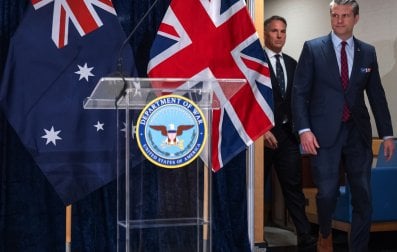
Sinodinos says Albanese must now build some kind of rapport with his counterpart, to push Australia’s case on key issues including the $368 billion deal for nuclear submarines, which is currently under a 30-day review by the Pentagon.
“Since the Australian election was concluded, it’s been imperative for the prime minister to meet personally with the president to establish a relationship,” says Sinodinos, who is now the chair of The Asia Group’s Australian arm.
“[He must] be able to speak with him face to face about the trade matters and the fate of AUKUS – and to hear it directly from the president what he thinks about AUKUS – whether he’s willing to make concessions on trade, recognising the value we bring to the table, including in areas like critical minerals.”
Those advantages are compelling, says the senior government source.
“What we offer the US alliance is presence in the region that no one else can. Pine Gap, everything else that we offer, the bases, the presence of the marines in Darwin, the fuel reserves that are there, the potential submarine base effectively in the West. It’s substantial.”
Wolfers says these are undeniably assets in the relationship, but Australia’s only real leverage is in threatening to remove them.
“Well, are we prepared to walk away from it? Because if not, then it’s not table stakes,” he says. “If we were willing to make those allowances contingent, then they would be relevant to negotiation. But even Trump understands, if I have it either way, then that’s called a present, not a chip.”
The pressure remains on Albanese, who has the return of parliament on July 22 before the international summit season in the second half of the year.
This article was first published in the print edition of The Saturday Paper on July 5, 2025 as "‘Pissed uncle at Christmas’: Inside Trump’s trade push".
For almost a decade, The Saturday Paper has published Australia’s leading writers and thinkers. We have pursued stories that are ignored elsewhere, covering them with sensitivity and depth. We have done this on refugee policy, on government integrity, on robo-debt, on aged care, on climate change, on the pandemic.
All our journalism is fiercely independent. It relies on the support of readers. By subscribing to The Saturday Paper, you are ensuring that we can continue to produce essential, issue-defining coverage, to dig out stories that take time, to doggedly hold to account politicians and the political class.
There are very few titles that have the freedom and the space to produce journalism like this. In a country with a concentration of media ownership unlike anything else in the world, it is vitally important. Your subscription helps make it possible.
Subscriber exclusive
Send this article to a friend for free.
Share this subscriber exclusive article with a friend or family member using share credits.