Books
Amy Taylor
Ruins
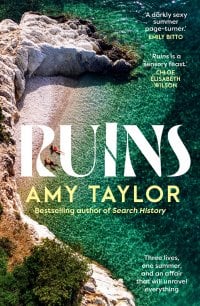
Emma and Julian, two British citizens, take a brief vacation in Corfu before extending their time in Greece with a three-month working holiday in Athens. The couple are also renegotiating their identities in the wake of a miscarriage. While Julian is convinced they’ll try for another child, Emma feels secretly relieved. A professional woman, she never really wanted to sacrifice her freedom. When Emma sees Julian dancing with another woman at a bar, she finds herself fantasising about watching him have sex with someone else. She sets about making her erotic dreams come true. Reality – or at least a melodramatic version of it – intrudes on Emma’s fantasy in ways I won’t give away, for the novel I’m describing, Amy Taylor’s Ruins, is very much plot-driven.
To describe it thus is not to cast aspersions. Taylor, as demonstrated by her debut novel, Search History, has a keen eye for a story that’s compelling and “relatable” – an omnipresent descriptor nowadays, despite clashing with that other popular catchphrase, “diverse”. Taylor also has an interest in a bigger picture – a world in which class determines fate and the environment is destroyed by corrupt corporations – though not in a way that would compromise the enjoyment of her readers, if that’s not what they’re into. The author also incorporates references to Greek philosophy and Greek tragedies, but these are likewise delivered with a light touch.
Julian himself is a philosopher, living his dream in the heartland of Western philosophy, but he’s also a dream man in the romantic sense: young, handsome, astonishingly affable and sensitive, good in the sack, with a trust fund to boot. Emma’s boredom with her husband’s work – she skips out on a dinner party at which he and his academic friends are debating the work of the French philosopher Guy Debord – gives readers permission to tune out of that aspect of his character too. Indeed, the story follows Emma to a bar, where she meets the young Greek woman, Lena, who aids Emma’s voyeuristic fantasy.
This is no novel of ideas, but the author does leave an ingenious trail of breadcrumbs embedded in the story for interested readers to pick up. These include references to Exarcheia and Eleftheria, names associated with the left-wing political scene in Athens. These work to trouble the privileged fantasy that’s being played out, as does the increasingly complicated and problematic plot. Ultimately, though, you’ll get out of this book whatever you want, whether that’s a holiday read or something a little more thought-provoking.
Allen & Unwin, 352pp, $32.99
This article was first published in the print edition of The Saturday Paper on August 2, 2025 as "Ruins".
For almost a decade, The Saturday Paper has published Australia’s leading writers and thinkers. We have pursued stories that are ignored elsewhere, covering them with sensitivity and depth. We have done this on refugee policy, on government integrity, on robo-debt, on aged care, on climate change, on the pandemic.
All our journalism is fiercely independent. It relies on the support of readers. By subscribing to The Saturday Paper, you are ensuring that we can continue to produce essential, issue-defining coverage, to dig out stories that take time, to doggedly hold to account politicians and the political class.
There are very few titles that have the freedom and the space to produce journalism like this. In a country with a concentration of media ownership unlike anything else in the world, it is vitally important. Your subscription helps make it possible.
Purchase this book
Ruins
BUY NOW
When you purchase a book through this link, Schwartz Media earns a commission. This commission does not influence our criticism, which is entirely independent.
Subscriber exclusive
Send this article to a friend for free.
Share this subscriber exclusive article with a friend or family member using share credits.