News
US senators are siding with the country’s drug industry to demand that trade deals attack subsidies such as Australia’s scheme, a letter to the administration reveals. By Jason Koutsoukis.
Exclusive: Australia to engage US lobbyists to defend PBS
Australia’s Pharmaceutical Benefits Scheme is squarely in the crosshairs of United States Republican senators and the American pharmaceutical industry, who are ramping up pressure on the Trump administration to end what they describe as global “free-riding” on American-funded drug innovation.
At stake is the future of the PBS, a system that has long delivered Australians some of the cheapest prices for medicines in the developed world and which now risks becoming a casualty of a broader US effort to recast global pharmaceutical pricing through trade leverage.
In a move that will increase pressure on the Albanese government as it works to shield Australian exports from rising US tariffs, 18 Republican senators last month signed a letter to United States Trade Representative (USTR) Jamieson Greer and Secretary of Commerce Howard Lutnick urging the Trump administration to use trade negotiations to dismantle foreign price controls on medicines.
The Albanese government now faces intensifying pressure on two critical fronts: trade and security. As US lawmakers and pharmaceutical lobbyists push Australia to lift PBS medicine prices under the guise of tariff negotiations, a parallel challenge has emerged in defence.
The Pentagon’s AUKUS review, spearheaded by hawkish Pentagon official Elbridge Colby, questions whether Australia is spending enough on its military to justify the alliance’s next phase. Both disputes stem from the same strategic demand – that America’s allies pay their own way, whether it’s in the cost of medicines or submarines.
For the Albanese government, the price of tariff relief may now include concessions on pharmaceutical pricing, just as the future of AUKUS may hinge on a multibillion-dollar lift in defence spending.
While the US senators’ letter does not name Australia or the PBS specifically, it frames national subsidy programs like the PBS as market distortions and non-tariff barriers, and calls for binding commitments to force countries to “appropriately value” American-made drugs.
The letter – which was signed by nearly one third of the US Republican Senate caucus, including senior lawmakers Lindsey Graham and Charles E. Grassley – reinforces President Trump’s May 12 executive order directing US officials to ensure that Americans pay no more for medicines than people in other wealthy countries by linking US prices to the lowest prices paid elsewhere.
The policy, known as a “most favored nation” approach, could see US drug prices pegged to those in lower-cost countries like Australia – meaning that American health insurers could demand the same low prices that patients receive here through the PBS.
To avoid this, US pharmaceutical companies could delay launching new medicines in Australia or refuse to sell their drugs to this country, on the basis that low Australian prices could undercut their profits in the far more lucrative US market. Alternatively, US pharmaceutical companies could try to force the Australian government to pay more for medicines that are listed on the PBS.
“For too long, some developed nations have benefited from American-financed innovation by implementing policies that suppress prices and limit spending on new medicines in their own markets,” the letter said. “These actions have contributed to American patients bearing a disproportionate share of global pharmaceutical innovation costs. U.S. trade negotiations offer a valuable mechanism to address these unfair practices, which not only burden Americans, but also function as non-tariff barriers to trade.
“Currently, dozens of countries – including those with longstanding pricing policies affecting U.S. pharmaceutical products – have expressed interest or are currently undergoing tariff negotiations,” the letter added. “Now is the time for Commerce and USTR to clarify top priorities, capitalize on opportunities, and resolve unfair foreign government policies in support of American workers and patients.”
The letter also calls on the Trump administration “to immediately designate a senior political official at USTR to lead the effort to secure and enforce pharmaceutical pricing commitments through trade negotiations and also to promptly nominate a qualified individual to fill the vacant position of Chief Innovation and Intellectual Property Negotiator.”
The Saturday Paper can also confirm that the powerful US pharmaceutical lobby group Pharmaceutical Research and Manufacturers of America (PhRMA) has listed Australia among nine countries it accuses of artificially suppressing drug prices through government pricing and reimbursement policies that undervalue US medicines.
PhRMA argues that longstanding features of the PBS – including mandatory discounts and price rebates paid directly to the Australian government by US drug companies – systematically undervalue medicines and force American consumers to shoulder a disproportionate share of the cost of developing treatments used worldwide.
The group has urged US trade negotiators to demand that countries like Australia commit a fixed percentage of GDP per capita towards buying new medicines.
In remarks to the Goldman Sachs global healthcare conference in June, Pfizer chief executive Albert Bourla, who took over as chair of PhRMA in February, launched a scathing critique of wealthy countries that use government-run schemes to keep medicine prices low.
While not naming Australia directly, Bourla’s comments zeroed in on the United Kingdom and Germany, accusing them of “free-riding” on US-funded pharmaceutical innovation. He also called on the US government to force its allies to pay more.
Asked whether European budgets could support higher drug prices, Bourla was emphatic that they could but had long been unwilling. “We had a situation that the US government never stood up to them about drug prices, never, until now,” he said. “So every time that there were trade negotiations, it was all about steel, it was all about cars, it was all about AI – never about medicines. This time is different.”
In an opinion piece published in June by online US pharmaceutical industry website STAT, PhRMA chief executive Stephen J. Ubl urged the Trump administration to push harder for allies to pay more for drugs.
“President Trump has already demanded that NATO allies spend more on defense. He could do the same for health care,” Ubl wrote, claiming that “artificially suppressed foreign prices account for an estimated 26% of U.S. prices.”
Ubl added that instead of adopting a “most favored nation” pricing model, the Trump administration should pursue trade-based solutions that would compel countries like Australia to spend a fixed share of GDP on new medicines, arguing that would represent a fairer and more sustainable way to ease the cost burden on American consumers.
The pressure from the US comes at a moment of heightened economic sensitivity for the Albanese government, which last week lifted restrictions on beef imports from the US – a trade barrier that had angered the Trump administration. The move was widely seen as a bid to head off broader tariff increases, though Albanese has described it as the outcome of a decade-long review of biosecurity concerns related to US produce sourced from Canada and Mexico.
If the Trump administration follows through on its promise to crack down on “unfair” foreign price controls, the Albanese government may be forced to choose between protecting the integrity of Australia’s world-renowned medicines subsidy scheme or securing favourable access to the US market for Australian exports. Prior to this administration, those exports had flourished for two decades under a free trade agreement.
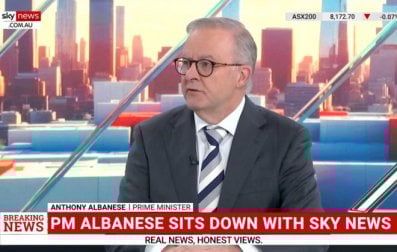
Albanese has repeatedly made clear that the PBS is non-negotiable – even amid pressure from the US administration and pharmaceutical lobby groups.
In a speech to the Australian Pharmacy Professional Conference in March – six weeks out from the May 3 election – Albanese said it was not surprising that there was a push for Australia to pay more for drugs.
“But let me be very clear and explicit, the Pharmaceutical Benefits Scheme is not for sale,” Albanese said. “Under Labor, under my leadership, it is not and will never be the subject of negotiation. It is a core part of who we are as Australians, and we will proudly defend it. And like Medicare, it is a monument to the fairness at the heart of Australian life. And we don’t negotiate our values. Simple as that.”
Asked during an interview on the ABC’s 7.30 on Monday whether he was concerned that Trump’s attempts to affect drug pricing could mean that US manufacturers could refuse to sell their drugs to Australia, Health Minister Mark Butler said it was not new that US manufacturers wanted bigger profits for the drugs they sell all around the world, including in Australia.
“It didn’t come along with President Trump. Twenty years ago, John Howard was dealing with this issue in negotiating the US free trade agreement,” Butler said.
“Our job is to use our buying power as a federal government – other countries do this as well – to negotiate the best possible price for medicines for taxpayers here in the country. We’ve been doing that. I get that US Big Pharma want more profits from their products. My job is to get the best possible price and then lower that price for Australian consumers. That’s what we’re doing.”
In a statement to The Saturday Paper, Australia’s peak pharmaceutical industry group Medicines Australia said its priority was to ensure Australians have timely and equitable access to the latest in innovative medicines, which in turn relies on a stable and predictable environment and is underpinned by the PBS.
“Medicines Australia is in regular contact with our counterparts in the US and globally to assess and understand the evolving dynamics and implications for Australians,” the statement said. “Medicines Australia supports the PBS as a cornerstone of our universal health care system. It is indisputable that a healthy population leads to a strong and healthy economy due to enhancing wellbeing, employment, and productivity gains.”
In the statement, Medicines Australia noted that the process by which medicines are assessed for listing on the PBS, the health technology assessment (HTA), hasn’t been updated in 30 years. The group calls for urgent reforms in line with recommendations from last year’s review, to help speed up listings.
“An important solution, not only for domestic policy but also to address implications from US policy, is meaningful implementation of reform to Australia’s HTA to ensure it is fit for the future,” the statement said.
“The Department of Health, Disability and Ageing has acknowledged that PBS listings are taking too long – at 21 months following registration.”
According to Australian pharmaceutical industry sources, Australian officials in Washington are now actively considering the engagement of high-powered US lobbyists to help push back against intensifying pressure from Republican lawmakers and pharmaceutical interests seeking to undermine the PBS.
The move reflects growing concern that, without a coordinated and informed response in Washington, Australia risks being outgunned in a complex policy fight with major implications for public health, trade and national sovereignty.
A decision to engage US lobbyists would not be unusual. The precedent was set when the Howard government negotiated the Australia–US free trade agreement in 2005, acknowledging that traditional diplomatic channels alone were not sufficient when up against powerful US industry groups.
“Pharmaceuticals are a bit more complex than steel or beef,” one industry source tells The Saturday Paper. “It’s one of the most technically complex and politically sensitive areas in US trade and domestic policy. The industry has an army of lobbyists and access to decision-makers at the highest levels. Australia will need help to even get a hearing on this, Kevin Rudd’s prowess notwithstanding.”
This article was first published in the print edition of The Saturday Paper on August 2, 2025 as "Exclusive: Australia to engage US lobbyists to defend PBS".
For almost a decade, The Saturday Paper has published Australia’s leading writers and thinkers. We have pursued stories that are ignored elsewhere, covering them with sensitivity and depth. We have done this on refugee policy, on government integrity, on robo-debt, on aged care, on climate change, on the pandemic.
All our journalism is fiercely independent. It relies on the support of readers. By subscribing to The Saturday Paper, you are ensuring that we can continue to produce essential, issue-defining coverage, to dig out stories that take time, to doggedly hold to account politicians and the political class.
There are very few titles that have the freedom and the space to produce journalism like this. In a country with a concentration of media ownership unlike anything else in the world, it is vitally important. Your subscription helps make it possible.
Subscriber exclusive
Send this article to a friend for free.
Share this subscriber exclusive article with a friend or family member using share credits.