Books
Cadance Bell
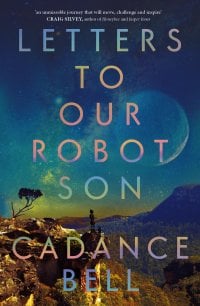
Letters to Our Robot Son
On the acknowledgements page at the end of Letters to Our Robot Son, author Cadance Bell reveals she signed with her publisher, Ultimo Press, because it called her manuscript “Science Fiction and meant it”. In describing this debut novel as science fiction, I am likewise sincere.
Letters to Our Robot Son is not gently speculative fiction in the vein of Kazuo Ishiguro’s Never Let Me Go. The imagined world in Bell’s science-fiction novel is traditionally technological, replete with drones, mechs and 3D-printed houses. In fact, Bell’s novel is narrated by a robot, albeit a humanoid one with “Skintech coating” and a head screen on which the robot “can make all kinds of animations”. What I’m trying to say – to use the kind of colloquial language favoured by Bell’s unusual narrator – is that there is a fair bit of geeking out going on.
The novel begins with its narrator, a robot named Arto, powering on and returning to consciousness. It’s a clever beginning, allowing for the introduction of the reader to the mind and body of its unfamiliar storyteller, as Arto discovers thought and memory, limbs and gravity. While filled with wonder at its body – “Is it just me, or am I rocking this existence?” – gravity “sucks”. “It’s so needy, always trying to pull me towards it!”
Bell’s style is enthusiastic, unafraid of exclamation marks or italics or even all-caps. There is also much in the way of linguistic energy. A sunset is exuberantly described: “A swansong of cheddar radiance swells.” The narrative is action-packed too. Arto, upon coming into consciousness, is immediately under threat from a giant robot with a wrecking ball, called a “Spidough” because it resembles “a twenty-metre-tall spider with a donut for a body!” Before fleeing, Arto saves an extremely fluffy kitten – “so fluffy!!!” – which it calls “Master Ultimate Fluffy Intelligence Nexus, or MUFiN for efficiency”. Arto also comes to the rescue of another robot, who claims to be Arto’s sister and with whom Arto goes on a quest to find out more about the humans that haunt the robot’s memory like “some fudgy fog lurking in the corner of my mind”. A complicated plot ensues.
This novel wasn’t written for me, but there will be readers who respond to its fun and games and, hopefully, to its underlying reminder of how climate change has the power to render humans an endangered species, beings that the robots they created “used to know”.
Ultimo, 336pp, $34.99
This article was first published in the print edition of The Saturday Paper on May 31, 2025 as "Letters to Our Robot Son".
For almost a decade, The Saturday Paper has published Australia’s leading writers and thinkers. We have pursued stories that are ignored elsewhere, covering them with sensitivity and depth. We have done this on refugee policy, on government integrity, on robo-debt, on aged care, on climate change, on the pandemic.
All our journalism is fiercely independent. It relies on the support of readers. By subscribing to The Saturday Paper, you are ensuring that we can continue to produce essential, issue-defining coverage, to dig out stories that take time, to doggedly hold to account politicians and the political class.
There are very few titles that have the freedom and the space to produce journalism like this. In a country with a concentration of media ownership unlike anything else in the world, it is vitally important. Your subscription helps make it possible.
Purchase this book
Letters to Our Robot Son
BUY NOW
When you purchase a book through this link, Schwartz Media earns a commission. This commission does not influence our criticism, which is entirely independent.
Subscriber exclusive
Send this article to a friend for free.
Share this subscriber exclusive article with a friend or family member using share credits.