Gardening
The liminal spaces are where interesting things happen, where change is effected – in the garden, as in life. By Margaret Simons.
The in-between
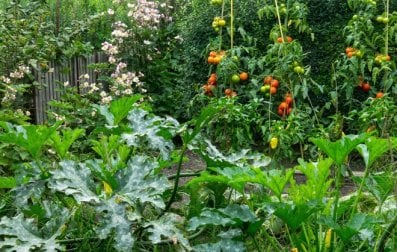
For years now there have been two uninvited shrubs growing in the cracks between the bitumen and the low brick wall that surrounds my garden. One of them, just inside the yard, prevented me from closing the thigh-high wrought iron gate that imperfectly demarcates my private space from the street. It didn’t bother me much because I rarely close that gate.
The other has caused problems. Last summer a council worker knocked on my door and threatened me with a fine. He said council had had complaints from others in the street about “people” growing things that overstretched or obstructed the footpath.
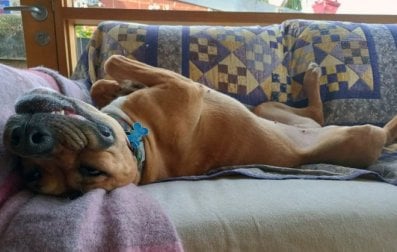
People, in this context, meant me. But I walk the length of this street three times a day, once in the liminal light of dawn with the dog surging towards the park for her main run of the day, and at least twice more – mid-afternoon and last thing at night – because she hates to wee or poo at home. I knew I was not the main offender.
Two doors up is the fence covered in English ivy. The owners cut it back a few times a year, but in between it threatens to topple onto the street.
Further up the hill, on the corner of the road that leads down to the public housing estate, a cumquat tree leans over the fence and, in season, drops fruit on the path. Nobody seems to pick it and I have thought about knocking on the door and offering to do so, in return for a jar of marmalade once the processing is done. But I haven’t had the nerve to intrude beyond their gate.
The fruit bats love this tree. When the dog and I pass by for our last-thing-at-night piss walk, they spring out of the leaves and soar away with a whoosh on their webbed wings. Their sweet brown poo sticks to my boots.
Further up the hill again is some kind of gum tree with silver bark and gumnuts. It is an art nouveau fairytale dream, with its graceful arabesques, and it leans so far over the street you can’t pass without either ducking or walking into the gutter. It smells like cough medicine and wilderness.
I love all these things, these incursions, these acts of assertion from the natural world. I understand that for those in wheelchairs or with children in pushers, they are a nuisance. And yet – so beautiful.
My personal favourite, the best victory over the bitumen, belongs to a gardener who has somehow managed to cultivate a great, shimmering display of a native grass in the crack between fence and pavement. The grass leans forward, always moving even when there isn’t wind, showing first white, then green, grey and mauve. At this time of year, the transition between summer fruitfulness and winter decay, the seed heads are more elegant and evocative than any flower. Surely there could have been no complaints about this lovely thing?
My woody shrubs are not as beautiful as any of these things, but they barely impede foot traffic. One is inside my yard and the one on the pavement is a stocking snagger, at worst.
I told the man from the council I didn’t plant it and it wasn’t on my land. The crack in which it grew was on the pavement side of the boundary. Surely it was the job of the council to get rid of it.
Our conflict was left unresolved, but he threatened to fine me. Yet, to my surprise, a week later a council worker arrived, sawed through the trunk of the shrub and carried the cuttings away.
One of the principles of permaculture is to attend to the in-between spaces – the gap between a garden bed and lawn, between one growing space and another, between garden and wilderness. And in this case, between public footpath and private garden. It is in the in-between, liminal spaces that interesting things happen, that change is effected. Pay attention to the edges, permaculture suggests, and the heart will be enriched. Hence, permaculture uses designs such as keyhole beds to extend the boundaries, to create as much edge as possible.
You can extend the metaphor to talk about life’s transitions – the space between childhood and adulthood, the subject of a thousand coming-of-age movies. Or between life and death.
Or in writing, there is the liminal space between the doubt-filled wrestles in front of the keyboard and the final result. The gap between the crap first draft – first drafts exist in order to be crap – and the final product.
So as always, the garden is a thing in itself and a crib sheet for life.
The weedy, woody shrub regrew, of course. I resumed cutting it back every time I judged it was big enough to annoy pedestrians. Meanwhile, I almost forgot the wrought iron gate was designed to close.
Regular readers know my father died recently. Grief is a liminal space, the pause between a death and an acceptance that living requires moving on.
And this time of year, autumn, is also an in-between. Some crops are finishing. Every day when the dog and I return home at sun-up, I contemplate whether I should now accept that the remaining cherry tomatoes may never ripen and that green tomato chutney is the thing. At what point do I pronounce the bean vines exhausted, and rip them out to make way for what comes next?
Soon, but not quite yet.
Last weekend, something shifted. I wanted to kill, to end the stocking snagger and the gate blocker. I went to Bunnings and bought the smallest container possible of Roundup, the Monsanto-patented herbicide.
I am an organic gardener, for the most part. My little concerns, my private backyard, this outward expression of my human need to fiddle and shape, does not seem to justify even the smallest incursion of pesticides and chemicals into the world. I don’t condemn those who use them. If your livelihood relies on selling brassicas, I doubt you would be content with picking off the grubs each morning and squishing them, as I do.
But it seemed I had decided to accept responsibility for the shrub I had earlier dismissed as council’s concern.
The next day, dog still tied to the fence from our morning walk, I lay full length on the footpath, sawing at the base of the two shrubs with a little wood saw. It was hard work. I was dripping in sweat. My neighbour asked me if I needed help but it was a one-woman job. Or perhaps he just thought I had gone mad.
When the job was done, I got an old paintbrush and doused the stumps in Roundup.
Dirt from the street all over my clothes, I piled the clippings in the green bin, put it away neatly and stood on the pavement as the sun came up.
Then, for the first time in a very long while, I closed my front gate completely, and latched it. And disappeared inside.
This article was first published in the print edition of The Saturday Paper on March 23, 2024 as "The in-between".
For almost a decade, The Saturday Paper has published Australia’s leading writers and thinkers. We have pursued stories that are ignored elsewhere, covering them with sensitivity and depth. We have done this on refugee policy, on government integrity, on robo-debt, on aged care, on climate change, on the pandemic.
All our journalism is fiercely independent. It relies on the support of readers. By subscribing to The Saturday Paper, you are ensuring that we can continue to produce essential, issue-defining coverage, to dig out stories that take time, to doggedly hold to account politicians and the political class.
There are very few titles that have the freedom and the space to produce journalism like this. In a country with a concentration of media ownership unlike anything else in the world, it is vitally important. Your subscription helps make it possible.
Subscriber exclusive
Send this article to a friend for free.
Share this subscriber exclusive article with a friend or family member using share credits.