News
In an exclusive interview with The Saturday Paper, Prime Minister Anthony Albanese says he is targeting new seats in all six states and believes he can hold majority government. By Karen Barlow.
The Albanese interview: ‘Anyone who didn’t vote for Scott Morrison … why are they going to vote for Peter Dutton?’
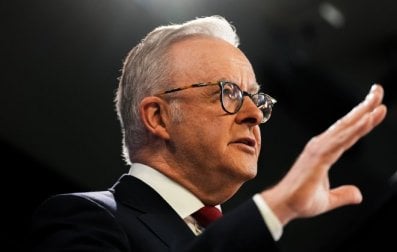
On New Year’s Eve, Anthony Albanese stopped drinking. He did the same thing before the previous campaign. After a difficult first term, the prime minister says he is match fit. Despite the polls, he believes Labor can win majority government.
“I’m better than I was 10 years ago. You know, this little one helps,” he says, pointing to his dog, Toto.
“I walk a lot. I swim, play tennis, do all that. I watch my diet, and I’m alcohol-free from Christmas, from New Year’s Eve, for the duration.
“I did that last time. It helps. And I love campaigning. I love engaging. We did the Lunar New Year event at Box Hill. Dutton wasn’t talking to anyone except Michael Sukkar and his own colleagues.”
All political players are in campaign mode. Every day, Albanese and his government list their achievements. After some clumsy moments in the last campaign, being caught out on figures and unable to name the cash rate, Albanese is consciously doing warm-ups.
“I gave 30-something full-scale press conferences with the Canberra press gallery last year,” he says, sitting at the Lodge for an interview with The Saturday Paper. “I do hard interviews. This year I’ve done a full suite of radio interviews, press conferences. I did two a day for a while, while we’re on the road.
“AM, all the sort of detailed interviews. Four podcasts in the last three weeks. I’ve been, as prime minister, right around the country, I’ve been out and about. I subject myself and the government to scrutiny, and I do think it’s very different from Peter Dutton’s approach.”
The opposition leader has barely put himself in front of the Canberra press gallery all term. Most of his press conferences are held outside city centres and away from experienced journalists. Instead, he has worked up significant cut-through on social media and in friendly conservative outlets.
Albanese and his team are bracing for the way this will interact with misinformation and disinformation in the campaign.
“These things have been weaponised, of course. And we are concerned about AI. Concerned about all of these matters,” the prime minister says.
“We will be seeking to address them as best as possible, but part of the challenge of modern politics is cutting through this.”
Asked if he wished he had truth-in-political-advertising laws in place for this election, Albanese says, “I wish they were not needed.”
Such laws, to make it illegal to lie in political ads, have been put aside by Labor and are not progressing in parliament.
Meanwhile, the opposition is full throttle on the prime minister’s “weakness” – focusing on whether or not he was informed by security agencies and New South Wales Premier Chris Minns about the discovery of an explosives-laden caravan in Sydney’s north-west last month.
“The prime minister has been asked on multiple occasions to be honest, open and straightforward with the Australian public as to why he wasn’t notified,” the opposition leader said in parliament on Wednesday. “The prime minister has previously advised dates on which he’s been notified of serious events by the Australian Federal Police. Why can’t the prime minister just be honest with the Australian people?”
Albanese was unmoved while the Coalition kept pushing the issue.
“There are two choices you can make here,” he said in reply. “One is to prioritise getting to the bottom of what is happening here, supporting the police and intelligence agencies. Or you can choose to play politics and play these games.”
Albanese believes Dutton is focusing on distractions. He is keen to push the opposition leader on the handful of initiatives the Coalition has announced, such as its uncosted tax-free lunch policy for small business.
“He’s interested in distractions because he doesn’t have any plans that matter to people,” the prime minister tells The Saturday Paper. “He’s not comfortable talking about the economy and, having opposed all of our cost-of-living measures, they’ve come up with this absurd policy of every taxpayer paying for some people to have free lunches or weekends away or entertainment with no limits on it, except $20,000.
“You end up with a bill of potentially up to $10 billion and something’s got to pay for that. He said on the weekend that there will be cuts, but he’ll tell you where after the election. He has to, at some stage, I think, be held to account for the lack of any accountability for what the impact of his fiscal position will be.”
For Albanese, the focus of his coming campaign is on the economy and he’s stressing “stable government” that is “not just occupying the space but shaping the change that occurs in society”.
“There’s no recession,” the Labor leader says. “We have reduced inflation from having a six in front of it, and rising, to having a two in front of it, and falling. At the same time, 1.1 million jobs have been created. More than any other government in our history.
“We chose to try to secure employment whilst we were lowering inflation. And those figures are all heading in the right direction.”
Albanese insists significant reform has been part of his government, particularly on aged care, childcare and other policies to assist families. He points to the gender pay gap falling and breaking an election promise to amend the Morrison-era stage three tax cuts, to “make sure that everyone got a tax cut, not just some”.
He calls this “the most difficult decision I think we have made – that was, at the time, not universally welcomed by the media”.
If Labor loses just two seats at the election, it would be stripped of its majority. The Coalition needs to win 19 seats, including many of those lost to the teal independents in 2022, to take office outright.
Ahead of the writs being issued for the official campaign, the majority of the polls, including Newspoll, Freshwater and YouGov, place the Coalition just ahead of Labor on the two-party preferred, 51-49. The latest Newspoll also showed the lowest approval levels for Albanese since he became prime minister.
The shift in polls towards the opposition began around the time of the Indigenous Voice to Parliament referendum in late 2023.
To this day, Albanese said he respects the outcome and is “given heart” by Indigenous Australians who, he says, thank him for agreeing to their request to try to get up a “modest” proposal.
Going into the election, tactics and messaging from the successful “No” campaign are being repurposed by the Coalition. One example is the focus on Canberra-based bureaucracy as wasteful.
Asked if Peter Dutton lied during the Voice campaign, Albanese says he does not want to “personalise it”, but notes the planned non-binding advisory committee was “quite clearly” portrayed as something it was not proposed to be.
“We know that even with some of the questions that were asked in the parliament were ones that people knew what the answer was for,” he says.
“No one believes that a Voice, an advisory committee, would be sitting down determining where Australia’s military, defence forces were located, for example. They were some of the questions that were asked in the parliament.
“People, I think, will draw their own conclusions. Peter Dutton has had more than two decades in public life. He has chosen throughout that to be someone who has been divisive rather than tried to bring people together. He’s done that across every portfolio he has ever held and across different groups.”
In this election Albanese will seek to remind voters of the Liberal prime minister he ousted, Scott Morrison. He points to the Coalition’s own reminder in its use of the word “back” in its campaign slogan “Getting Australia back on track”.
“He’s seeing a back. His first word is back on track,” the prime minister says. “You know, do people want to go back to where inflation was almost triple what it is now? Back to low wages being a key feature of the economic architecture? Back to women’s policy and gender equity being something that’s an add-on to some things, an afterthought, or is it a core part of economic policy, national policy?
“Do want to go back to a prime minister that has six or seven portfolios without even telling the treasurer? Like, it’s a shambles.”
For Albanese, the Labor campaign narratives continue to be “No one left behind” and “No one held back”.
“Looking after people,” he says. “I regard kindness as something that is a characteristic that Australians have for each other. It’s not a negative. It’s strong to be kind. But as well, taking advantage of the opportunities that are there. So, no one held back.”
Away from the bustle on the hill, Albanese appeared in a buoyant mood at the Lodge this week. In parliament, he was in the middle of what is likely to be the last sitting before he calls the election date.
Asked if people and pollsters are all wrong to expect a hung parliament, he insists they are.
“I’m aiming for majority government. We hold a majority now. Before the last election, people said the same thing. There are seats that we currently don’t hold that Labor is targeting winning in almost every state and territory – literally in every state, not every territory, but in all six states.
“And I believe as well, I’m confident when people focus on the campaign – and historically, you know, we have been on 50 per cent. The lowest we’ve been on in any public poll that I’ve seen is 49, but for almost the whole time we’ve been above 50. And I think that the lack of a coherent alternative will really focus attention.”
Albanese does not see the tide turning on teals such as Zali Steggall, Sophie Scamps and Allegra Spender, describing them as “strong advocates”, “active” and people who have a “clear view of what they stand for”.
“I can’t see that anyone who didn’t vote for Scott Morrison in 2019, if they’re in Warringah or Mackellar, why are they going to vote for Peter Dutton, when the reasons why I think many of those candidates were successful was about climate policy, integrity and the National Anti-Corruption Commission and gender equity,” he said.
“If anything, the Liberal Party has become more right-wing.”
The retirements of senior Liberal moderates such as Paul Fletcher and Simon Birmingham, and earlier the departure of former minister Christopher Pyne, was significant, according to Albanese. At the same time, he says, Dutton’s appointment of Michael Sukkar as manager of opposition business was telling of where the party was going.
“This is not someone who I see as appealing to anyone who regards themselves as a centrist, and I think that is alienating of people – whether they be independent voters or people who are swing voters – thinking about whether they’ll vote Labor or Liberal, [they] will have a look at their team and I can’t see the motivating factor,” Albanese says.
“Notwithstanding it’s been difficult global economic times. It’s a difficult time to be in government. But my government has been focused, never taken our eye off the main game either. We have always been focused on the economy.”
Pressed on the case he is presenting to voters underwhelmed by Labor’s first term and uncertain about a second, the prime minister says he accepts that “people on the progressive side of the spectrum will always be impatient for more reform”.
“I say to them, have a look at what we have achieved … whether you’re a worker, whether you’re a single parent, whether you’re someone who wants action on climate change. Have a look at what we have done,” Albanese says.
“And we’ve done that and achieved that with a global inflationary environment, with an obstructionist opposition, and where we hold 25 votes out of 76 in the Senate.
“We’ve got, I think, a story to tell, and Dutton represents going backwards.”
This article was first published in the print edition of The Saturday Paper on February 8, 2025 as "The Albanese interview: ‘Anyone who didn’t vote for Scott Morrison … why are they going to vote for Peter Dutton?’".
For almost a decade, The Saturday Paper has published Australia’s leading writers and thinkers. We have pursued stories that are ignored elsewhere, covering them with sensitivity and depth. We have done this on refugee policy, on government integrity, on robo-debt, on aged care, on climate change, on the pandemic.
All our journalism is fiercely independent. It relies on the support of readers. By subscribing to The Saturday Paper, you are ensuring that we can continue to produce essential, issue-defining coverage, to dig out stories that take time, to doggedly hold to account politicians and the political class.
There are very few titles that have the freedom and the space to produce journalism like this. In a country with a concentration of media ownership unlike anything else in the world, it is vitally important. Your subscription helps make it possible.
Subscriber exclusive
Send this article to a friend for free.
Share this subscriber exclusive article with a friend or family member using share credits.