News
As Donald Trump threatens even the closest allies with tariffs, Trade Minister Don Farrell prepares to argue the case for exempting Australia – and America’s biggest rival, China. By Karen Barlow.
Inside Labor’s plan to fight tariffs
Don Farrell believes his best strategy to keep Australia out of an escalating series of trade wars initiated by United States President Donald Trump is “cool, calm and collected” common sense.
This is what he plans to bring to a difficult mission: presenting a case not only against tariffs on Australia but also against those on China. The US’s biggest economic rival is also Australia’s top trading partner and key to precious exports revenue. Farrell aims to meet with Howard Lutnick, his assumed counterpart, as soon as possible.
“We would be advocating for no tariffs on Chinese products. We’re not just saying, ‘Don’t do it to us’ – we have a strong argument, I think, as to why they shouldn’t do it to us. But we’re saying, ‘Look, free and fair trade is not just in Australia’s interest, not just in China’s interest, but in the longer term, it’s in the interest of the United States.’ ”
Farrell scoffs at suggestions the Coalition would be better placed to defend Australia’s interests when dealing with a US president who favours the blunt force of tariffs to get what he wants from other countries. Trump’s first targets are the US’s largest trading partners – Canada, Mexico and China – and he has said the European Union is next, as it needs to buy more from the US.
“Look, he’s certainly a disrupter. There’s no doubt about that,” Farrell tells The Saturday Paper. “But I think if your argument is strong enough, then hopefully common sense says that that will be listened to in the halls of power in Washington.”
Before Trump’s secretary of commerce pick has even taken up his post, the president has swiftly done what he and Lutnick, a former Wall Street executive, pointedly flagged throughout the presidential campaign: using tariffs, or at least the threat of “very powerful” tariffs, as a negotiating tool to get foreign policy action.
The executive order applying 10-25 per cent tariffs to US neighbours Canada and Mexico over the flow of opiates and illegal immigrants is on pause after the two nations pledged action to strengthen security on their borders. Though the specific measures were in large part previously agreed with former president Joe Biden, they appeared to give Trump a win.
It is the separate imposition of a sweeping 10 per cent tariff on all Chinese imports, however, that has caused Australia the most concern. The levies went ahead on Tuesday and China has retaliated with targeted tariffs worth about US$20 billion against American imports.
Australia is still recovering from the diplomatic deep freeze with China that followed Scott Morrison’s accusations over the origins of the Covid-19 outbreak. The last of $20 billion worth of trade barriers came off just three months ago, with the unblocking of live lobster trade.
“There’s no doubt that an increase in Chinese tariffs to the United States would have an impact in Australia,” Farrell says.
“One of the reasons there’s that enormous trade with China is that we’re providing the raw materials which they convert into cars or computers or whatever else and send to the United States. And that does have the potential to have an impact on us.”
Treasurer Jim Chalmers revealed this week that his Treasury department had done a “heap” of preparatory work on the “possible consequences of trade tensions” before the US election, which he presented to the National Security Committee, the cabinet and other cabinet committees.
The US is Australia’s fifth-largest export market and among our top exports are gold, financial services and lamb. In addition to his announcements of tariffs targeting specific countries, Trump has threatened sector-based levies – the most prominent being on computer chips but also on copper, steel and aluminium.
Even as a solid political ally of the US, Australia’s case must be remade. Under this administration, the usual rules do not apply, says Justin Wolfers, a professor of economics and public policy at the University of Michigan, and member of former president Biden’s National Bureau of Economic Research.
“It’s following a script which, if someone were trying to make a terrific television drama, it would be a great TV show to watch. So, when we try to run an economy, this might not be the right approach,” Wolfers tells The Saturday Paper.
“Things are fixed with Mexico and Canada, but they weren’t broken to start with, and they’re only fixed for 30 days. We’ve had a Trump presidency before. We know what it’s like. It’s idiosyncratic, it’s sometimes weird, it’s often dangerous, and it’s following that script pretty well.”
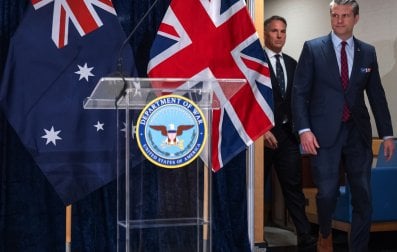
Farrell is prepared to travel to the US as soon as Lutnick is confirmed. The commerce secretary can’t officially engage until then. In the meantime, Foreign Affairs Minister Penny Wong, having attended Trump’s inauguration, was among the first to press their nation’s interests with the new secretary of state, Marco Rubio. This week, Deputy Prime Minister and Defence Minister Richard Marles will meet the new defense secretary, Pete Hegseth, where he is expected to highlight the ties forged by the AUKUS agreement and secure an assurance from the US on its continued commitment to provide Australia with nuclear submarines.
Asked if the US relationship with Australia will mean much to Donald Trump, Farrell says, “Well, I hope it does. We’re a political ally.
“Who were the first group that Mr Rubio met with? It was the quad group, you know: Australia, India, Japan and the US. So, we’re talking with them, and I just think that that is the best way of projecting our interests and protecting our interests in the discussions with the United States.”
The main message, though, is not one of history or even loyalty, according to Farrell – it is economic sense. It’s an argument Malcolm Turnbull deployed as prime minister during Trump’s first term.
Two-way trade with the US was just over US$77 billion in 2022, according to the latest available data, and the balance was overwhelmingly in America’s favour. The US sold $52 billion worth of goods and services to Australia and bought just $25 billion.
“We’re not like Mexico, China, Canada,” the trade minister said. “We’ve got a net deficit, and they’ve got a surplus with Australian products … We’re in the top four countries that have actually got the surplus with the United States.”
“Second, of course, we are working with the United States to build the [AUKUS] submarines. We’re potentially investing $368 billion in the United States.
“To a country where you’ve got a surplus, why would you be applying a tariff? Just doesn’t make any sense economically.”
With an election coming in less than 100 days, Opposition Leader Peter Dutton has claimed a Coalition government would be best placed to navigate the US–Australia relationship under Trump.
There’s no evidence of that, according to Farrell, who cites the Albanese government’s repairing of the trade relationship with China. “They couldn’t even get their phone calls returned. Couldn’t get a face-to-face meeting,” the minister said.
“I’ve had nine meetings in the last three years with my Chinese counterpart. In the previous three years, they couldn’t get one. I think our cool, calm and collected way of prosecuting the arguments has been successful. How will it be with Trump? Well, time will tell, but I think that is the best and most sensible course of action.”
The battle as it stands may not harm Australia, according to Wolfers, who points out that American goods just became 10 per cent more expensive and China has to buy from somewhere. US demand for Chinese products could be similarly redirected.
“Australia happens to be one of those other countries,” he says.
The US’s largest export to China is soybeans, while China’s to the US is consumer electronics.
Meanwhile, Trump’s love of tariffs isn’t widely shared domestically. Even his own Treasury secretary, Scott Bessent, has shown only qualified support, preferring a more gradual and targeted approach. Wall Street is awash with forecasts of how much the varying levels of tariffs will shave off US growth and add to inflation, as a byproduct of rising domestic prices. All of which may explain Trump’s willingness to delay and impose lower rates than threatened.
The strategy is ultimately self-defeating, Wolfers says. “Remember, the whole point of the economics of tariffs is the people that are hurt by tariffs, the people in your own country, as well as people in other countries,” he says.
“So, America’s tariffs – Trump is basically punching the American consumer in the mouth.”
Nevertheless, the president is clearly keen to continue on his protectionist path as a negotiating tactic.
“Tariffs are very powerful both economically and in getting everything else you want,” Trump told reporters in the Oval Office this week.
“Tariffs, for us, nobody can compete with us because we’re the pot of gold,” Trump said. “But if we don’t keep winning and keep doing well, we won’t be the pot of gold and then tariffs won’t be so good for us.”
This article was first published in the print edition of The Saturday Paper on February 8, 2025 as "Inside Labor’s plan to fight tariffs".
For almost a decade, The Saturday Paper has published Australia’s leading writers and thinkers. We have pursued stories that are ignored elsewhere, covering them with sensitivity and depth. We have done this on refugee policy, on government integrity, on robo-debt, on aged care, on climate change, on the pandemic.
All our journalism is fiercely independent. It relies on the support of readers. By subscribing to The Saturday Paper, you are ensuring that we can continue to produce essential, issue-defining coverage, to dig out stories that take time, to doggedly hold to account politicians and the political class.
There are very few titles that have the freedom and the space to produce journalism like this. In a country with a concentration of media ownership unlike anything else in the world, it is vitally important. Your subscription helps make it possible.
Subscriber exclusive
Send this article to a friend for free.
Share this subscriber exclusive article with a friend or family member using share credits.