News
The opposition has seized upon the firebombing of a Melbourne synagogue to claim that the government is contributing to rising anti-Semitism in Australia. By Karen Barlow.
Politicising the Melbourne synagogue attack
Anthony Albanese says the current spate of anti-Semitism sends “shivers down the spine of all Australians” and diminishes the nation.
Escalating attacks have seen firebombing and anti-Semitic graffiti in Australia’s largest cities and led to criticism of the prime minister’s leadership and judgement.
For Melbourne resident Joel Burstyner, there has been an unsafe, anti-Semitic sentiment on the streets since well before the Hamas attack on Israel on October 7, 2023, and the war that followed it.
“It doesn’t just arise out of nowhere. It’s lingering at a level,” he tells The Saturday Paper. “What October 7 did was it made people feel more comfortable to express it and be violent about it and vibrant about it. And then there’s just a whole lot of people there who are really just leaves in the wind who will attach to any mob mentality.”
The lawyer lives not far from the Adass Israel Synagogue, which was firebombed just after 4am on Friday, December 6, as people inside prayed. No one was killed, but the fire ripped through the building, torching prayer books and Torahs.
Like many in the community, Burstyner has always been attuned to anti-Semitism.
“I don’t know that it’s massively changed the dial in terms of how fearful we are, because, personally, the way I look at it, is as an opportunistic attack and we’ve always needed to be mindful of our security,” he says.
“It is an escalation point. It is a low point to see that sort of attack on property with a disregard as to whether there are human lives in there at risk. It is a very low point.”
This week, the attacks continued.
In the early hours of Wednesday, the misspelt phrase “kill Israiel” was spray-painted in large letters on a wall near where a suspected stolen car was set alight in Sydney’s Woollahra. Two masked men are being sought.
They are “thugs who belong behind bars”, in the words of Home Affairs Minister Tony Burke.
The New South Wales premier, Chris Minns, said it was a “violent act of destruction, clearly anti-Semitic, designed to strike fear into the community that lives in this part of Sydney”. “I want to make it clear that these are shocking crimes,” Minns told reporters in a press conference, interrupted by a passer-by shouting “Free Palestine”.
“Of course, we’re concerned and worried about it, but we also need to put forward a very strong message to the Jewish community of NSW that 99 per cent of Australians that live in this state are behind you,” Minns said. “They’re appalled, appalled by this behaviour. They are appalled by these crimes, and … they stand with the Jewish community of NSW.”
The recent attacks follow the firebombing of other cars in Woollahra and attacks on the office of Labor MP Josh Burns in Melbourne. A 52-year-old Brisbane man was arrested on Saturday by Queensland counterterrorism detectives over a social media post in which they allege he had threatened to “blow up” a Jewish community centre in Melbourne.
“We’re a tolerant country,” Albanese said. “We’re a country that is based upon respect for each other. And we will work with all of the authorities to make sure the perpetrators of these crimes, which is what they are, are brought to justice.”
The Australian Federal Police’s Special Operation Avalite was announced on Monday, following Victoria Police’s declaration of a “likely” terror attack and after the prime minister chaired a national security committee of cabinet meeting.
Avalite will investigate anti-Semitic threats, violence and hatred. The AFP will be assisted by the domestic spy agency ASIO and state and territory police, with ASIO Director-General Mike Burgess repeating his warning for people to be cautious of the impact of charged rhetoric.
“Inflamed language leads to inflamed tensions and can lead to violence,” he said.
Four days after the Adass fire and after days of opposition and media criticism for not breaking a three-day Perth visit, the prime minister offered a plea for unity outside the burnt synagogue. “This arson attack is an act of terrorism,” he said. “It was fuelled by anti-Semitism and it was stoked by hatred. We’re a country that needs to come together and unite.”
Albanese stood with locals, inspected the damage and vowed to help to rebuild Adass.
“We built this with our blood and sweat. We have to do the same all over again,” one congregational member told the prime minister.
“We will see what we can do to help,” Albanese responded.
The prime minister was jostled as he moved around the site with Burns and a pressing media pack, but he was warmly welcomed by community leaders and shown the charred interior. There was frustration in the crowd, but the main heckling came from right-wing provocateur and commentator Avi Yemini as he was filming.
Anger and disappointment are spreading.
“There’s a sense that we as a society and particularly the federal government have allowed this to occur,” the Executive Council of Australian Jewry co-chief executive Alex Ryvchin told reporters outside the synagogue.
“This is something that requires deep reflection on the part of the prime minister and the government.”
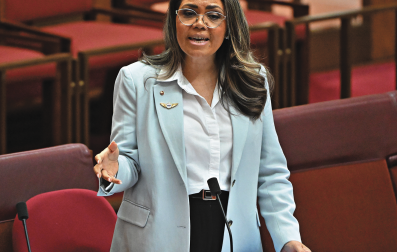
The federal opposition went further, with frontbencher Jane Hume accusing Anthony Albanese of “emboldening and enabling” the perpetrators and being “missing in action” in the wake of the firebombing.
The Victorian senator sees the Albanese government as “prevaricating” and “failing” to take the leadership that the “Jewish community are looking for”.
Peter Dutton has made the political division clear, refusing to allow Liberal frontbencher James Paterson to read out a public statement on behalf of Burns, who had lost his voice in the wake of the attack.
The opposition leader also accused the Jewish politician of failing to “speak up” about anti-Semitism in the community.
Sledging Burns is an opportunity to take another piece off Albanese.
“Josh is a nice guy, but Josh lost his voice long before the weekend,” Dutton said. “Josh hasn’t stood up to a weak prime minister, and the job for a Labor MP is to stand up to a prime minister who has put political interests of the Labor Party ahead of our national security interests.”
Israel’s Prime Minister Benjamin Netanyahu has also weighed in, linking the “abhorrent” and “reprehensible” Adass Israel Synagogue fire to the “extreme anti-Israeli position of the Labor government” at the United Nations.
“Anti-Israel sentiment is antisemitism,” he posted on social media.
On Thursday, Australia voted for a resolution in the UN General Assembly to call for an “immediate, unconditional and permanent” ceasefire in Gaza. A separate resolution demanded Israel reverse a ban on the UN’s Palestinian aid agency, UNRWA. Both resolutions passed with more than 150 countries in support, while Israel and the United States are among a small group of nations that voted against the resolutions. UNRWA has been banned by Israel over allegations some of its staff had ties with Hamas.
The ceasefire resolution calls for the “immediate and unconditional release of all hostages” and expresses deep alarm at the “ongoing catastrophic humanitarian situation” in Gaza but did not condemn Hamas’s terrorist acts.
Albanese insists there is no change to Australia’s standpoint.
“Australia’s position is we support a two-state solution,” Albanese said at the Jewish Museum in Sydney, prior to the votes.
“I think though, very clearly, that cannot involve Hamas. It cannot involve – it needs to ensure that all of the hostages need to be released. There’s no role for Hamas in any future Palestinian state.”
Former Liberal treasurer Josh Frydenberg has also criticised Albanese, while the Simon Wiesenthal Center in the US issued a travel warning for Jewish people as it castigated the Australian government for “failing to act against the ongoing demonisation of Jews, Israel and Zionism”.
The government is navigating a middle ground in a controversy that is showing no signs of slowing down.
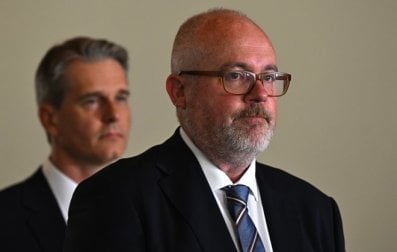
“I’ve never seen a terrorist attack be blamed on the prime minister of the day or the government of the day in the way that this one has,” says political consultant Dean Sherr, a former adviser in Albanese’s office and former national president of the Australasian Union of Jewish Students.
He says the criticism is verging on a feeding frenzy but said there is no doubt the sentiment in the Jewish community is real.
“It’s obviously a very historic escalation of violence against the Jewish community,” he tells The Saturday Paper.
“There’s possibilities for which kind of group committed this attack. Is it far left? Is it far right? Is there a connection to some sort of specific terrorist entity? Or is it connected to a broader network? Or is it just the actions of three people who sort of took it on themselves?
“It’s almost said as a ‘fact’ by a lot of people that this is a failure of the government and the prime minister and that’s a pretty extraordinary position to arrive at.”
On Wednesday, Albanese announced $8.5 million in next week’s budget update to redevelop the Sydney Jewish Museum. The money accompanies $32.5 million over the next 18 months to increase security for Jewish communities.
“We need an end to anti-Semitism. It is evil. It diminishes us as a nation,” he said, pointedly making the announcement with the independent member for Wentworth, Allegra Spender, as well as his cabinet colleague and Left faction rival, the member for Sydney, Tanya Plibersek. “We need a whole of government, but whole of society as well, effort to make sure this is stamped out. This museum plays an important role. This plays a role in education for everyone who comes here to be able to learn of the history, particularly of the Holocaust.”
Spender has flagged she will be pushing for stronger laws relating to the vilification of communities when parliament resumes.
In the countdown to the Jewish festival of Hanukkah, which falls on the same day as Christmas Day this year, police and security resourcing is being increased around synagogues and community facilities.
“This is a heightened period. It’d be silly not to recognise that,” Minns said, before saying he was also open to law changes to protect multicultural communities.
“We cannot have a situation where we are importing conflicts around the world onto the streets of Sydney and saying, ‘Well, it’s just inevitable because something happened on the other side of the world.’
“That’s not going to be the case in Australia.”
This article was first published in the print edition of The Saturday Paper on December 14, 2024 as "Attack turns political".
For almost a decade, The Saturday Paper has published Australia’s leading writers and thinkers. We have pursued stories that are ignored elsewhere, covering them with sensitivity and depth. We have done this on refugee policy, on government integrity, on robo-debt, on aged care, on climate change, on the pandemic.
All our journalism is fiercely independent. It relies on the support of readers. By subscribing to The Saturday Paper, you are ensuring that we can continue to produce essential, issue-defining coverage, to dig out stories that take time, to doggedly hold to account politicians and the political class.
There are very few titles that have the freedom and the space to produce journalism like this. In a country with a concentration of media ownership unlike anything else in the world, it is vitally important. Your subscription helps make it possible.
Subscriber exclusive
Send this article to a friend for free.
Share this subscriber exclusive article with a friend or family member using share credits.