News
As the Coalition finally releases its long-delayed nuclear costings, its chosen economic modeller, Danny Price, takes aim at Labor’s numbers. By Mike Seccombe.
Coalition’s economic modeller goes nuclear on energy transition costings
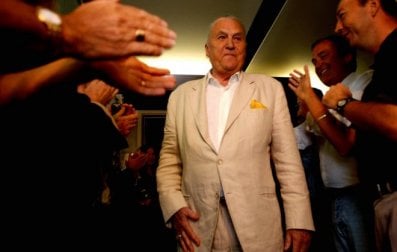
Danny Price would like to disabuse those who think economic modelling is dull and wonkish, an arcane discipline peopled by number-crunching boffins who sometimes politely disagree.
“In the world of financial and economic analysis, it’s pretty rough and tumble. So if you can’t stand criticism, get out of the debate,” says Price, founder and managing director of Frontier Economics, the federal Coalition’s current favourite economic modeller.
Price has probably played as rough as anyone throughout his long involvement in perhaps the most hotly contested field of modelling in this country: the cost and means of addressing the climate crisis. He seems to have had run-ins with almost everyone who’s anyone involved in climate policy.
Consider just a few examples from the past decade.
He once told a policy forum that reforms to the national electricity market recommended by Australia’s former chief scientist Alan Finkel would “lead us into an interventionist pit”.
He has called for the abolition of the Australian Energy Market Operator (AEMO) and accused its former head, Audrey Zibelman, of making an “audacious public grab for power”, by advocating a new strategic power reserve to avoid summer blackouts.
He dramatically quit the board of the Climate Change Authority (CCA) in protest at then prime minister Malcolm Turnbull’s “crazy” climate policies, which he claimed were frightening investors. He portrayed Turnbull’s decision to back the “Snowy 2.0” hydro scheme as the epitome of half-baked policy.
Price has done work for both sides of politics and been accused by both sides of being a partisan hack. He is equally disdainful of those “who hold themselves out as experts but clearly are not” and those “too frightened to speak out against the orthodoxy”.
He wears the counter-criticism from those he despises – such as the new CCA chair and former New South Wales energy minister Matt Kean – as “a badge of honour”.
“Danny,” says Tony Wood, director of the energy and climate change program at the Grattan Institute, “has a habit of falling out with people. He has strong opinions and when someone disagrees with him he becomes very aggressive.”
“He loves a stoush,” says another expert.
Even by his past standards, though, Price has set himself up for an epic fight this time. He has made common cause with the federal opposition in its attempt to prove nuclear power a viable option for Australia.
When Opposition Leader Peter Dutton finally released his long-awaited nuclear plan on Friday, all the numbers cited were the product of Price’s modelling.
They are very big. But, according to Price and Frontier, the opposition plan would cost $263 billion – or 44 per cent – less than Labor’s between now and 2050.
The Coalition wants renewables to provide 54 per cent of generation in the National Electricity Market by 2050, with nuclear making up 38 per cent, and the remainder coming mostly from gas.
This compares with the government’s target of 82 per cent renewables by 2030.
The assumptions behind the plan are also Price’s – and they are even bigger. They provide for a very rapid rollout of nuclear, with the first reactor to begin operating just 11 years from now, if it is a small modular reactor, or 13 years from now, if it is a large conventional one. That compares with the CSIRO’s estimate of at least 15 years.
Importantly, the plan relies on Australia’s existing, aged coal-fired power stations operating for years longer than currently planned.
It’s fair to say Price is in the minority of experts who champion nuclear. In the view of most it is far too expensive, and the lead time for getting it up and running in Australia far too long, for it to be a practical means of addressing the urgency of the climate crisis.
The case against nukes was buttressed on Monday with the release of the latest annual GenCost report, produced by the country’s premier scientific body, the CSIRO, in collaboration with AEMO and energy industry stakeholders.
It found – again – nuclear was vastly more expensive than renewable wind and solar energy.
The 2024-25 draft report found renewables “to have the lowest cost range of any new-build electricity generation technology, for the seventh year in a row”.
Per megawatt hour, solar and wind, even with the costs of firming included, came in at $98 to $150. Large-scale nuclear was $125 to $252, and power generated by small modular nuclear reactors – as yet globally uncommercialised but championed by the federal opposition – ranged from $400 to $663.
The report further noted that the price of renewables was still falling: the capital cost of large-scale solar photovoltaics had dropped 8 per cent for the second consecutive year. And the cost of battery storage, crucial to compensating for the intermittency of solar and wind, had fallen precipitously. “Battery costs recorded the largest annual reduction with capital costs falling 20 per cent,” it said.
The report was a blow for Peter Dutton’s opposition, which has made nuclear the key plank of its promise to lower power prices. All the more so because the GenCost report specifically addressed opposition complaints that its previous assessments had failed to adequately consider three relevant issues that could affect the cost competitiveness of nuclear. Those related to the longer operational life of nuclear facilities compared with renewables, their higher “capacity factor” – the average time they operate at full capacity – and the time it took to plan and build them.
In relation to the first, GenCost found no economic advantage due to longer life, because there were “substantial nuclear re-investment costs required to achieve long operational life”.
In relation to the second, GenCost reviewed its previous analysis and reconfirmed its estimate of nuclear’s “capacity factor range of 53-89 per cent [was] fair and remains unaltered based on verifiable data and consideration of Australia’s unique electricity generation sector”.
And regarding the third, it found “that global median nuclear construction times have increased from 6 years to 8.2 years over the last 5 years”, and overall development times, including planning and permitting, ranged from 12 to 17 years.
“Based on this analysis, GenCost maintained the total development lead time for nuclear in Australia will be at least 15 years,” it said.
The problem is, all of the nation’s geriatric coal generators are scheduled for closure by 2038 – just 14 years away.
Coalition policy would see Australia rely heavily on gas generation while we wait for the promised nuclear generators to be built. GenCost’s numbers suggest that would be a very expensive way to go.
The estimated cost of unabated gas was in the range of $128 to $192 per MWh, or about 30 per cent more than renewables. With attached carbon capture and storage – which is both technically problematic and necessary if gas generation is to be made carbon-neutral, that cost would rise to $187 to $284. That is, even more expensive than nuclear.
The response of Peter Dutton and his energy spokesperson, Ted O’Brien, was to take aim at the messenger. No sooner did GenCost drop on Monday than Dutton accused the CSIRO of political bias.
“They haven’t even seen our plan yet, and yet they’re out bagging it,” he said. “It just looks to me like there’s a heavy hand of Chris Bowen in all this.”
Actually, they were not bagging it. They were simply continuing an iterative process of assessing comparative energy costs, as they have done since the first GenCost report was commissioned under the former Coalition government in 2018.
It was hardly fair to attack GenCost for its focus on the costs and timelines associated with nuclear, given the report had set out to answer questions posed by the opposition itself. The climate change and energy minister, Chris Bowen, took offence. Not on his own behalf – he couldn’t give “two hoots” he said, about what was said about him – but on behalf of CSIRO.
“It makes my blood boil when he attacks the integrity and independence of the CSIRO, which deserve better from the alternative prime minister of Australia,” Bowen said.
“To suggest that the CSIRO would let a government of any persuasion interfere with their work is deeply, deeply offensive ... He should apologise.”
Dutton did not apologise, of course. But in a televised debate on the ABC’s 7.30 program O’Brien took a different line of attack. He did not question the CSIRO’s political impartiality, but its expertise. And he sought to move the discussion on from the comparative costs of different power technologies to something called “total system cost”.
“Our focus as a Coalition is on getting prices down. You must calculate the total system cost because that’s what hits your bill at home,” he said.
Easy definitions of total system cost are hard to find. One expert paper published in the Journal Energy a couple of years ago summarised it as “the sum of all the investment and operating costs related to processes/technologies/sectors within system boundaries”.
Professor Bruce Mountain, energy economist and director of the Victoria Energy Policy Centre, describes it more simply.
“It is nonsense,” he says. “It is just the latest zeitgeist jargon term.”
In his debate on Monday night, O’Brien did not attempt a definition, but the essence of his argument was that the inclusion of expensive nuclear power as part of a “balanced energy mix” would make the whole system more economic.
“I can assure you that our balanced energy mix, which includes zero emissions nuclear energy, will come in cheaper,” said O’Brien.
This assurance, made in advance of any published costings, had the simple appeal of the old Bunnings ad: “Lowest prices are just the beginning”.
The detail is anything but simple, however. And for that the Dutton opposition is dependent on Danny Price, apostle of total system cost.
“Total systems cost analysis,” he tells The Saturday Paper, “is the job of a very complex mathematical optimisation tool. There’s a lot of the economics that go into it. The constraints of [generation] plant – that is how they can ramp up, ramp down, variable operating costs at different heat rates, the reliability or unreliability of wind, the correlation between wind and solar. There’s enormous amounts of things that go into determining system costs.”
Enormous amounts of contestable data and assumptions, that is. The government began contesting them even before their release.
Just as Dutton accused the CSIRO of having a political agenda, so Bowen accused Price.
“The opposition have secretly asked Danny Price to do them a favour, abandon facts and evidence and cook up spurious numbers. They should open the books and have transparent costings,” Bowen said.
“What Bowen said about me was pretty scurrilous, suggesting that I cooked the books or something. Anyone who knows me knows that I’d never do that,” says Price in response.
It’s at least a little prejudicial of Bowen to have called Price a “Liberal consultant”. For, as previously noted, he has done work for both sides of politics, including recently for the Labor government of South Australia.
Price says he is not being paid for his work modelling the Coalition’s energy policy.
As he tells it, he was motivated to do it simply because he was dissatisfied with the “really poor ways of thinking about the relative costs of power systems” that he says currently drive policy.
“What happened was I did an interview on the ABC about nuclear, because I was already doing some stuff in this area. And then the opposition, Ted O’Brien’s office, contacted me and said they’d be interested in talking about my work. That would have been a few months ago.”
That said, he could hardly be called independent, either. When The Saturday Paper asked him on Tuesday when his work might be released, he could not say.
“Actually, I don’t know. You need to talk to the opposition about that. I don’t, I don’t know.”
Meanwhile, Price has been chipping away at the current numbers. Last month he produced his alternative calculation of Labor’s costing of the energy transition. Essentially it came down to different accounting methods, says Wood.
“AEMO said that the capital cost of the renewal generation, with some storage and some transmission augmentation, is $122 billion. Price said that the total cost, on his model, is $642 billion. That’s the total cost of supplying electricity from that system over the next 25 years.
“But they’re not comparable. That’s like comparing the cost of buying a car with the cost of ownership of that car over the next 25 years. It’s a nonsense comparison,” says Wood.
He doesn’t blame Price for this. “He just did the numbers,” says Wood. “Danny didn’t make the comparison.”
It was the right-wing anti-renewables section of the media that made a big deal of that. Murdoch’s Daily Telegraph splashed an “exclusive” headline across page one: “Bombshell report: ALP ‘hiding’ real cost of renewables-only grid. $500B GREEN HOLE”.
The opposition leadership has been retailing the false comparison ever since, to Wood’s great annoyance. “Dutton and co should not be allowed to get away with it,” he says.
Bowen’s office insists the government’s calculations followed the same accounting practice as its predecessor.
“Peter Dutton is a hypocrite,” says the minister. “If Peter Dutton has a problem with this method, he should take it up with his own shadow treasurer who put it in place.”
The government’s problem is that explaining the difference is complex, and a simple untruth beats a complex truth, particularly when the former is relentlessly pushed by a large section of the media.
When it comes to economic modelling, concepts of truth and untruth become complicated, because everything relies on the quality of the assumptions that feed into the model. “Garbage in, garbage out,” as former Liberal leader John Hewson was wont to say.
This is not to suggest Price’s work is bad. Indeed, most of his peers readily acknowledge he is very competent at what he does.
As Richard Denniss, executive director of the progressive think tank The Australia Institute and an economist with considerable background in the energy space, puts it: “What I’d say is Danny Price runs a successful modelling firm, and that means he clearly makes his customers very happy.”
Bruce Mountain describes him as “a consultant first and foremost”.
“He focuses on his clients, and that’s the long history of his work. So there’s a difference between consultancy and academia and independent economic advice, and Frontier Economics is not an independent economic adviser.”
Matt Kean goes harder. “Ted O’Brien might as well have just written the costings himself,” he says.
Price isn’t disturbed by the criticisms. Other people, he says, might be “afraid of having someone like Chris Bowen impugn you, or Matt Kean impugn you. It doesn’t bother me.”
Price is not motivated in the same way as the federal opposition – he does not see nuclear as a way of deferring action on climate change.
“Planning for nuclear doesn’t mean that you stop building renewables,” he says. “Why do people automatically think that’s the case? There’s no reason to think that. In fact, it’s wrong to think that because you’re planning to put nuclear in place, it means that there’s, you know, a discontinued investment in renewables.”
It’s clear, however, there are many in the Coalition ranks, particularly among the Nationals, who oppose renewables and in some cases still deny the reality of climate change.
Just last week Dutton promised that a Coalition government would “rescind” the declared offshore wind zone off the New South Wales Central Coast, which would torpedo a $10 billion two-gigawatt proposed development.
The promise of nuclear power is a way of papering over that rift between these people and the mostly urban Liberals who know their constituents want serious action on climate change, says Denniss, by promising a nuclear solution, a decade or so hence.
And the combative Danny Price, with his complex modelling and his optimistic assumptions and blinkered view of the realpolitik of the situation, is helping Dutton considerably. Maybe even helping him into government.
Whether he is ultimately helping the fight against global heating is another question.
This article was first published in the print edition of The Saturday Paper on December 14, 2024 as "Coalition sets Price on nuclear costings".
For almost a decade, The Saturday Paper has published Australia’s leading writers and thinkers. We have pursued stories that are ignored elsewhere, covering them with sensitivity and depth. We have done this on refugee policy, on government integrity, on robo-debt, on aged care, on climate change, on the pandemic.
All our journalism is fiercely independent. It relies on the support of readers. By subscribing to The Saturday Paper, you are ensuring that we can continue to produce essential, issue-defining coverage, to dig out stories that take time, to doggedly hold to account politicians and the political class.
There are very few titles that have the freedom and the space to produce journalism like this. In a country with a concentration of media ownership unlike anything else in the world, it is vitally important. Your subscription helps make it possible.
Subscriber exclusive
Send this article to a friend for free.
Share this subscriber exclusive article with a friend or family member using share credits.