News
As Pauline Hanson tells The Saturday Paper her One Nation party is ‘not going to be a bridesmaid anymore’, Labor insiders reveal the prime minister’s approach to dealing with racial anxieties. By Jason Koutsoukis.
‘It’s visceral’: Albanese’s fear of anti-immigration rhetoric
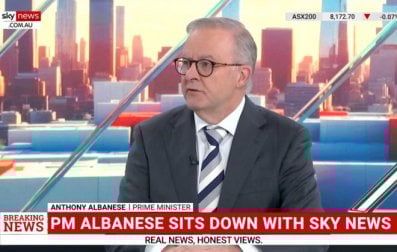
Few headlines make Anthony Albanese anxious the way headlines about race and immigration do.
He learnt that lesson as a senior minister during the Rudd and Gillard governments, after the dismantling of the Howard government’s controversial “Pacific solution”.
Night after night, the news was filled with images of overcrowded vessels and drownings at sea – a crisis that fuelled Tony Abbott’s rise to the prime ministership.
“Anthony has absorbed many lessons from the Rudd years, and migration is one of the most consequential, because when migration dominates the news cycle, Labor always loses control of the story,” says a former minister from the Rudd and Gillard governments.
“But it goes way deeper than that, it’s visceral … The images of all those boats still haunt me and, I would guess, not just me but all of us who were there during those years. It absolutely wrecked the government.”
Polling published this week suggests that while voters are no longer worrying about boat arrivals, they are concerned about the record annual migration intakes driven by the country’s post-pandemic reopening.
With net overseas migration peaking at 556,000 in the year to September 2023, a poll in the Nine newspapers this week showed that 49 per cent of voters believe permanent migration is too high and 55 per cent think the government is handling immigration in an unplanned and unmanaged way.
This week’s polls also put Pauline Hanson’s One Nation at its strongest showing in years – 10 per cent in Newspoll and 12 per cent in Resolve. The stronger numbers come at the same time as rancorous marches against migration in capital cities.
Labor insiders point to four recent statements that highlight Albanese’s extreme sensitivity when it comes to anything that touches on migration: the agreement with Nauru under which Australia will send people who no longer have legal status in Australia to Nauru for long-term residence; the settings for the 2025-26 permanent migration program; the prime minister’s observation that “good people” attended the anti-immigration marches that were dominated by neo-Nazis; and his response to a report in The Australian that the government was planning to repatriate a group of Australian citizens stranded in northern Syria, known as the “ISIS brides”, before Christmas.
“You could fit the statement announcing the agreement with Nauru on a Post-it note. The permanent migration intake announcement was literally three sentences long. And the PM’s response to a question on the ISIS brides in parliament was five words long,” one Labor adviser tells The Saturday Paper. “In other words, say as little as possible.”
The adviser said the prime minister and Home Affairs Minister Tony Burke were “working in lockstep to starve these issues of any oxygen at all. It’s a masterclass in political discipline and how to manage a series of highly complex policy settings, any one of which could blow up in our face at any moment.”
The government’s caution extends beyond its language. Earlier this month it quietly updated the Migration (Australian Values Statement for Public Interest Criterion 4019) Instrument 2025, the form that every new visa applicant must sign.
According to the new instrument, signed by the assistant minister for immigration, Matt Thistlethwaite, new applicants must pledge to respect freedom of religion and speech, the rule of law, gender equality and what the statement calls “the fair go” – values presented as the glue that holds the country together.
For those applying for permanent residency, the pledge goes further, requiring them to make a reasonable effort to learn English and to acknowledge that Australia’s democratic system is built on shared civic obligations.
In calmer times, such a measure might pass unnoticed. In today’s climate of mounting anxiety about migration levels, the reissuing of the instrument shows how sensitive Labor has become to the charge that migration is not just about numbers but about identity and social cohesion.
It is that sensitivity on which Pauline Hanson is intending to capitalise.
“Multiculturalism has divided our nation,” the One Nation leader tells The Saturday Paper.
Nearly three decades after she first entered federal parliament at the 1996 federal election, Hanson says the conditions she warned about in her first speech – mass migration, multiculturalism and the erosion of what she sees as traditional Australian values – have now come to a head.
“People have lost hope,” she says. “They’ve lost trust and faith in the politicians that they feel are only there for their own self-gain, self-interest, and they’re angry. And wherever you look – mass migration, climate change, the education system, escalating crime, the cost of living, job security, being able to buy a house – the whole country is in one hell of a mess, and that’s why they’re angry and they want change.”
Hanson argues that the recent far-right marches against immigration were only the most visible sign of a deeper shift.
“It’s just not the marches. I’m getting a lot of messages from people that they’re saying, ‘I want to apologise to you. Years ago, I didn’t understand you. I didn’t know what you stood for. Now I can understand you were ahead of your time.’ Once people actually come to One Nation, they’re usually there for the long haul.”
Hanson makes comparisons to Britain and the United States, where Nigel Farage’s Reform UK tops the polls and where Donald Trump’s presidency grew out of a Tea Party movement that resembled in some aspects the anti-immigration marches of the past few weekends.
“Nigel Farage is touching on the issues that are important to the people in Britain, the same as Trump,” Hanson says. “And people are saying, why can’t we have the same here?”
Central to Hanson’s pitch is that she has been consistent where others have drifted.
“The major political parties, especially the Coalition, have always followed in my wake. They wait for the polls. I go on my gut instinct and I go on my connection to people and talking to people. I know what’s happening.”
For her, the Liberal Party has abandoned conservative voters in a bid to court progressive voters.
“They’ve lost the seats to the teals, so they’re trying to pull back those green votes or teal votes and they’re trying to look like they’re progressive. The Liberal Party has been taken over by the moderates and the progressives … they’ve done nothing to fight for family values.”
For Hanson, the latest polls are proof that discontent is gathering force.
“It will happen,” she says of One Nation governing one day. “If I don’t have that vision for the party, how can I expect other people to have that vision for me? I’m not going to be a bridesmaid anymore. One Nation is the only party to actually drive this country forward.”
Hanson argues that the latest polls are not a swing in public opinion but the culmination of a fight she has waged for 30 years: a chance to turn disaffection into power and to show that the insurgent can one day become the incumbent.
Anthea Hancocks, the chief executive of the Scanlon Foundation Research Institute, argues the opposite. She says the data shows Australians remain overwhelmingly positive about diversity.
“Australians are incredibly supportive of multiculturalism,” Hancocks tells The Saturday Paper. “They are also very supportive of non-discriminatory migration. They don’t expect us to discriminate on anything, particularly religion or ethnicity.”
What unsettles people, she says, is not who is coming but the perception that too many people are arriving at once.
“In 2024, people were concerned about all the narratives that were coming from every side about the numbers,” Hancocks says. “As soon as you start saying the numbers are great, then people start to think, well, that must be the reason why X, Y or Z.
“So right now, they’re looking for people to blame about their children not being able to get housing, or the cost of living, or they can’t get the job they want. So they’re looking for someone to blame. And right now there’s people out there saying, ‘Oh, you know who you should blame. It should be the people that are migrating here to Australia.’ ”
For Hancocks, this doesn’t mean an inevitable breakthrough for Hanson.
“I think that’s unlikely,” she says. “What is more likely is people will vote based on who they think is best going to protect their economic circumstances and provide the best opportunity going forward. Australians generally are very moderate, and most of the structures in which we operate really don’t lean towards the extremes.”
She argues that support tends to drift towards independents who campaign on specific issues, such as climate change or integrity, rather than to anti-immigration parties.
The danger for the Albanese government, she says, lies not in multiculturalism but in the perception of loss of control.
That distinction highlights the challenge for Albanese. Hanson insists multiculturalism has “divided our nation”. The research suggests most Australians see it as an inherent part of national identity.
In an era of housing stress and spiralling costs, however, narratives about numbers can still take on dangerous force, especially if people start to believe the government is no longer in command.
While the recent polls suggest One Nation is enjoying its strongest run in years, Murray Goot, emeritus professor of politics at Macquarie University, cautions against reading too much into them.
For Goot, the larger picture is not of a far-right surge but of a political system in which both major blocs continue to command the bulk of the vote, even as they fragment at the edges.
“As of the 2025 election: left – ALP plus Greens – is on 46.8 per cent; right – Liberal, LNP, Nationals, CLP, Pauline Hanson’s One Nation, Trumpet of Patriots and Family First – on 41.9 per cent. Independents – including teals – on 7.3 per cent. And others, some of which could be assigned to the left or to the right, on 4 per cent.”
Whether there is space for another populist party on the right, he argues, is far from certain. He notes that Australia’s system of compulsory preferential voting is perceived as ensuring that politics stays in the “middle”. But that system can also buoy smaller parties.
“Compulsory voting brings many to the polls – including those whose support goes to parties on the far right – who would not otherwise have voted. Preferential voting may assure them that their vote won’t be ‘wasted’.”
In other words, while One Nation’s double-digit poll numbers may not translate into a breakthrough, even modest shifts on the fringes can rattle the centre ground that Albanese is determined to hold.
For Goot, the lesson of the latest polls is not that One Nation is on the cusp of a historic breakthrough, but that even in a fractured landscape the bulk of the vote still clusters around the major blocs.
Marija Taflaga, a lecturer in the School of Politics and International Relations at the Australian National University and director of the Centre for the Study of Australian Politics, takes the point further.
“In part, Australia’s electoral system does insulate us from a surge in a Reform/UKIP-style party because it favours the median voter and this forces parties to moderate their positions,” Taflaga tells The Saturday Paper. “We also have the Senate, which forces more bargaining and negotiation – again forcing politics to the centre.”
The contrasts with Britain are instructive, she says.
“The UK has endured almost two very difficult and harsh decades since 2008, with two major financial disruptions – the great recession and Brexit. Australia doesn’t have these preconditions.”
Yet she warns against dismissing Hanson’s relevance.
“I would say that One Nation is our Reform/UK Independence Party-style party. One Nation has undergone a significant overhaul of its brand from where it was in 1996. It is a far-right party, but it is no longer ‘beyond the pale’. It has effectively undergone a process of normalisation, which the preference deal with the Liberal Party formalised.”
That normalisation is what makes Albanese’s caution so pronounced. Taflaga sees a political environment in flux: “At this current juncture, what appears to be happening is that there is some space opening up for new political parties or entrepreneurs to establish a part or to claim part of the political landscape. This is in part because broader social and economic changes are unsettling patterns of what people think left and right means.”
If those entrants falter, she argues, the major parties will absorb their energies. For the Liberals, that process is complicated by their own split between moderates chasing the centre and conservatives tempted to compete directly with Hanson.
The prescription for Albanese, Taflaga says, is simple but difficult: “Do your job! Deliver. Make progress on housing and infrastructure, make progress on social mobility. Recast Australia’s egalitarian and socially mobile social contract for the 21st century!”
Albanese learnt in the Rudd–Gillard years that migration headlines can wreck a government. His challenge now is to ensure they don’t wreck his – by holding the centre ground against a populist tide that, for the moment, is louder in Britain and America, but which he knows could just as easily find its voice here.
This article was first published in the print edition of The Saturday Paper on September 20, 2025 as "‘It’s visceral’: Albanese’s fear of anti-immigration rhetoric".
For almost a decade, The Saturday Paper has published Australia’s leading writers and thinkers. We have pursued stories that are ignored elsewhere, covering them with sensitivity and depth. We have done this on refugee policy, on government integrity, on robo-debt, on aged care, on climate change, on the pandemic.
All our journalism is fiercely independent. It relies on the support of readers. By subscribing to The Saturday Paper, you are ensuring that we can continue to produce essential, issue-defining coverage, to dig out stories that take time, to doggedly hold to account politicians and the political class.
There are very few titles that have the freedom and the space to produce journalism like this. In a country with a concentration of media ownership unlike anything else in the world, it is vitally important. Your subscription helps make it possible.
Subscriber exclusive
Send this article to a friend for free.
Share this subscriber exclusive article with a friend or family member using share credits.