News
MPs are demanding the government make public a ‘terrifying’ intelligence report on climate change to support this week’s National Climate Risk Assessment and target. By Karen Barlow.
Exclusive: Government refuses to release climate security report
According to MPs who have seen a “terrifying” external threat assessment kept secret by the Albanese government for nearly three years, Australians have been given only half of the “wake-up call” needed on the threat of climate change.
The warning comes as the government announced a 2035 emissions reduction target range of 62 to 70 per cent. Defying climate and science groups, Prime Minister Anthony Albanese regards the range as the “sweet spot” for a target to be both ambitious and achievable.
“A target over 70 is not achievable. That advice is very clear,” Climate Change Minister Chris Bowen said on Thursday. “We have gone for the maximum level of ambition that’s achievable.”
Australia’s 2035 net zero target, up from the still to be reached 43 per cent goal for 2030, is offered in the wake of the National Climate Risk Assessment, released this week.
The landmark report warned that nothing – notably human life, agriculture, productivity and the Australian coastline – will be spared unless stronger climate action is taken.
It is paired with a national security report from the Office of National Intelligence (ONI) that the Albanese government has refused to make public.
“What we see in the National Climate Risk Assessment, if you look at something like the 1.5 million Australians who will potentially be inundated and have to move, what does that mean for Pacific Island nations?” independent senator David Pocock tells The Saturday Paper.
“It means they’re gone … the other half of the risk assessment is context.
“Where are we situated in the world, and what does that mean for all of our neighbours, low-lying atoll states, countries like Papua New Guinea, Indonesia? … I think that’s where we need more leadership from the Australian government.”
The Saturday Paper revealed in March that progressive and persistent members of the cross bench, excluding the Greens, were quietly briefed by the government on the classified ONI report on December 9. They also got advanced notice of the just released domestic risk assessment led by the Australian Climate Service.
The risk assessments were ordered by Labor soon after taking office. The domestic report was supported by experts from the Bureau of Meteorology, CSIRO, Geoscience Australia, the Australian Bureau of Statistics and Treasury, among others. The ONI report was run largely by Australia’s most senior intelligence chief, the ONI’s director-general, Andrew Shearer, with input from the Department of Defence.
Former chief of the Australian Defence Force, retired Admiral Chris Barrie, says the domestic report shows “we should get off our clackers and get going”.
Having originally encouraged Labor to commission the ONI report, he now wants to see it made public.
“It complements. This is a whole story. So, when we began this in September of 2021 we thought this would be a comprehensive whole. We have got one half. We were missing the other half,” say Barrie, who is a member of the Australian Security Leaders Climate Group.
“There have been briefings to people like Senator Pocock on that. He can’t tell you what’s in it, but what he can say is it’s horrible.”
Pocock says the ONI report’s contents were “frankly terrifying”. Zali Steggall, who was also shown the report, says it should be released.
“I think … what’s essential, and has been missing, is they are acknowledging that climate has a profound effect on geopolitical climate risk, has a profound effect on geopolitical stability. And that’s publicly known. That’s nothing to do with the ONI report,” the independent member for Warringah tells The Saturday Paper.
“The government’s argument for not releasing it has been because it never has in the past, which is hardly a sound argument. The government of the day has to be able to evolve with the circumstances and situation of the day. The US and the UK have released declassified reports, so clearly there is precedent for it to happen with our allies.”
The Saturday Paper sought the official status of the ONI risk assessment, which formed advice to the national security committee of cabinet. It is understood that the government remains firm on not releasing the classified report.
The minister responsible for the ONI is the prime minister. Albanese said this week he regarded the domestic report as a “wake-up call” for climate change deniers.
“The government’s position is clear – climate change is a national security issue. That’s why we commissioned the assessment,” a government spokesperson said in a statement.
“Unlike the former Coalition government and the current Coalition opposition, we take climate change seriously.”
In releasing the domestic risk report, just days before the 2035 target announcement required under the Paris climate agreement, Bowen said it was the “most comprehensive analysis of the impacts of climate change on our country ever compiled”.
He stressed it was independent and should be taken seriously.
Assistant Minister Josh Wilson said it would help “galvanise” further action.
Indeed, it was timed with the unveiling of the target that Albanese will shortly take to the United Nations in New York.
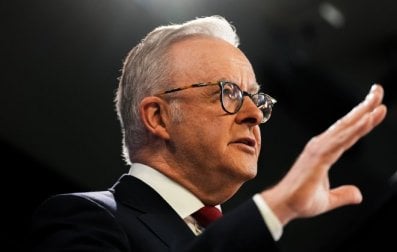
“There will be criticism from some who say it’s too high,” Albanese says. “There’s some who will say that it’s too low. What we have done is accept the Climate Change Authority’s advice and, importantly, this is world’s best practice.”
The authority’s chair, Matt Kean, said he was hopeful that Australia can “overachieve” the range.
“We have a target range,” Albanese says. “It depends upon … whether there is a lean in.” He says “the federal government can only do so much” and that other levels of government, the private sector and industry must also contribute.
Australia is five years away from a 2030 emissions reduction target of 43 per cent below 2005 levels. Departmental figures show Australia may just meet the target on the current trajectory, but it is not certain.
The ultimate goal of net zero by 2050 is, according to Bowen, ambitious. “We’re committed to it. It’s going to be hard work, but we believe the country can get it done.”
The 2035 target for Australia, one of the world’s biggest greenhouse gas polluters per capita, has disappointed climate and community groups, which regarded 75 per cent as an absolute minimum.
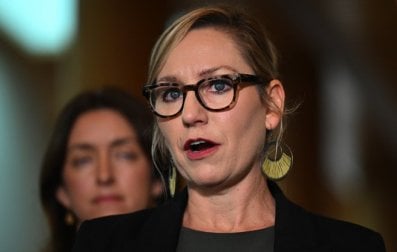
“The only reason they put a range in place is so that they can hit the lowest end of the range and then claim to be heroes,” Greens leader Larissa Waters told reporters
in Brisbane.
“This target is so appallingly low it will not keep us safe from the climate damage that was forecast in the risk report released just this Monday, a report that the government received on the same day as they approved Woodside’s North West Shelf mega gas project.”
By contrast, the Business Council of Australia says even the lower end of the range will be challenging to meet, flagging that the target range will require significant capital investment, major reform and “exceptional collaboration” between the public and private sectors.
The National Climate Risk Assessment sets out what Australia should expect under three levels of global heating: 1.5, 2 and 3 degrees above pre-industrial levels. It notes that human-induced warming has already reached 1.5 degrees and without strong action the world will reach 2.7 degrees by 2100.
At the assessment’s most extreme setting of 3 degrees above pre-industrial levels, heat-related deaths in Sydney would surge by almost 450 per cent, with a similar expected outcome for Darwin. Melbourne would experience a 259 per cent increase in deaths. It also warned that 1.5 million Australians would be at risk from rising sea levels by 2050, a figure that would double by 2090. Areas at risk of almost daily coastal flooding include Sydney and Brisbane.
Even under the current 1.5 degrees temperature-rise scenario, the direct cost of floods, bushfires, storms and cyclones to the Australian economy is expected to reach
$40 billion a year by 2050.
There were warnings about decreasing crop yields due to more drought, increased susceptibility to fire and a significant loss of social cohesion.
“High-risk communities are likely to experience domestic migration, which in turn could disrupt local economies, social networks, traditional identities and cultural heritage,” the report stated.
“Extreme events will lead to property damage, increased insurance costs and even loss of homes, particularly in coastal areas vulnerable to sea level rise and erosion. These impacts will contribute to the cost of living, placing further stress on household budgets.”
The opposition, particularly the smaller grouping of net zero opponents, has slammed the domestic assessment as “climate alarmism”. Nationals senator Matt Canavan says it is being used to “scare the bejesus” out of farmers.
However, Victorian Liberal senator Jane Hume praised its “most precise statistics” and fellow Liberal senator Andrew McLachlan said it read like a “briefing for wartime preparedness” and was “not ideology”.
Steggall says this is exactly why the ONI report should be released.
“For Australians to properly appreciate and understand why this is important, that is why a declassified report matters,” she says. “Because, if not, you have a situation like what’s happening in the media today, where the Coalition are lining up on most media platforms to discredit the national risk assessment, and to question that, as in that it’s not really as bad as it might sound.”
Just days after the dumping of Jacinta Nampijinpa Price from the front bench for failing to provide confidence in Sussan Ley’s leadership, the Coalition’s Home Affairs spokesman and firm net zero opponent, Andrew Hastie, issued an ultimatum that he would quit shadow cabinet if Ley did not dump a net zero target.
Tasmanian senator and frontbencher Jonathon Duniam followed Hastie with the assessment that there could be a “mass exodus” from the opposition front bench if the 2050 target was adopted “at any cost”.
That’s a reference to the potential costs to businesses, households and living standards, although Chris Bowen has stressed this week that “the cost of inaction will always outweigh the cost of action”.
After stirring up the opposition, Hastie later made this admission: “Most of my colleagues, in fact, don’t support my position, so I’m in the minority here.”
For David Pocock, it is about credible action to meet emissions and renewable energy targets. He says Australia should be “setting a moonshot” when it comes to climate change, because “everything hangs in the balance”.
The independent senator is furious about the government’s post-election approval for the 40-year extension to Woodside’s North West Shelf project.
“I think this National Climate Risk Assessment shows just how dire the future is if we don’t have the kind of bold leadership to lead from the front as a major fossil fuel exporter, have ambitious targets domestically, and then actually stop approving new export projects,” he tells The Saturday Paper.
“It’s hard not to get very, very angry when you see the way that things happen in this place. And you can understand why some Australians get cynical. But the thing I’d urge them to do is to actually lean into this. We all have to try and solve this.”
This article was first published in the print edition of The Saturday Paper on September 20, 2025 as "Exclusive: Government refuses to release climate security report".
For almost a decade, The Saturday Paper has published Australia’s leading writers and thinkers. We have pursued stories that are ignored elsewhere, covering them with sensitivity and depth. We have done this on refugee policy, on government integrity, on robo-debt, on aged care, on climate change, on the pandemic.
All our journalism is fiercely independent. It relies on the support of readers. By subscribing to The Saturday Paper, you are ensuring that we can continue to produce essential, issue-defining coverage, to dig out stories that take time, to doggedly hold to account politicians and the political class.
There are very few titles that have the freedom and the space to produce journalism like this. In a country with a concentration of media ownership unlike anything else in the world, it is vitally important. Your subscription helps make it possible.
Subscriber exclusive
Send this article to a friend for free.
Share this subscriber exclusive article with a friend or family member using share credits.