News
Alice Springs’ long promised Aboriginal and Torres Strait Islander Art Gallery is mired in farce, with millions spent, a school pulled down, faulty consultations and no sign of construction. By Michael Winkler.
The mishandling of the proposed Aboriginal and Torres Strait Islander Art Gallery
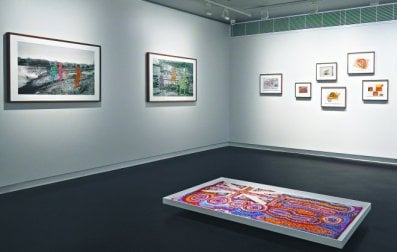
At least $15 million has been spent over the past decade on the proposed Aboriginal and Torres Strait Islander Art Gallery of Australia in Alice Springs (ATSIAGA). All there is to show for it is a half-completed design, several pink corflutes at Anzac Oval denoting it is the proposed site, and significant community dissatisfaction.
Local historian Alex Nelson calls it the most woefully mishandled project in the era of Northern Territory self-government. Arrernte man Peter Renehan describes it as a farce. A former NT arts minister, who asked not to be named, says the time for this project has passed and it should be abandoned.
The Northern Territory government continues to pledge $80 million for the project, augmented by a promised $80 million of federal money. Some community leaders are calling on the Albanese government to withdraw that pledge, arguing the current project proposal has changed so much that it voids the promise.
About two decades ago, local Indigenous leaders, including Renehan, Harold Furber and Owen Cole, developed the idea for a national Aboriginal and Torres Strait Islander art and culture museum. When their vision collided with political pragmatism and funding realities, the dream of an iconic institution foundered.
Scott McConnell, a former Labor member in the Territory parliament, accompanied Furber and Cole on research trips within Australia and internationally. He explains the project like this: “Harold Furber articulated the first principles: it needed to be national; it needed to be both art and culture; it needed to be governed and owned by Aboriginal people, with curatorship independent of government; and it needed to be in Alice Springs.”
When Adam Giles’ Country Liberal Party government sold the Territory Insurance Office for $424 million in 2014, $20 million of the proceeds was allocated to a national Indigenous art and culture centre.
After Labor’s Michael Gunner won power in 2016, a steering committee led by prominent arts administrators Hetti Perkins and Philip Watkins recommended the gallery be built at the Alice Springs Desert Park, eight kilometres west of town. By this stage, the proposal for a cultural component and truth-telling had already been dropped. The Gunner government overrode the Alice Springs Desert Park recommendation and chose the site of the former Anzac Hill High School.
This site is unacceptable to Arrernte Traditional Owners and Custodians. Doris Stuart Kngwarreye, Apmereke-artweye (senior Traditional Owner) for Mparntwe, said the consultation process was “a complete joke … If you’re there and they’re consulting with you and you say, ‘No, end of story’, consultation goes on without you there. The boxes have been ticked.”
She made clear that Anzac Oval is on a sacred women’s site and that overlaying stories and images from other parts of Australia, as would happen in a gallery, would be deeply inappropriate. “If you put a building up there with stories that don’t belong there, how do you think the ancestors will feel towards that?”
The Gunner government earmarked a further $50 million for the art gallery project, on top of the original $20 million. Anzac Hill High School, a functional building still in use, was demolished in 2019 at a cost of $2.5 million, after which the government decided the sports field next to it would be a better gallery site.
This was opposed by Alice Springs Town Council, but the decision was upheld at the NT Civil and Administrative Tribunal. In March 2023 compulsory acquisition of Anzac Oval by the Fyles Labor government was completed at a cost of $3.66 million.
After the CLP won government again in 2024, Chief Minister Lia Finocchiaro said the oval must be saved. The gallery site was moved to the sporting field’s car park on Wills Terrace, diagonally opposite the Todd Tavern.
Scott McConnell, who left the Labor Party to sit as an independent, blames his former leader for the mess.
“Michael Gunner and his adviser were adamant that they should divide the project into two, separating art and culture,” he says.
“I realise now they were being disingenuous and had no intention of committing to a cultural centre or a truth-telling concept. It was appropriating Indigenous high culture for tourism purposes. At one end of Todd Mall we’d have air-conditioned spaces and glass cases showing art, and at the other end of the mall we’d chase Aboriginal kids with police dogs and lock them up.
“There was attempted bullying of members of the steering committee trying to get them to say the project could only proceed at Anzac Oval. There was a lack of understanding that this was a project of national significance, not a parochial little thing positioned to profit a small cohort of mainly non-Indigenous businesspeople. This was short-term political expediency. The person ultimately responsible is Gunner, for derailing a nationally significant project.”
Gunner, now living and working in Western Australia, did not respond to a request for comment.
Peter Renehan, chief executive of the Centre for Appropriate Technology and the son of Doris Stuart Kngwarreye, says the Territory government “should not be in control of anything to do with Aboriginal projects and builds”.
“They want to use Aboriginal-allocated money for their own purposes. They stole the Aboriginal IP and all of Harold and Owen’s work, then split art and culture against Aboriginal people’s wishes. I strongly feel the [government] should be held accountable for that misappropriation of the Aboriginal story, money and truth-telling component. That is missing in Australia’s make-up and needs to be told by us, not others,” he says.
“The federal government needs to do the right thing and put the money back where it was supposed to be, in a joined art and cultural truth-telling centre on land south of the [Heavitree] Gap with support of Aboriginal people. It needs to be Aboriginal-led, not government-led …
“Big business support from Sydney wanting to redevelop in the vicinity seems to be more important than custodian or community wishes.”
Updated concept pictures for the project – by BVN and Susan Dugdale and Associates – were released in late July. Public response was poor.
Still, the Territory’s treasurer, Bill Yan, is bullish. “The NT government is committed to delivering the ATSIAGA within scope and within budget,” he says. “It should be noted the actual reduction in gallery exhibition space with the new design is less than 100 square metres than the original design.
“This follows the previous NT Labor government’s complete mismanagement of the project spiralling into a $300 million cost blowout of the original design. While the NT government has committed $80 million towards this project, it is difficult to justify spending another $220 million on a gallery when we have more urgent priorities funding infrastructure and roads, and dealing with law and order.”
The federal minister for infrastructure, Catherine King, continues to say the $80 million committed towards the gallery project under the Priority Community Infrastructure Program will be honoured.
“We are aware of the Northern Territory government’s desire to review the gallery’s design to support keeping Anzac Oval available for community use,” a government spokesperson tells The Saturday Paper. “The Commonwealth will continue to work constructively with the NT government to deliver a successful project for the Alice Springs community.”
It is a tough time for NT museums and galleries. At the start of this month Alice Springs’ Museum of Central Australia closed its doors. In June it was announced that, with construction almost complete on the $150 million art gallery in State Square in Darwin, the project would be abandoned due to cost overruns.
Finocchiaro called it a “shemozzle”, acknowledging that the holding collection was at risk in the inadequate storage facility at Bullocky Point. She said if an expression of interest process to take over the new State Square building was unsuccessful, “we can put a chain around the door and not open it”. This precedent makes critics question if her government will stay committed to the Alice Springs project.
Shadow minister Chansey Paech, a former Labor minister for arts and culture, says, “The initial budget was always a starting point, with work under way to bring in further investment from private partners, philanthropic and Aboriginal investment corporations, building towards a $250-280 million project.
“It is incredibly disappointing to see the CLP government walk away from this vision. What they have proposed will be flat out getting a single local through the doors. It would not surprise me if they tried to not proceed with it.”
Pushed on the fact the Labor government chose a sacred Arrernte site for the project, Paech says, “That site was chosen back in 2017, well before I was in cabinet, and was the result of cabinet decisions I was not a part of.”
Scott McConnell and others continue to mourn what might have been. “This project could have been the most significant museum this country has ever seen, or will ever see, but if this is a nationally significant facility, where is the national debate?” he says.
“The federal government has a perfect opportunity to say, ‘We will listen to Doris Stuart and we cannot proceed with funding something offensive to local people that is so much less than the sum of its parts.’ The NT government is subjugating, not celebrating, Indigenous people, and therefore has no mandate for involvement in this project.”
This article was first published in the print edition of The Saturday Paper on September 20, 2025 as "Rogues’ gallery".
For almost a decade, The Saturday Paper has published Australia’s leading writers and thinkers. We have pursued stories that are ignored elsewhere, covering them with sensitivity and depth. We have done this on refugee policy, on government integrity, on robo-debt, on aged care, on climate change, on the pandemic.
All our journalism is fiercely independent. It relies on the support of readers. By subscribing to The Saturday Paper, you are ensuring that we can continue to produce essential, issue-defining coverage, to dig out stories that take time, to doggedly hold to account politicians and the political class.
There are very few titles that have the freedom and the space to produce journalism like this. In a country with a concentration of media ownership unlike anything else in the world, it is vitally important. Your subscription helps make it possible.
Subscriber exclusive
Send this article to a friend for free.
Share this subscriber exclusive article with a friend or family member using share credits.