News
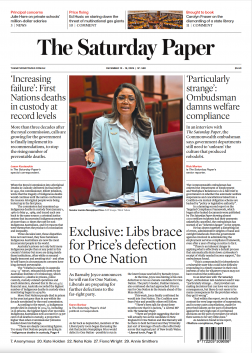
As Barnaby Joyce threatens to destroy the Nationals, those close to him say he is smarting at the party leader he claims to have made and by whom he was ‘repaid with exile’. By Jason Koutsoukis.
Your subscription makes these exclusive articles possible
Subscriptions make these exclusives possible SUBSCRIBE NOW
Exclusive: Dutton told Joyce ‘we just want you out …’
Before the last election, then Coalition leader Peter Dutton gave Barnaby Joyce an ultimatum: we just want you out of the parliament.
“It was made very clear that this was what both Dutton and Littleproud wanted,” a Coalition source familiar with the conversation tells The Saturday Paper.
“It was like the wife saying, ‘Not only do I not want to share the same bed with you, but I want you to go sleep in the corner and I never want to be seen in public with you again.’ ”
Twenty years earlier, in a small accountancy office on the main street of St George, a cotton town about 500 kilometres west of Brisbane, then senator-elect Barnaby Joyce pointed to a signed portrait of his political hero, Joh Bjelke-Petersen, and declared that the days of the Nationals being kicked around by the Liberal Party were over.
Joh’s fixed grin looked down from the wall, a relic of the party’s most combative years, when power in the bush meant never bowing to inner-city Liberals. On his desk sat a family photograph of his then wife Natalie and their four young daughters.
Between the two images – the patriarch of Queensland populism and the young family man he imagined himself to be – Joyce set out the creed that would guide his political life.
“To tell you the truth, I have never really liked Liberals much. They all think they have something special happening in their lunch box,” Joyce told me at the time. “People say I’m a maverick. Wrong. A maverick is someone who represents himself – not a constituency ... Anyone who thinks I am going to become an independent like Bob Katter has completely misread me.
“I have not joined the Nationals to tear them down. I am passionate about this party – and the conservative Coalition – and I am going to help rebuild the National Party by standing up for the things our supporters – working rural people – believe in.”
Joyce spoke of John “Black Jack” McEwen, the legendary leader of the Country Party – which was founded in 1920 and renamed the National Country Party in 1975 before becoming the National Party in 1982 – as if reciting scripture. McEwen was, he said, a man who embodied the party’s enduring virtues of independence, loyalty and an unbending belief that the bush should never be taken for granted.
That was 2005, before Canberra, before the sex scandals, before the long cycle of gaining power and losing it. Joyce was 38, not yet sworn in to the Senate, his rural office furnished with a hand-me-down desk and a cast-off chair from Westpac.
Two decades later, Joyce is no longer an insurgent outsider preparing to enter parliament but, rather, the twice-fallen leader of a party he now seems intent on wounding.
Having announced he will not recontest his lower house seat of New England, Joyce is now openly flirting with the idea of defecting to Pauline Hanson’s One Nation.
“I’m not saying yes, I’m not saying no,” Joyce told ABC Radio National Breakfast this week when asked if One Nation was his most likely destination.
It is a remarkable turn in a career that began with vows of loyalty.
The man in that office later walked out on the family in the photo on his desk, to start a second family with his press secretary, and is now courting the party he once believed was a threat to everything the Nationals stood for.
Central to the story is the Nationals current leader, David Littleproud, a man he once lifted into cabinet.
In 2017, Joyce personally promoted Littleproud to cabinet as minister for agriculture and water resources – fast-tracking Littleproud barely 18 months after he entered parliament.
The son of a Queensland state minister who served under Bjelke-Petersen, Littleproud would later betray the favour with quiet precision, successfully challenging Joyce after the Coalition’s 2022 election defeat and consigning his former patron to the back bench following this year’s election defeat.
Three years after Joyce entered parliament, former treasurer Peter Costello already had him pegged. In his 2008 memoir, Costello described Joyce as someone elected on a populist rural platform who “felt no loyalty to the Coalition” yet wanted “to share the Coalition’s record of achievement in economic management but also to oppose the measures necessary to deliver those results”.
“He made the life of the National Party leader a misery and undermined his authority in the party and in the broader community they represented,” noted Costello. “There are no big differences between the Liberal Party and the National Party. But there are big differences inside the National Party, especially the National Party in Queensland, where there is a Coalitionist wing, represented by Senator Ron Boswell, and a populist wing, represented by Barnaby. Most of Barnaby’s supporters are the people who had supported the Joh-for-PM campaign.”
That faultline still exists today, with Littleproud’s tidy pragmatism up against Joyce’s performative defiance. Where Littleproud wants the party to look forward, Joyce still wants it to roar like it used to when he first entered the senate.
Friends and colleagues describe Barnaby Joyce as a man who still burns with conviction – who has not lost faith in what he believes the Nationals should stand for but who no longer recognises it in what Littleproud says and does.
“Barnaby’s problem,” says one long-time political associate, “is that he still believes he’s fighting for the same party he joined 30 years ago – the one that looked like Joh and Black Jack. But he doesn’t think that party exists anymore.”
Others close to Joyce say three forces have brought him to this point. The first is philosophical: the belief the Nationals have drifted from the values that once anchored them, values of certainty, conviction and a willingness to “die in the ditch” for the bush. The second is personal: the deep resentment of a leader he believes he made and who then discarded him. The third is emotional: a refusal to fade quietly into irrelevance while the fire of the first two still burns.
Littleproud, whom Joyce refers to privately as “spivweasel”, remains a particular sore point.
“There’s a loyalty issue there,” one Nationals insider tells The Saturday Paper. “He feels he built Littleproud – and was repaid with exile.”
Since wresting the leadership from Joyce in 2022, Littleproud has kept him at the margins, barring him from travelling outside his electorate during this year’s election campaign, even to seats where he had been personally invited by local branches, and cold-shouldering him from the party forums Joyce once dominated.
“You can’t treat people like that, especially when that person is the most popular rural politician in the country,” Joyce’s ally says. “And the lesson here is that if you make someone feel they have no role, don’t be surprised when they go and find one.”
That sense of exclusion has festered alongside ideological frustration. Joyce sees the Nationals’ drift towards what he regards as political convenience – particularly on Australia’s commitment to net zero – as proof the party has lost its bearings.
Two years ago, Joyce led a push at the Nationals’ federal conference to dump the party’s net zero commitment, while Littleproud manoeuvred behind the scenes to block it.
“He looks at that and sees a party that doesn’t really believe in anything anymore,” says one Joyce confidant, adding that while “you might not agree with Barnaby’s views, at least you know he believes in something”.
Those who have spoken to Joyce recently describe a man as pugnacious as ever, who tells friends he is not leaving the Nationals so much as defending what they used to be – a party unafraid of conflict with the Liberals, proud of its independence and rooted in the regions.
“He’s not lost his passion for politics or for the country,” says the same colleague. “He just doesn’t think the Nationals are that party anymore.”
For Joyce and his dwindling circle, the Nationals under Littleproud have become too managerial. They see the party as compliant where it once was tough, accommodating where it once was tribal.
To his critics, this is self-serving mythology – a story Joyce tells himself to rationalise his own mistakes and failures. To his allies, it’s proof he still embodies a strain of conviction politics the party no longer rewards.
“He’ll roll the dice again and see what comes up,” says one parliamentary colleague. “That’s what he always has done. He gave up a safe Senate spot in Queensland to run for the seat of New England across the border in New South Wales.”
Few doubt Joyce is serious about joining One Nation, believing the courtship has been under way for more than two years.
Hanson herself might not be ready to quit politics and bequeath the party that carries her name to a successor, but she and her advisers understand the value of Joyce’s brand: the name recognition, the nostalgia, the sense of grievance that overlaps almost perfectly with their own.
In Joyce, they see a vehicle to fundamentally expand the party’s reach and influence.
For all of Joyce’s personal bitterness, his departure exposes a deeper problem for the Nationals, however – and for the Coalition that depends on them.
Dr Jill Sheppard, a political scientist at the Australian National University, who worked for a Nationals agriculture minister in the Howard years, says the danger for the Coalition is not just that Joyce might leave – but that he could take others with him, such as his former staffer, Nationals senator Matt Canavan, and Country Liberal Party senator Jacinta Nampijinpa Price.
“It’s really hard for the Nationals to toe the line between being an expressly rural- and regional-based party, and also being in coalition with a Liberal Party that relies heavily on business for both votes and donations,” Sheppard says. “You have to genuinely believe in that arrangement to make it work, because it’s not necessarily rational.”
From a purely strategic perspective, she argues, the more logical path for the Nationals would be to walk away from the Coalition.
“The most electorally rational thing for the Nationals to do is to leave the Coalition agreement, campaign separately, devise their own policy campaign on that basis, and then after every election – when the two parties get a joint majority – sigh and say, with great reluctance, ‘We are working with the Liberals again.’ ”
Sheppard says that logic is clear to Joyce but less so to his successor.
“David Littleproud knows it’s probably rational for them to leave, but there are too many in the party who just feel like this is their home, for better or worse. And Barnaby obviously doesn’t think that.”
The divide, she says, is now existential. “You’re not even arguing on the same dimension. One side is arguing, ‘We just need to win more votes – and if we can do that with One Nation, then all the better.’ The other side is arguing from a sense of history and identity, a belief in what the National Party should be, not necessarily what it could do to win.”
If Joyce’s departure threatens to fracture the Nationals, historians such as Dr Stephen Wilks see it as another chapter in a much longer story – one that has always oscillated between decline and survival.
“I think they’re facing the hard reality of overall decline,” Wilks says. “But what’s more remarkable is how long the Nationals have been able to manage that reality and deal with it.”
He points out that, in the early 20th century, rural parties sprang up across the world – in Scandinavia, Canada, the United States, New Zealand and Australia. Almost all disappeared or were absorbed by larger conservative movements. “The incredible thing,” he says, “is how the Australian Country Party – the National Party – has been able to deal with the tough reality of population shift and lesser standing in the nation. It’s absolutely and utterly amazing. It could be unique.”
What saved them, Wilks argues, was the Coalition itself – the “magic formula” that balanced independence with influence. “We’re separate from the Liberals, we’re different, but at the same time we’re part of a big show,” he says. “That balance kept them relevant for a century.”
Twenty years ago, Barnaby Joyce swore the Nationals would never again bow to the Liberals. Today, it is not the Liberals who threaten the party’s survival but Joyce himself.
This article was first published in the print edition of The Saturday Paper on October 25, 2025 as "Exclusive: Dutton told Joyce ‘we just want you out …’".
For almost a decade, The Saturday Paper has published Australia’s leading writers and thinkers. We have pursued stories that are ignored elsewhere, covering them with sensitivity and depth. We have done this on refugee policy, on government integrity, on robo-debt, on aged care, on climate change, on the pandemic.
All our journalism is fiercely independent. It relies on the support of readers. By subscribing to The Saturday Paper, you are ensuring that we can continue to produce essential, issue-defining coverage, to dig out stories that take time, to doggedly hold to account politicians and the political class.
There are very few titles that have the freedom and the space to produce journalism like this. In a country with a concentration of media ownership unlike anything else in the world, it is vitally important. Your subscription helps make it possible.
Subscriber exclusive
Send this article to a friend for free.
Share this subscriber exclusive article with a friend or family member using share credits.