Comment
Paul Bongiorno
Chalmers retreats on super reforms
Soon after Labor’s thumping election win, Jim Chalmers was assuring doubters he would not be “changing policies we took to the election”. Within three months, however, that determination was undercut by Anthony Albanese quietly telling the treasurer to come up with a more saleable prescription on superannuation reforms.
There have been more spectacular episodes of a prime minister overriding a treasurer, but nonetheless Jim Chalmers had to swallow hard.
This week, those changes were announced: a watered-down proposal to address massively generous tax concessions for Australia’s richest, lest the proposal that was taken to the election upset the big end of town or hand political opponents the elements for a scare campaign.
It is not clear if Chalmers would have been forced to ditch the reforms altogether if he didn’t find a different solution, but the treasurer was of no mind to confront the prime minister on it. Albanese has unrivalled authority within the parliamentary party following May’s landslide election win.
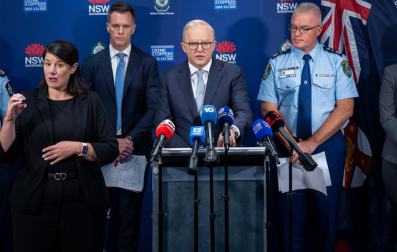
The government is high in the opinion polls and the fact the rumblings on the tax proposals were kept in-house shows discipline is holding. Indeed, Monday’s news conference announcing the changes to the tax concessions caught the gallery by surprise. For one thing, Albanese was out of the country on holidays. Normally, he would be front and centre of any major government announcement.
While some saw this absence as Albanese leaving it to Chalmers to carry the can, it did allow the treasurer to put his most positive spin on what the opposition called “a full knock-down rebuild of an utterly failed policy”.
Chalmers rejects this characterisation, saying he and the prime minister had a number of conversations since August “about finding another way to deliver on the objectives of our policy”. Though he cannot deny that the refurbished policy leaves the budget poorer than he would have liked, it does go some of the way to meeting Treasury’s concerns about the revenue’s dependence on personal income tax and the enormous cost of the tax concessions.
One long-time associate of Albanese’s says that although he is a member of the Left, with a firebrand reputation from his student days, he is more cautious than bold and could more accurately be called conservative.
Albanese’s skittishness was exacerbated by what Chalmers concedes were the “very strong views” tirelessly advanced to him by former prime minister Paul Keating ever since the policy was originally announced.
The targets of Keating’s invective, privately put but nonetheless reported, were the failure to index the threshold at which the tax on earnings in superannuation accounts would be doubled and the fact it would be applied to unrealised capital gains.
These features were designed by Treasury to overcome the complexities involved in making the system more equitable, in the full knowledge they would only hit about 100,000 high-wealth Australians.
Assistant treasurer Andrew Leigh says retirement savings tax concessions are costing the budget about “$55 billion a year, and in a couple of decades the super concessions will cost more than the pension”.
Not to be missed in this discussion is the huge kerfuffle generated by the Liberals and sections of the finance media over Labor being less generous to the wealthiest Australians, expecting other taxpayers to subsidise this wealth accumulation.
Without broadening the tax base to assets, there would be either drastic cuts in expenditure on health, education, social services and defence, or an increase in taxes for working people and younger Australians.
Thanks in part to the multibillion-dollar tax concessions in superannuation and housing, Australia faces burgeoning wealth inequality.
According to the latest UBS Global Research, household wealth in the September quarter in Australia surged 2.1 per cent quarter on quarter for an annualised climb of 7.7 per cent – or by $1.3 trillion to a record $18.1 trillion. Not surprisingly, most of that wealth is tied up in superannuation and housing.
Wealthy Australians have been allowed to subvert the entire purpose of superannuation as a retirement-protection vehicle into a tax-minimisation vehicle.
Tax data quoted in The Sydney Morning Herald suggests there are 30 people with more than $100 million in their super at an average of $209.3 million a person.
It is disappointing to some in Labor’s ranks that the prime minister is spooked by finance writers in The Australian and The Australian Financial Review doing their best to stymie this tax reform. According to a Treasury source, a number of the scenarios painted in the scare stories were simply fanciful.
Keating’s role does not escape criticism from some of his hitherto admirers in the party. The former prime minister praised Chalmers for putting a cap on accounts above $3 million and $10 million and indexing them. They are still receiving generous concessional treatment and paying less than they would have under Chalmers’ original plan.
Chalmers called Greens leader Larissa Waters immediately after Monday’s cabinet meeting had signed off on his revamp. He was keen to inform her of his boost to the low-income superannuation tax offset (LISTO), changing the cap from $500 to $810 a year and extending it to incomes up to $45,000. He told her this will mean 1.3 million Australians, mostly women and students, will get more super when they retire.
The Greens are Chalmers’ best hope of getting the changes through the Senate, despite their parliamentary tactician, Sarah Hanson-Young, accusing the government of going “weak on taxing the wealthy” and saying this “isn’t the type of superannuation reform the Greens wanted to see”.
The Greens will not wave through the reforms without the government giving them something. Hanson-Young says the party will work through the details when the bills hit the Senate.
The government is expecting the Coalition to oppose its reforms, even though shadow treasurer Ted O’Brien described the “tax backflip” as a “humiliating admission of failure” and a “victory for the coalition of common sense”.
One government source says the Liberals are no friend of superannuation and their ideological blind spot will see them attempt to block this proposal but then also claim to be champions of tax reform.
Chalmers says he’s dealt with the two issues the Liberals said were a sticking point for them and they have run out of excuses. He said they wanted to “jack up taxes on a hundred per cent of Australian workers, but they go to the wall for less than half a per cent of people in the super system with very large superannuation balances”.
Economist Chris Richardson fears genuine tax reform is just too hard for politicians. He says the strong backlash prompted by Chalmers’ overhaul underscores how “spectacularly hard” tax reform remains, even under a government that has received a clear mandate and a thumping majority.
Richardson, one of Australia’s most prominent economists and a former Treasury official, says Australia increasingly needs change. “Much of our taxing is terrible, much of our spending is stupid,” he says, adding that for decades our national housing policy has been the word “no”.
He says: “Today’s timidity worries me.”
Timidity is one thing; sheer cussedness is another. A line in Ted O’Brien’s press release would give Richardson even more concern. The shadow treasurer says the Coalition’s principles remain clear: “super should be about helping Australians build a nest egg, not a blank cheque for the government to fund its spending spree.”
Apparently O’Brien’s preference to defend billions of dollars in tax concessions to wealthier Australians and investors is, to his mind, not already a spending spree – a profligate one at that.
In this mindset, the only safe tax reform is to sock the poor. This sort of policy is what gave us robodebt and makes a virtue out of attacking “dole bludgers” and “welfare cheats”, winning plaudits from the Murdoch tabloids and Sky News after dark.
https://www.youtube.com/watch?v=wkWWIJy_YYo
The prime minister will return from his South Pacific sojourn today, before jetting off for his Oval Office tete-a-tete with United States President Donald Trump in Washington, DC. He can be grateful he has a treasurer who is a team player, willing to temper his ambitions for reform in favour of living to fight another day.
Chalmers will be in the American capital at the same time as Albanese, attending the annual International Monetary Fund and World Bank meeting, grappling with the global uncertainty generated by Trump’s disruption of international trade and his stand-off with China over access to critical rare earth minerals.
The treasurer has played his part in helping set up Australia as a foil for China’s monopoly on these minerals, which are so integral to modern technologies, with tax offsets for miners and processors.
Australian and US officials have been working on a framework agreement for Australia to provide a guaranteed supply chain, expected to be announced by Trump and Albanese after their meeting.
The White House conversation is sure to steer away from tax reform and economic management, though. The approaches of the Trump administration and the Albanese government couldn’t be further apart, nor could the styles of the two leaders.
This article was first published in the print edition of The Saturday Paper on October 17, 2025 as "Super cap a fragile leap, inequity’s atrocious".
For almost a decade, The Saturday Paper has published Australia’s leading writers and thinkers. We have pursued stories that are ignored elsewhere, covering them with sensitivity and depth. We have done this on refugee policy, on government integrity, on robo-debt, on aged care, on climate change, on the pandemic.
All our journalism is fiercely independent. It relies on the support of readers. By subscribing to The Saturday Paper, you are ensuring that we can continue to produce essential, issue-defining coverage, to dig out stories that take time, to doggedly hold to account politicians and the political class.
There are very few titles that have the freedom and the space to produce journalism like this. In a country with a concentration of media ownership unlike anything else in the world, it is vitally important. Your subscription helps make it possible.
Subscriber exclusive
Send this article to a friend for free.
Share this subscriber exclusive article with a friend or family member using share credits.