News
EXCLUSIVE: The trade minister tells The Saturday Paper about Australia’s edge in negotiations with the US over tariffs. By Karen Barlow.
‘World upon his shoulders’: Farrell on the trade challenge facing the US
Don Farrell isn’t sweating over Australia’s missed meeting with the American president – the trade minister has a different perspective on where the real pressure is being felt.
Donald Trump set a tight deadline for remaking America’s trade relations with the world – 90 deals in 90 days. July 8 is rapidly approaching and there’s not much to show for it.
“If you had seen Jamieson Greer in Paris two weeks ago, you would have thought he had the worries of the world upon his shoulders,” Farrell says of Trump’s top trade representative.
“Of course, it was the biggest meeting of trade ministers of all time, and everybody wanted to be talking with the Americans.”
A UK–US tariff deal is in place and reportedly most of a “framework” with China, but with so much still to be done, it is a valid question as to which side, the United States or Australia, has the most to lose in trade negotiations that are still pending.
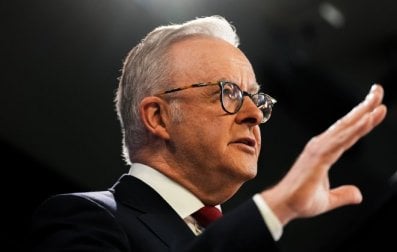
Speaking to reporters at the G7 gathering in Kananaskis, Canada, Prime Minister Anthony Albanese was pragmatic about Trump’s cancellation of their meeting – the president left a day earlier than scheduled to deal with the Middle East crisis from the White House.
“We’re mature about the circumstances of what happened. It’s perfectly understandable,” Albanese said. “We’ll reschedule a meeting. From time to time, that is what occurs.”
Instead, he met this week with Greer, US Treasury Secretary Scott Bessent and the director of the National Economic Council, Kevin Hassett. The prime minister has put to them Australia’s case on the US-imposed tariffs but wants to also talk about the future of the AUKUS nuclear-powered submarines agreement, which is currently under a 30-day review by the Pentagon.
Albanese remains under some pressure to secure an audience with the US president, having so far managed just three phone calls and no face-to-face meetings. Farrell says the president is hardly less pressured, however, given the deadline he himself set. A ratcheting up of tariffs is hardly ideal for the US, given the market turmoil that has attended them and how unpopular they have proved domestically. The Australian strategy with the Trump administration, according to the trade minister, is focused on calm and clear-headedness. And we are looking to diversify on key areas of national concern.
That strategy is clearly already advancing, as Albanese worked with ambassador to the US Kevin Rudd in the orbit of the leaders of the world’s seven top economies in Kananaskis. Before leaving Canada, the prime minister announced that Australia will start talks on a security and defence partnership with the European Union.
“We don’t panic. We don’t overreact. We know what we want out of our relationship with the United States in terms of defence and security,” Farrell says.
“We don’t want to link security with trade. We see them as separate issues. My job, along with the prime minister, is to keep talking with the Americans.”
The trade minister says part of the current difficulty is knowing what the Americans want.
“The person who wins a negotiation is the person who knows what they want and sticks to it,” Farrell says. “It’s still not clear to me what it is that the Americans want out of their trade relationship generally, but more specifically, what they want out of the relationship with Australia.
“We need to know what the Americans are seeking out of a trade agreement and work out what our response to that might be.”
The minister says Australia wants clarity on whether the “new minimum” on tariffs is going to be zero or the 10 per cent “baseline” applied on April 5 to Australian goods imported into the US – the lowest level imposed on any country. The tariffs were blocked from coming into effect in late May by a US federal court, and the Trump administration is appealing against the ruling.
The 50 per cent tariffs that were also announced on products such as steel and aluminium are not affected by the ruling.
“I don’t know whether after the eighth of July that will become clearer,” Farrell says. “Certainly, it’s not clear to me based on the three conversations I’ve had with Jamieson Greer as yet, whether or not the American policy will, in fact, be a minimum of 10 per cent across the board for everybody, and then other countries subject to a higher figure.”
Australia’s position remains that the tariffs are unjustified, as America has enjoyed a roughly 2:1 trade surplus with this country since the 1950s. Moreover, the two nations have a legally binding free trade agreement.
“That agreement obliges free trade on both sides and tariff-free access … even though our goods are now subject to a 10 per cent tax, and in the case of aluminium and steel a 50 per cent tax – we have not retaliated,” Farrell says.
“We are honouring the terms of our free trade agreement and we want the Americans to do the same.
“We want America to honour what we reached 20 years ago, and that is free and fair trade between both our countries. We don’t apply tariffs to them. They don’t apply tariffs to us.”
As for retaliation, the minister says he “hasn’t seen a single case” to persuade him that applying reciprocal tariffs on American imports would work.
What is clear is that Australia is actively seeking trading and security partners other than the US. Farrell says we are now selling more wine to China than before the trade freeze of several years ago. That action by our largest trading partner came in the early months of the pandemic, when China imposed taxes ranging up to 220 per cent on Australian wine as part of a broad-based trade dispute with the Morrison government.
Farrell says progress has been made on a free trade agreement with India, and one with the United Arab Emirates is due to start in a few weeks.
“That will give us tariff-free access to virtually every Australian product into the United Arab Emirates,” he says. Farrell describes the country as “like the Woolies warehouse of the Middle East. If you can get your product in there, you can get it to the six other Middle Eastern countries.”
Negotiations with the European Union over a free trade agreement are more challenging, Farrell says, though he sees “plenty of positive signs”.
He cites “good meetings” with the new EU trade commissioner Maroš Šefčovič, who negotiated the Brexit agreement with the United Kingdom on behalf of the Europeans.
“He’s got a track record of negotiating tough, tough agreements,” Farrell says.
“I met with the French. They also were positive about a free trade agreement, despite some of the internal pressures on them from the agricultural sector element with the Germans.
“So, I came away from Europe very positive.”
As for Australia’s edge in negotiating with the US, one thing America wants is a reliable source of critical minerals and rare earths – 36 of them in particular.
Farrell says Australia has a well-deserved reputation for honouring contracts and needs access to capital to take advantage of one of the world’s largest mineral reserves.
“Our discussions with the United States, as they have been with the Europeans, and have been with the Japanese and the South Koreans … it’s all about trying to get countries who are interested in access to our critical minerals and having alternative markets to purchase from,” the minister says.
“It’s all about ensuring that we can definitely extract those minerals. So that’s the discussion we’re having with the United States.
“Why is Donald Trump interested in Greenland and Ukraine? Well, because he’s interested in their critical minerals.”
As for our national security interests, the fate of the AUKUS agreement remains front and centre. The Albanese government took some comfort from a slight exchange at the G7 between Trump and British prime minister Keir Starmer, in which the latter described AUKUS as an “important deal”. Trump nodded and talked ambiguously about the UK–US alliance and the friendship they have across the political divide.
Asked if the UK leader gave him any sense that Trump is in favour of AUKUS, Albanese said, “I’ve seen nothing to suggest otherwise.”
Even if the agreement survives the Pentagon review, however, doubts persist about the timeline for the delivery of the promised Virginia-class subs from the US, and the plans to build SSN-AUKUS nuclear-powered subs in Adelaide.
Under Secretary of Defense for Policy Elbridge Colby – who is leading the Pentagon’s review of the AUKUS deal – has long been sceptical of AUKUS and the ability of the US defence industrial base to supply the US with enough submarines for its own needs.
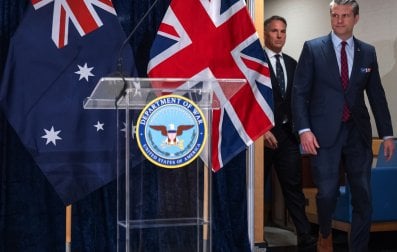
The Albanese government regards the review as “routine”. On Thursday, US Defense Secretary Pete Hegseth said it had come about after “long, personal conversations” with AUKUS counterparts, John Healey in the UK and Australia’s Defence Minister Richard Marles.
He also hinted to the Senate Armed Services Committee in Washington, DC, that the trilateral agreement might boost US nuclear deterrence in the Indo-Pacific.
“Working through AUKUS as a possible avenue for that is a good thing,” Hegseth said.
Albanese talked up the defence and technology pact as, “The sum of one plus one plus one sometimes equals more than three”, that it has the “capacity to lift up the capability of all three countries”.
The group of Labor Party members Labor Against War wants someone within the caucus – which is now significantly populated by Left-faction members – to challenge the whole $368 billion AUKUS proposition.
“I think the party room is mute,” Labor Against War’s national patron and former senator Doug Cameron tells The Saturday Paper.
“I think the party room is doing a great disservice to the rank and file by not testing these policy positions on AUKUS and we need some courage, we need some conviction, and we need people that are aware and wedded to the values that Labor have in relation to peace.
“I can’t see any active push for peace. Where are the Tom Urens? Where are the Simon Creans within the party? Where are the Paul Keatings who understood the global approach on these issues?”
Cameron, who insists he is no pacifist and acknowledges Australia needs to protect itself, praises the Labor member for Fremantle and assistant minister Josh Wilson as a “courageous and effective parliamentarian” for speaking up as much as he has on AUKUS.
Wilson, who has a long history in peace and disarmament, wrote an article late last year for Australian Foreign Affairs outlining his concerns and calling for an “appropriately searching public conversation about the largest defence acquisition in Australia’s history”.
“We have embarked on an excruciatingly long, complex, fraught and costly endeavour that, in my view, remains substantially unexplained and unjustified,” Wilson wrote.
For now, at least, the Albanese government is mounting a case to stick with AUKUS and secure our longstanding trade ties. Albanese just needs to do that face-to-face.
This article was first published in the print edition of The Saturday Paper on June 21, 2025 as "‘World upon his shoulders’: Farrell on US trade test".
For almost a decade, The Saturday Paper has published Australia’s leading writers and thinkers. We have pursued stories that are ignored elsewhere, covering them with sensitivity and depth. We have done this on refugee policy, on government integrity, on robo-debt, on aged care, on climate change, on the pandemic.
All our journalism is fiercely independent. It relies on the support of readers. By subscribing to The Saturday Paper, you are ensuring that we can continue to produce essential, issue-defining coverage, to dig out stories that take time, to doggedly hold to account politicians and the political class.
There are very few titles that have the freedom and the space to produce journalism like this. In a country with a concentration of media ownership unlike anything else in the world, it is vitally important. Your subscription helps make it possible.
Subscriber exclusive
Send this article to a friend for free.
Share this subscriber exclusive article with a friend or family member using share credits.