Fashion
Susan Dimasi’s designs reflect her philosophy that fashion for professional women should be beautiful, functional and good for mental health. By Lucianne Tonti.
Susan Dimasi’s three principles that inform MaterialByProduct
Susan Dimasi makes the kind of clothes that are increasingly difficult to find. Her aim is to flatter the female form, which requires a delicate balance between revealing and concealing it. She understands how a woman’s hormones might cause her size to fluctuate over the course of a month, or what she might want from a garment as her body changes with age. Over the two decades she has run her label MaterialByProduct, she has made empowering women her raison d’être.
“When I start my process, I’m thinking about the needs of the women I serve. They need clothes that are comfortable, that are practical and that function in a way that allows them to get dressed on autopilot.”
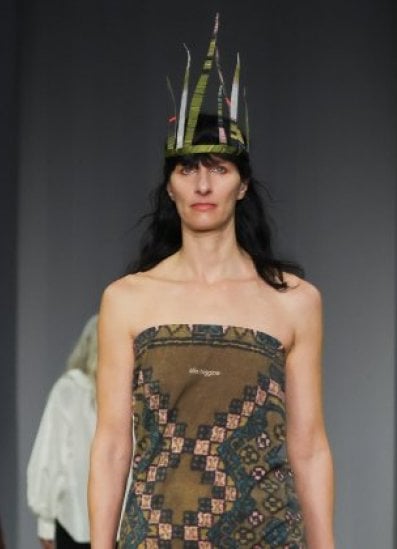
Hers are dresses with clean lines and French seams with enough fabric to drape across the bust and the belly. Silk blouses with interesting sleeves. Jackets and pants cut from pure wool and leather. And Dimasi is a fierce advocate for high-quality cloth made from natural fibres.
MaterialByProduct launched in 2003 when Dimasi’s collection from her master’s degree at RMIT was picked up by a boutique in Milan. For years she operated the brand according to fashion’s conventional structure. She produced several collections each year and would sell them to boutiques and department stores, with the help of her then business partner, Chantal McDonald.
“We would go to Milan and Paris two or three times a year to show our work,” she says. “We were playing an expensive game with no money, no trust fund, no backing and we did fucking well.”
During this time, the label developed a cult following. It was stocked at some of the coolest stores in the world, the National Gallery of Victoria bought eight pieces for its archive and it won two Premier’s Design Awards. By 2010, however, the fallout from the global financial crisis and the rise of ecommerce was beginning to affect retail and she changed course. Now, she operates in an idiosyncratic way, dealing only with private clients who commit to a year-long consultation process and offering courses to educate women about how to build a wardrobe.
Dimasi is deeply thoughtful, with wild curly hair and an aquiline nose that reveals her Italian heritage. She speaks softly but with a powerful presence and clear conviction about the important role that clothes play in our lives.
Her fascination with professional women goes right back to her childhood – she grew up in Mildura, dreaming of becoming an artist or a fashion designer. After completing her bachelor’s degree, also at RMIT, she spent a few years working in London at the luxury department store Liberty. There she was exposed to some of the most exciting designers in the world, including Margiela, John Galliano and Alexander McQueen. When it was quiet she would turn the garments inside out and study them top to bottom.
“I got to serve people like Jane Campion and Helena Bonham Carter. The Pet Shop Boys were regulars; so was one of the heiresses of the Ferrari fortune,” she says. “But it was the women who were intelligent, capable, spending their own money on fabulous clothes and driving their life forward on their own terms who have always really captured my imagination. I wanted to grow up to be an independent woman.”
Her approach to fashion is informed by three intersecting philosophies. First, good design should be functional and beautiful and solve a problem for the person who will wear it. Second, successful, professional women of a certain age are wildly under-served by the clothes available to them in retail stores, which causes them unnecessary angst while costing them time and money. And finally, being empowered with the knowledge and skills to take control of your wardrobe and understanding your own personal style is good for your mental health and your career.
It’s with her private clients Dimasi is best able to realise this Venn diagram, in the form of an ongoing, collaborative service that is similar to counselling. First, she works with the client to figure out how she wants to present herself to the world. The next step is a wardrobe audit to assess where there might be gaps, or if anything needs to be altered. The final step is the creation of new pieces that are cut to order and will act as anchors for every outfit. The minimum order is three pieces and payment is on a subscription model that starts at $1000 a month.
Given the price, Dimasi’s clientele are mostly powerful, professional women “who out-earn their husbands”, she says. They include bankers, chief executives, barristers and board members. Dimasi builds a strategic plan with them to ensure they are never looking at their wardrobe thinking they’ve got nothing appropriate to wear. “We’re being strategic and methodical about it. We’re not being ad hoc,” she says. “Literally none of my clients should ever have to go out shopping because a special occasion or high-level presentation has come up. They always have pieces at their fingertips.”
Since she is designing garments her private clients will be able to wear frequently and for a long time, that can be altered or reimagined if necessary, Dimasi is adamant they are saving money in the long run. “Literally most women spend $100,000 [on clothes] over the course of their lifetime – to constantly feel compromised,” she says. That is without counting the value of their time, she adds.
For a fraction of what her private clients pay, Dimasi also offers courses on how to curate a wardrobe, including instructions on the cornerstones of a working wardrobe. According to her there are three: make friends with pure wool, wear silk every day, add leather.
In many ways, Dimasi is trying to level a corporate-sartorial playing field that, as symbolised by the suit, has always favoured men. She notes that field has transformed over the past 20 years: the quality of clothes has declined with the rise of fast fashion, variety has disappeared as the expansion of global brands into the Asia–Pacific has squeezed out independent makers, and stretchy synthetic fabrics have replaced proper construction in garments. According to Dimasi, these changes, combined with the casualisation of the corporate world post-pandemic and the jeans-and-hoodies style of tech executives, have made the clothing landscape a complete disaster for middle-aged women at the height of their professional power.
“It is jarring for highly capable women who have worked so hard in other parts of their life – studying, being the best in their field and rising up in the industry – to go into [a retail store] and they’ve got no choices or the choice has been made for them,” she says. “I have intelligent conversations with intelligent women about their identity and that’s what shopping is for them.”
This article was first published in the print edition of The Saturday Paper on May 4, 2024 as "A cut above".
For almost a decade, The Saturday Paper has published Australia’s leading writers and thinkers. We have pursued stories that are ignored elsewhere, covering them with sensitivity and depth. We have done this on refugee policy, on government integrity, on robo-debt, on aged care, on climate change, on the pandemic.
All our journalism is fiercely independent. It relies on the support of readers. By subscribing to The Saturday Paper, you are ensuring that we can continue to produce essential, issue-defining coverage, to dig out stories that take time, to doggedly hold to account politicians and the political class.
There are very few titles that have the freedom and the space to produce journalism like this. In a country with a concentration of media ownership unlike anything else in the world, it is vitally important. Your subscription helps make it possible.
Subscriber exclusive
Send this article to a friend for free.
Share this subscriber exclusive article with a friend or family member using share credits.