Fashion
Inspired by her grandmother’s craft circles and underground feminist punk, designer Ruby Pedder’s creations are soft but with a jagged edge. By Lucianne Tonti.
Ruby Pedder’s Still Life collection marries the feminine and the rebel
In Mark Rothko’s 1956 painting Untitled (Red), a dark-pink square sits above a rose-pink band that bleeds into a burnt orange rectangle. The composition is his stripped-back signature: striking blocks of colour suspended on canvas. When Sydney-based designer Ruby Pedder cites it as the inspiration for a dress from her collection Still Life, it’s not immediately clear why.
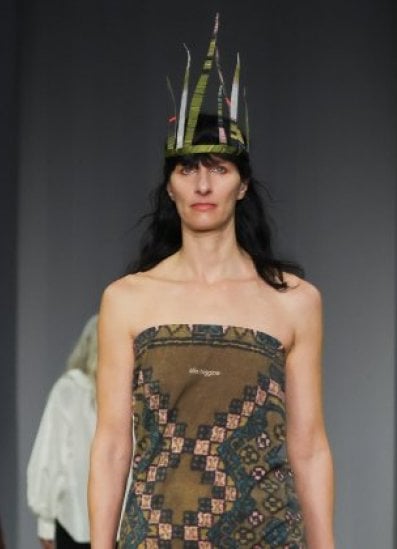
The mini dress is form-fitting and has a cap sleeve that comes out, off the shoulder, with a slight frill. This is due to the volume created by the signature smocking technique Pedder uses to give all her garments movement and body.
The technique uses very fine silk on what Pedder describes as a “tiny little machine”, which has long cylinders with ridges that gather and tightly fold the silk as it is fed between them and onto a row of needles that secure the pleats with thread. The effect is to turn big pieces of printed silk into smaller, ruched sections that she uses to construct her garments. The process, which Pedder does by hand in her bedroom, is time- and resource-intensive.
The dress is made of an asymmetrical patchwork of these sections, each with its own print and form. The right side of the torso and much of the chest is covered in white cats and bright red roses. On the left torso, the words “the last” are printed in black block letters on a white background – in this piece, the smocking finishes about halfway down so the rest of the silk billows freely over the hip. The skirt is a pale teal with dark shadows of leaves and flowers moving down from the waist, to finish in a ruffle that runs along the hem.
Like many of Pedder’s silhouettes, the dress is distinctly feminine. Despite the flirty shape and the lightness of each print, however, collectively the impression the dress creates is something darker: a desire for chaos.
“I use scale and big colours to evoke emotion,” says Pedder. “Like a crazy combination of opposing colours to create the feeling of all this movement.”
This, then, is where Rothko comes in, with his famous declaration: “I’m only interested in expressing basic human emotions – tragedy, ecstasy, doom and so on.” The great abstract expressionist went on to declare: “The fact that a lot of people break down and cry when confronted with my pictures shows that I can communicate those basic human emotions.” Pedder’s desire to connect with her audience feels like something more energising, more punk.
Pedder is just 24. She graduated from the University of Technology Sydney in 2021. In the three years since, she has collected the highest accolades available to Australian fashion school alumni. Her graduate collection was featured in the National Graduate Showcase at Melbourne Fashion Festival in 2022. After a stint in New York working for cult label Vaquera, she returned home in 2023 to participate in the Next Gen runway at Australian Fashion Week and launch her brand, Rube Pedder. In July this year, she won Ubank’s Feel-Good Fashion Fund, a $30,000 prize available to emerging designers. As part of the award, she will create three couture pieces and a limited edition ready-to-wear capsule collection that will be released later this year. An online store is to follow.
In a departure from the copycat habits much of the fashion industry has fallen into, every one of Pedder’s garments derives from her artistic practice. The silk is printed with artwork she has created; whether they are photos she’s taken or drawings, etchings or screen-prints she’s made. “I have a big library of random prints that I’ve done over the past five years that I reach for and edit,” she says.
For Still Life, she has used a series of photos and paintings from the period after she returned to Australia from New York, when she was staying with her grandparents in the north-eastern Tasmanian town of Scottsdale.
“It was this very slow life and I was painting still lifes and doing a lot of reconnecting with nature. It sounds so corny when I talk about it, but this collection was mainly just about stillness and the beauty of the natural environment,” she says. “It was about slowing down and coming back.”
Her grandmother is a keen gardener and being among her flowers was a sort of respite. “Through every season of the year there’s always something in bloom at her house. It’s really beautiful,” Pedder says.
This love of flowers is evident in a strapless black dress that features a print from a photo Pedder took. “It was a bouquet of flowers that was just sitting in my room,” she says, peppering each point she makes with art references. “It’s a study of form and colour.”
The white lisianthus and their green stems and buds pop against a black background. Each piece of fabric is trimmed with cornflower blue. When the smocking technique has a raw edge, this creates the effect of a blue tulle ruffle along the top of the bodice and over the right hip of the skirt that finishes at the knee.
The same print is used on another strapless dress that has hips so exaggerated they arch upwards so the short skirt sits off the body as if defying gravity. This is done by constructing a frame beneath the skirt using a combination of boning and metal.
Pedder explains that she uses “the historical principles of womenswear” in all of her pieces. Aside from a pair of black flares with an aggressively low-rise and exaggerated texture and proportions, the collection is made up of corsets, skirts, singlets and dresses. The corsets are boned, every garment is lined and the designs are made using patterns and finished by hand on the body. Pedder sews and smocks everything herself, which means the pieces are expensive: they are made-to-order so prices vary, but Pedder says $700 is the starting point.
The grandmother who grows flowers is also a seamstress who introduced Pedder to both sewing and smocking and a fourth love: meeting like-minded people through art. “In her community it was a form of connection,” says Pedder. “They would catch up weekly and share their work.”
Pedder says she is inspired by the way they built community through art and fashion, and in this way draws a curious comparison between her grandmother’s craft circles and the Riot Grrrl underground feminist punk movement of the 1990s. These two worlds are embodied in each garment, where softness is juxtaposed with a sharp edge.
“I know there was a lot of ostracisation for women in the punk scene, and so they went off and created it themselves,” she says. “Fashion was one of the tools they used to show their subversion or rebellion and connection.”
Although they’re not exactly punk, another career highlight for Pedder was being contacted by the stylist of the wildly popular K-pop band Blackpink. One of the four girls in the band, Jennie Kim, wore a top from Still Life onstage when they toured Australia in 2023.
The tank top marries the two sides of Pedder’s work: the feminine and the rebel. It is made from several pieces of ruched silk stitched together. Each is printed with what looks like the negative photo of a large, single butterfly in black and white.
“I love music, and I love girl music too,” says Pedder. “I think about how people connect and it’s always been through art.”
This article was first published in the print edition of The Saturday Paper on September 14, 2024 as "Riot grrrl".
For almost a decade, The Saturday Paper has published Australia’s leading writers and thinkers. We have pursued stories that are ignored elsewhere, covering them with sensitivity and depth. We have done this on refugee policy, on government integrity, on robo-debt, on aged care, on climate change, on the pandemic.
All our journalism is fiercely independent. It relies on the support of readers. By subscribing to The Saturday Paper, you are ensuring that we can continue to produce essential, issue-defining coverage, to dig out stories that take time, to doggedly hold to account politicians and the political class.
There are very few titles that have the freedom and the space to produce journalism like this. In a country with a concentration of media ownership unlike anything else in the world, it is vitally important. Your subscription helps make it possible.
Subscriber exclusive
Send this article to a friend for free.
Share this subscriber exclusive article with a friend or family member using share credits.