News
ANALYSIS: Many politicians and public figures wrongly link violence with Indigenous cultural identity, which only intensifies stigma and does nothing for prevention efforts. By Dr Tracy Westerman.
How First Nations men are being demonised
Content warning: This piece contains descriptions of the impact of violence and abuse.
One woman is killed by an intimate partner every week, on average, in Australia, and studies indicate that she is 11 times more likely to be Indigenous. That’s despite the fact that just 4 per cent of Australian women are Aboriginal or Torres Strait Islander.
I am often asked if I believe there is a “culture of violence” in Aboriginal communities. I respond that any offender is enabled by a culture; by those who normalise and minimise violence; who feed their sense of entitlement and demonise victims.
Violence is a human issue, not a Black person issue.
Senator Jacinta Price, the shadow minister for Indigenous Australians, has long argued that violence is linked with Aboriginal culture. She recently went a step further by threatening to cut funding from a violence prevention organisation that refused to link Aboriginal culture with violence.
There are obviously significant problems in arguing violence is inherent within Aboriginal culture. The first is that it truly doesn’t get more offensively eugenic than this. The second is that it offers no value to violence prevention efforts. When violence is made to be about cultural identity, violence will prosper, because it trains systems to focus on the wrong characteristics; which are not only unalterable, but which stigmatise and blame rather than prevent. The result is the most vulnerable victims become more vulnerable – an outcome no one wants.
Simple ideas offer simple solutions, and the violence trajectory is anything but simple. When we stereotype and demonise Indigenous men and Indigenous culture, we are missing factors that maintain the victim–offender abuse cycle.
The data on Indigenous intimate partner violence has long been inadequate, and concerns about data gaps long ignored. The most significant research, conducted in 2023, excluded Aboriginal women from the sample, despite this being the most at-risk population. The research showed most victims stayed in violent relationships because they could not afford to leave. Financial abuse is all about perpetrators exerting control. So, when governments implement cashless welfare cards in predominantly remote Aboriginal communities, they create even more danger for Aboriginal victims and have the gall to call it violence prevention.
No one is denying there is an issue with violence in some Aboriginal communities; as there is in some predominantly non-Indigenous communities. The difference is that for the latter, the behaviour is labelled rather than the entire culture. Known as the “other-race effect” – a phenomenon steeped in racial neuroscience – it groups all Aboriginal people as implicated in the behaviour.
One of the very few studies of violence in Aboriginal communities reflects the inadequacy of research on intimate partner violence. It first analyses one dataset that shows Aboriginal men are more likely than non-Indigenous men to be “apprehended by police” for acts of violence – though they are also more likely to be acts of lower-level violence than sexual offences.
They then analyse an unrelated, second dataset showing what we have always known: that Aboriginal women are over-represented as victims of intimate partner violence. The study then attempts to join the two findings, to argue a case of entrenched violence perpetrated by Aboriginal men. No research has asked Aboriginal women “was your offender an Aboriginal man?” or linked ethnicity of victim with ethnicity of offender.
The assumption is that Indigenous men are the sole perpetrators of this violence in each case. However, data indicates that about 72 per cent of Indigenous women are married to non-Indigenous men.
It’s typical in high-risk Aboriginal communities for a relatively small number of families to dominate service provision. Generational risk is being passed through the same families unabated. For example, if we remove just 10 of the most densely Indigenous-populated remote communities from the 76 Northern Territory communities represented in the intimate partner violence data, the rate of incidence is almost halved. This shows that such violence is concentrated in a very small number of Aboriginal communities. In essence, 50 per cent of the violence is occurring in just 13 per cent of the communities.
If we then compare this adjusted rate with similarly sized remote towns in the Pilbara region with low Indigenous populations, we find these remote towns have more than double, and in some cases triple, the rate of intimate partner violence. That’s despite the Pilbara being more demographically stable and less socioeconomically disadvantaged.
This suggests intimate partner violence is concentrated in specific high-risk settings, regardless of cultural background, and we must examine broader structural, economic and service-related drivers.
It needs to be better understood that there are unique risk characteristics that make Aboriginal women more vulnerable to intimate partner violence.
Time and again, these victims of abuse are punished for being victims. We see three examples. First, police are more likely to erroneously label Aboriginal victims as the perpetrators, and it happens so often to Aboriginal women that many fear police more than they fear their assailants.
Second, the fastest growing cohort of child removals is from Aboriginal women allegedly “exposing their children to violence”.
Finally, there has been a 148 per cent increase in the incarceration of Aboriginal women since the release in 1991 of the Royal Commission into Aboriginal Deaths in Custody report. Of these, 90 per cent are the targets of intimate partner violence; 80 per cent are mothers, and the most common reason for incarceration is “assault”.
These scenarios represent a perfect storm of racial profiling and the overpolicing of Aboriginal victims when they come into contact with the legal system. Senator Price herself, as a survivor of intimate partner violence, has spoken of the additional trauma she experienced in a system that would not believe the account of an Indigenous woman with a non-Indigenous perpetrator.
If the systems that are supposed to protect only perpetuate the abuse, where do you go for help? What happens when you fear the system more than your own perpetrator?
The impossible choice: have your child removed, be incarcerated by police or cop the abuse.
One response I have noted among Aboriginal victims who understand that the system will not protect them is “fawn trauma”. It is other, rather than self-directed, and involves behaviours that appear as compliance, co-dependency and servitude but are, in fact, initiated to avoid additional trauma by appeasing abusers. It can also manifest as victims deliberately provoking reactions from abusers to initiate control over the conditions under which the inevitable pattern of abuse occurs – explosive anger is harder to predict and more likely to result in harm to self and others, particularly if children are in the dynamic. To untrained observers it can look as though abuse isn’t even occurring, or worse, that victims are the initiators of the abuse.
It might seem illogical that regions with the highest proportion of Black people are more, not less, oppressed, and often account for the bulk of statistics on intimate partner violence, suicides, incarceration and child removals per capita. However, during the era of apartheid, more than 80 per cent of South Africa’s population was Black. Australia’s remote communities have historically endured the most restrictions on human rights, from cashless welfare cards to curfews and alcohol restrictions, creating a collective learnt helplessness that is irrefutably linked to ongoing poor outcomes.
Racial trauma is an emerging field, and should be considered a separate trauma category because racism is both inescapable and enduring. The “other-race effect” tells us that the brain processes blackness as more threatening than whiteness. The “racial empathy gap” then tells us the pain of Black people is appraised as less than the pain of white people. It is therefore easier to believe negative rather than positive about Aboriginal people, because difference is perceived as threat and activates a heightened response that is about imagined rather than real fear. We see this in the overpolicing of Aboriginal people – the Northern Territory has the highest police-to-population ratio in Australia, more than double the national average. There is also the associated under-policing of those better placed culturally to understand and therefore manipulate systems.
As a psychologist with decades of experience in high-risk communities, I am interested only in what is preventable and alterable. Aboriginality cannot be altered. But risk factors that increase the likelihood of an Aboriginal person engaging in violence can be. Training frontline services to understand the unique dynamics of Aboriginal women suffering intimate partner violence can have an enormous impact.
The broader issues around the trajectory of violence are poorly understood. Untreated childhood trauma has strong links with both substance abuse and violence. Those with trauma tend to be more impulsive and limited in their capacity to self-soothe when triggered by intimate relationship breakdowns, which can look like an overreaction to conflict. We are already starting to see a lot of crime among Aboriginal youth and adults who are highly impulsive, or reactive to interpersonal conflict.
An effective violence prevention strategy should include teaching distress tolerance skills to generationally at-risk cohorts of families to prevent the damage being passed down. The need for such programs is beyond urgent. Parents who cannot consistently provide love and safety for their children are mostly hampered by their own compromised attachment and conflict reactivity.
How people change, and their motivation to do so, always comes back to relationships – because attachment matters. When core attachment has been compromised by trauma, relationships are also compromised. Understanding that there is a unique cultural trajectory to intimate partner violence gives us a better opportunity to prevent it.
Sadly, our political leadership keeps calling for inquiries – the Coalition had 13 into abuse in Indigenous communities during its last term. Politicians remain uninterested in the unique causal contributions beyond cultural identity. Confirmation bias in research perpetuates it as the primary driver. Existing violence risk assessments, for example, inflate risk based on Aboriginality alone. Existing violence prevention programs have no measured impacts because they are not assessing risk correctly and do not target Indigenous-specific risk factors. Because of the “all Aboriginal people are violent” rhetoric, we are failing to develop and mobilise critical prevention programs for disproportionally impacted communities – programs that literally can be life-saving.
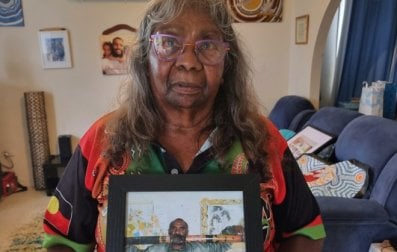
My mum, who is 83, explains it this way:
My son is a beautiful father, husband and son. Can you imagine if your son was labelled as a violent abuser, purely because of his cultural identity?
Simply put, it makes no sense.
This article was first published in the print edition of The Saturday Paper on April 26, 2025 as "Violence is a human issue".
For almost a decade, The Saturday Paper has published Australia’s leading writers and thinkers. We have pursued stories that are ignored elsewhere, covering them with sensitivity and depth. We have done this on refugee policy, on government integrity, on robo-debt, on aged care, on climate change, on the pandemic.
All our journalism is fiercely independent. It relies on the support of readers. By subscribing to The Saturday Paper, you are ensuring that we can continue to produce essential, issue-defining coverage, to dig out stories that take time, to doggedly hold to account politicians and the political class.
There are very few titles that have the freedom and the space to produce journalism like this. In a country with a concentration of media ownership unlike anything else in the world, it is vitally important. Your subscription helps make it possible.
Subscriber exclusive
Send this article to a friend for free.
Share this subscriber exclusive article with a friend or family member using share credits.