News
Economist Mariana Mazzucato, who tours Australia this month, has been acclaimed by leaders from the UK to the Vatican for her vision of a mission-based approach to the world’s most serious challenges. By Emily Barrett.
Economist Mariana Mazzucato on how to fix capitalism
Mariana Mazzucato is bemused by conservative critics. She is a believer in the essential roles of markets and business – she just wants a fundamental rethinking of their relationship with the state. The University College London professor has built out her vision of a more productive collaboration between government and the private sector across a series of books, including The Entrepreneurial State, Mission Economy and The Big Con. She speaks with The Saturday Paper on the eve of her Australian visit.
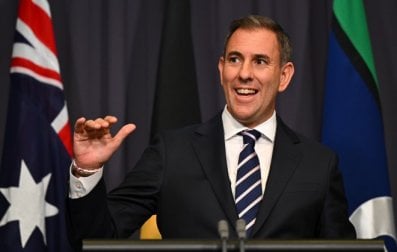
Emily Barrett In his essay in The Monthly last year, Treasurer Jim Chalmers cited your work as inspiration for a more equitable form of capitalism in which markets can better meet society’s goals. Critics here accused him of radicalism, of dismissing the benefits of deregulation and of pushing for more state control. What do you think of the reception?
Mariana Mazzucato That pushback from the right is very common, but it makes no sense. Proper conservative positions should deal with the meat and talk about details like: what would deregulation mean for specific aspects of health, of energy, of water and so forth? Just using these abstract concepts – deregulation is good or the state is Leviathan – is just a very immature way to have this much-needed discussion. I might have a more progressive stance, but I very much respect a conservative stance on this topic, and I do think it should be debated.
Why people like Jim Chalmers are interested in my work is precisely, I think, because it goes beyond this false dichotomy, public versus private.
As I wrote in Mission Economy, we needed 400,000 people to get to the moon. There were so many different businesses involved. It wasn’t just aerospace, it was nutrition, materials, electronics, software and so on. And what the state did is exactly what I say it should be doing with our societal wicked challenges. It led the way. It didn’t micromanage. It was clear.
The second thing the state did was change its tools to bring in the private sector. It needed things like outcomes-oriented procurement policy – a challenge-orientation for all the problems along the way. What would the astronauts wear? What would they eat? How would they go to the bathroom? All of these concrete problems needed solutions, and that’s what drove the growth. We ended up with camera phones, foil blankets, baby formula, software – all from the private sector in response to publicly set problems.
So the state catalysed all this innovation. That would have never happened if it just kept this vague “partnership”. It needed outcomes-orientation, companies were rewarded if they innovated and produced good quality. So it’s fixed-price procurement with incentives for quality improvement and innovation, instead of cost-plus procurement, for example.
And interestingly, NASA were so confident about their role that they also made sure the contracts were effective and designed a fair deal. NASA said no excess profits. Not no profits – you don’t get to the moon with charity, you don’t solve climate change with charity – you need proper business, proper government working together. No excess profits meant no rents, we’re going to share the risk, share the rewards. They did some of the high-risk, early-stage capital-intensive investments.
It’s harder, but it’s the same approach that’s required for the UN’s Sustainable Development Goals. They need to be turned into missions, which require investment, and put at the centre of industrial strategy. We should be tackling our health and water challenges, for example, in a moonshot way. But it’ll never happen without state capacity.
There’s no reason a conservative person should be against this. The private sector is key to missions. They’re just not key in the sense of just getting subsidies and handouts and guarantees. They’re key if they can work well with government and if government knows how to work with them, hence the capacity building. What I’ve witnessed around the world is that capacity is missing today, as well as confidence.
EB You’ve been an adviser on economic policy to governments, could you give examples of how this reframing you’re talking about has worked or could work, and what are the major hurdles?
MM We did have a mission-oriented state in the US, which fuelled the IT revolution and the green revolution. But because of that lack of the entrepreneurial state they didn’t see it through properly. So they ended up funding the internet, which goes into Google, and GPS, which is for Uber and so on. Tesla and Solyndra both got close to $500 million in a guaranteed loan. It was a portfolio – which is good, right? You don’t put all your eggs in one basket – but when one of the companies goes bust, Solyndra, the taxpayer has to bail them out. When things go well, oh, it’s the genius, it’s Elon Musk, it’s private sector initiative.
Well, no. That early-stage, high-risk public capital investment was absolutely required. And the government did the opposite of what it should do. It said to Tesla, if you don’t pay the loan back, we’re going to get three million shares in your company, which is a bad decision because if the company doesn’t repay, it’s probably unprofitable. Why would you want three million shares in a bad company? Had they said, if you do pay it back and you’re successful, we get three million shares… The price per [Tesla] share in the meantime went from $9 to $90. The difference multiplied by three million would have more than paid for the Solyndra loss and the next round of investment.
So that’s what I call public venture capital. There are examples of that. Israel has had Yozma Group, a public venture capital fund. The US has In-Q-Tel. It’s in the CIA. It’s one of the biggest venture capital funds in the world and it does retain equity.
These are exceptions. I think they should become more the rule. Not for the basic research funding – there’s no point in equity in that case – but when governments are giving specific companies early-stage funding it makes sense to get a return.
It’s not just equity stakes. [The government] should also be making sure that the patent system, the intellectual property rights system, is not abused. Lots of health innovations are down to public sector, early-stage, high-risk investment. It’s fine for the private sector to take it on and to see it through to commercialisation. But the patent system, which is governed by the public sector, should make sure that the patents aren’t too wide or too strong, so hard to license and aren’t too upstream.
Another example would be the price system. In that same sector of health, the prices of the drugs that are publicly co-invested in should take that into account. We shouldn’t allow prices to go to what markets will bear, which is what value-based pricing allows.
EB In Australia, the cost-of-living debate is still at a peak, with the concern that perhaps inflation isn’t coming down fast enough, and questions over whether the central bank is going far enough or has gone too far. Does what you’re suggesting, as a more expansive role for the state, risk stoking inflation?
MM First of all, the big inflation that the world has had to deal with has nothing to do with inflation caused by demand. The inflation that we’ve experienced is due to seller’s inflation. So supply-side inflation – prices, monopoly prices, excess prices, excess profits in energy, oil, gas and food. The big food producers have passed on their excess costs to consumers, but in a way that’s really in excess even of their own costs. They’ve taken advantage of supply-chain shortages, which we witnessed after Covid, but also the hikes in gas and energy prices – which should be illegal, if we actually had proper monitoring systems.
We should be not just reactively reacting to inflation by increasing interest rates, which of course just makes the cost-of-living crisis worse – the cost of debt rises, so their mortgage bills rise, the cost of buying anything on credit cards rises – when people are already hurting. That potentially puts countries into recessions because consumers start to spend less.
That kind of monopoly power is a problem. It requires government to have the confidence to work with business and have deals, like they did in Spain, making sure that some of these excess profits were taxed directly to then cover the cost-of-living rises in the population.
Remember that this isn’t about being anti-profit. Profits can be Schumpeterian, created through investment and innovation. Or they can be created just because you have access to some sort of monopoly or special asset which others don’t have access to, and that’s called the rent in the system. Classical economists like Adam Smith – and he is often cited by conservatives – his notion of the free market was free from rent, not free from the state. In order for states to be active in reducing rent seeking and capture, they need to be smart states, capable states and know how to use regulation, but also make sure that rewards are socialised as much as the risk-taking. So Adam Smith, I think, would love what I’m talking about.
EB Should governments be wary of taking on more debt, though? Debt servicing costs are high and they’re climbing with interest rates rising. You’re not a modern monetary theorist, I understand, so where do you see the threshold?
MM Your debt to GDP is crazy low, though. I mean, it is not a problem at all for Australia. Even for a country where it’s very high, it might not be a problem. Modern monetary theory is actually correct, theoretically. It’s not correct politically, because obviously it’s naive politically to say, “Oh, just print money, it doesn’t matter.”
My point is, if you do mission-oriented policies which catalyse private-sector investment, that increases the long-run driver of your denominator, GDP, so the ratio stays in check. Now, what the right ratio is, there is no magic number. There’s some countries with 100 per cent debt to GDP and they’re doing absolutely fine. Some have 40 and they’re not doing fine. What matters is the driver of that debt. If that debt is invested now into better infrastructure, better resilience in the economic system, both in terms of the social fabric – because it costs less to educate someone than to imprison them – but also in the productive fabric, with conditionality that gets the private sector the funds they need but makes sure they’re investing and innovating.
If you’re doing that, then the debt doesn’t hurt you. If you’re just throwing a lot of money at industry, hoping for the best, or even to consumers, hoping for the best, without actually thinking through the additionality that funding is going to create, in the case of industry getting investments to happen that wouldn’t have happened otherwise, then it’s not going to work. The debt is simply debt.
EB You’ve talked a lot about confidence in government. Are governments too timid?
MM They’re definitely too timid. But it’s not just about confidence. They are often not investing within their own capacity.
The Defense Production Act, which [United States President Joe] Biden used for vaccines, comes from wartime. It was an outcomes-oriented procurement coming from the military industrial complex. There’s nothing deterministic in these problems we have, governments just haven’t treated our societal or climate or health or digital divide problems as urgently as they have treated war. When we want to win wars, we somehow wake up and not only create money but then design the system to be outcomes-oriented. When millions of people were dying during Covid that act was reinvigorated. That’s too late. Why weren’t we doing that before the pandemic?
So there’s three different points. One is we need to treat all our problems – like the digital divide, health, climate, the SDGs [Sustainable Development Goals] – as urgent. Second, that means putting them at the centre of the economy and our economic systems – like industrial strategy, innovation policy, financial policy. Third, you need to invest within the civil service in order to govern that process with the private sector. And you need a narrative to combat the lobbyists. The confidence is also about being secure in the story you’re telling, that you want to be socialising risks and socialising rewards, this is how you’re going to do it, and you need business to play the game with you instead of just extracting rents along the way. You need a narrative about creation of wealth, not just redistribution of wealth.
I’ve criticised left-wing and progressive governments for being too able and capable to talk about redistribution and not very able and capable to talk about value creation. You’re never going to win the battle as a government to get the policies right if all you know how to talk about is redistribution. You need to know how to govern production.
EB There is an entrenched perception, certainly in Australia, and I think around the world, that the left is no good at economic management. Why has that persisted?
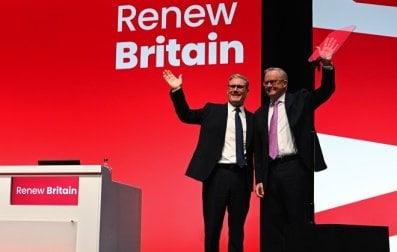
MM What the left needs to do is not only have these strategies that I’m talking about, mission-oriented strategies, but also a narrative to explain what it means for the economy, in such a way that you don’t do what [British Labour leader] Keir Starmer is doing now, which is to say, “We’ll spend £28 billion on green. Oh, but actually, no, we won’t because we don’t have the money.” The point is not the number. The point is, what is your actual strategy to make sure that that public investment catalyses a massive multiplier effect, which more than pays for itself?
By creating wealth with all these spillovers across the economy, catalysing private investment – which, by the way, in Australia and in the UK is below the OECD average, you don’t have enough private investment – smart public investment catalyses a ripple effect in the private sector. Non-strategic public investment doesn’t – it’s just handouts. Embedding conditionalities at the centre of public investment can help.
An example would be in Germany, where the steel sector got a big loan from KfW, the public bank, on condition that the sector lower its material content, which it did through repurpose, reuse, recycle technology. So now we have green steel in Germany. If you embed conditionality, which means the private sector has to do its job, then that expands the economy and that pays back the investment, both in tax revenue and because people are better off when the private sector is actually investing in human capital formation – training, research and development.
EB In The Big Con, which you co-wrote with Rosie Collington, you say the consultancies have captured bureaucracy in a way that has infantilised government. How did they get such a grip? And what can be done?
MM The consultification of government – Australia is the case study of what goes wrong. If you stop investing in the state, you get screwed by consultants who are on both sides of the street, consulting with the medical device companies and with the regulators of the medical devices. They did the climate strategy for Australia in a really silly way, when actually Australia had capacity – the CSIRO, for example, which could have been much more involved.
We looked at what has happened in the last 50 years of neoliberal thinking, where at best we talk about the role of the state as fixing market failures, as enabling and de-risking the private sector. If you’re just seen as a tinkerer, a regulator, an administrator, and not a co-shaper and co-creator of markets, there’s no justification for making these key investments in the capacity of government. We should begin the whole conversation with a new vision, a narrative and remit for the civil service. That’s the first big change that’s needed.
Second, you have to invest in that internal capacity and capability creation to work well with not only the private sector but with the consultants. We need them on the side, not at the centre.
And by the way, consultants include people like myself, nurses, doctors, head teachers. We’re looking at an industry that has taken advantage of weak governance. And we have to mandate transparency about conflicting interests – it’s amazing it doesn’t happen.
EB Do you have a moment to describe your next book, The Common Good?
MM I’ve written a paper on it: in order to address our future challenges – like the SDGs, like our housing crisis, like water and biodiversity – we need collective action. We need a public and private and a third sector, civil society institutions, to work together. And my thesis is we have no idea how.
In economics that notion of what is good has basically fallen through the cracks. Good is talked about as a public good – and that’s just a correction for a market failure.
We need a common good way of thinking, which starts with an objective. The objectives are the missions, the how matters as much as the what. The how – the public and private work together, making sure they’re sharing knowledge, they’re not extracting excessive amounts, they’re actually collaborating with true collective intelligence.
And it’s not about giving up profits. It’s about making sure that the way we’re producing, we’re distributing, is aligned with the goal. The whole notion of stakeholder value or purpose-oriented businesses means nothing unless we have this common good framing for how the different actors work together.
This article was first published in the print edition of The Saturday Paper on March 9, 2024 as "How to fix capitalism".
For almost a decade, The Saturday Paper has published Australia’s leading writers and thinkers. We have pursued stories that are ignored elsewhere, covering them with sensitivity and depth. We have done this on refugee policy, on government integrity, on robo-debt, on aged care, on climate change, on the pandemic.
All our journalism is fiercely independent. It relies on the support of readers. By subscribing to The Saturday Paper, you are ensuring that we can continue to produce essential, issue-defining coverage, to dig out stories that take time, to doggedly hold to account politicians and the political class.
There are very few titles that have the freedom and the space to produce journalism like this. In a country with a concentration of media ownership unlike anything else in the world, it is vitally important. Your subscription helps make it possible.
Subscriber exclusive
Send this article to a friend for free.
Share this subscriber exclusive article with a friend or family member using share credits.