News
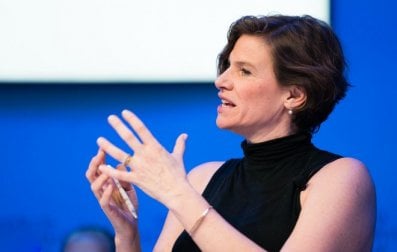
Michele Bullock led the Reserve Bank to another rate cut this week, balancing a more complex environment than her critics give her credit for. By Emily Barrett.
Can Bullock rebuild the Reserve Bank’s credibility?
The Chief Executive Women’s annual dinner, held on Thursday, April 10, was no place for pandemonium.
This is where Michele Bullock, the governor of the Reserve Bank of Australia, made her first public comments since America’s so-called “Liberation Day” on April 2. United States President Donald Trump’s tariff announcements had wiped trillions off US sharemarkets and were driving similar losses around the world.
Throughout that turmoil, there had been calls for an emergency board meeting to cut the cash rate – from former central bank governor Bernie Fraser, the Greens, The Australia Institute and former Labor economic adviser Stephen Koukoulas.
“I think the Reserve Bank should be out there doing something and catching up on its reluctance to do anything up to this point in time,” Fraser told the ABC’s Radio National Breakfast on April 8, calling for a 50 basis point cut. “It’s time to take action decisively.”
Two days later, Bullock took the stage at the Melbourne event as keynote speaker. “I hadn’t intended to talk about the RBA’s policy responsibilities tonight,” she began, to wry laughter.
Bullock then offered a brief preface, in light of the week’s events, to her speech on women’s empowerment. In spare terms, she explained that the previous week of global market upheaval was not the worst she’d seen.
She said the impact from the US president’s tariff announcements on April 2 was not as bad as that of the 2008 global financial crisis, and “the Australian financial system is strong and well placed to absorb shocks from abroad”.
Bullock had met with Treasurer Jim Chalmers and other financial authorities the previous day to discuss the turmoil – a summit that briefly interrupted the treasurer’s election campaigning and did no damage to his pitch as a strong economic manager. There was no change to the RBA’s plan to meet in nearly six weeks’ time, as scheduled.
That meeting took place on Tuesday. At the post-meeting press conference, Bullock explained the thinking behind a modest 25 basis point cut, to 3.85 per cent, following a similar drop in February from a 13-year peak of 4.35 per cent. Describing the intervening weeks as “a roller-coaster, frankly”, Bullock noted the “unpredictable” outlook in understated terms and did not name the US president.
The takeaway from her speech is that the central bank has the means to “be agile”, as Bullock put it, and cut rates in the face of a steeper downturn. Most economists are predicting two to three more interest rate cuts this year and the governor hasn’t contested that outlook. “If we need to move quickly, we can – we’ve got that space,” she said on Tuesday.
Bullock was careful to point out that the 132 references to “uncertainty” – as tallied by one journalist – in her Tuesday speech didn’t reflect a lack of confidence on the board about the correctness of the latest decision.
That projection of confidence is key. “Geopolitical uncertainty” is a platitude in central bank speeches, but it’s hard to recall a more uncertain or destabilising time. Former assistant RBA governor Luci Ellis, who is now chief economist at Westpac, tells The Saturday Paper this week: “I’ve never known in my entire career someone to say that uncertainty was below average. That said, we are in a world of greater geopolitical and global uncertainty than normal because of the behaviour of the Trump administration.”
The effects of an unprecedented surge of protectionism globally are almost impossible to model, as Jo Masters at Barrenjoey financial services points out. “When policy is moving – so at the moment we’re talking about trade policy uncertainty – households and businesses can’t make and don’t tactically make large, hard-to-reverse decisions … Even if you’re a company that benefits from US tariffs, you can’t actually invest and hire because you don’t know how long or at what rate those tariffs will sustainably be in place. And that sort of uncertainty is almost impossible to model with any level of conviction.”
Masters says that, by her bank’s model, “the economic hit to growth post Liberation Day versus post the US–China agreement halved for Australia … So that’s the kind of moving parts that you’re dealing with.”
Central banks must take into account the direct, indirect and unforeseen consequences of a rapidly reshaping global trade system. For Australia, there’s the extent to which China’s growth will suffer, dragging on demand from our largest trading partner. There’s the potential for supply bottlenecks to raise prices, the prospect of a sharper global economic downturn, and the compounding effects of volatility in financial markets – which in some countries have shed trillions and then rebounded in the worst upheaval since the GFC. Interest rate cuts aren’t the answer to all of these problems, nor to at least three-and-a-half years of irrational American leadership.
The most important insight, at least at this point in the unfolding drama, is that the damaging effects of tariffs in the US would force a backdown by the president. “It was never going to be the case that the tariffs, as originally announced, were going to stick,” says Ellis. “They were an act of economic self-harm for the US. They were going to always pull back on that.”
According to Climate Council economist Nicki Hutley, Bullock has been working to repair damage to the RBA’s credibility following issues during Philip Lowe’s time as governor. She says Bullock “has rebuilt confidence in the bank very, very quickly, a confidence that had been eroded – she’s done an excellent job on that front”.
To call an emergency cut, such as the bank last carried out in the global financial crisis, would have been counterproductive, Hutley says. “Given the volatility and what we didn’t know, it would have struck more panic into markets rather than settling them. Her leadership has been cool, calm and collected.”
Bullock has faced no shortage of pressure in her first year as Reserve Bank governor. In September, the RBA was criticised by Jim Chalmers for “smashing the economy”, and by his former boss Wayne Swan for “putting economic dogma over rational decision-making” by keeping rates on hold at 4.35 per cent.
Australia’s rate-hiking cycle was moderate by global standards. Rates didn’t rise as high or as quickly as they did in the US, where inflation is nevertheless still above its target and growth slowing worryingly. Australia is more sheltered than many economies from the fallout of erratic US policy, and this is borne out in the analysis of former RBA board member Warwick McKibbin. His longstanding model of individual economies, G-Cubed – which has been used by the International Monetary Fund and major central banks as well as the Australian Treasury – so far shows this country avoiding a recession.
At least for now, after the crisis of the pandemic and its inflationary aftermath, Australia seems to have pulled off the elusive “soft landing”. Interest rate increases have brought consumer price inflation back down to within the RBA’s target band of 2-3 per cent. Though the trimmed mean remains at the upper bound, the trajectory has been a consistent decline. Unemployment, which tends to rise as higher interest rates constrain economic activity, remains well below the central bank’s own estimate of “full employment”.
“Unemployment is lower than it was pre-pandemic and inflation is at the midpoint of the band,” says Masters. “So, you know, today, job well done.”
That is in part due to Bullock’s stewardship. “A steady, calm, well-telegraphed, well-communicated hand is beneficial for businesses and investors that are trying to make decisions,” Masters says, “and I think she’s done a good job with that.”
That’s not to say there aren’t valid criticisms of the RBA’s call on waiting until February to lower interest rates. Average mortgage holders bore a more than 40 per cent increase in their repayments from the start of the rate rises to their peak in January 2024, driving rental costs sharply higher. Both Ellis and Hutley say the bank overestimated the strength of wage growth and has been too fixated on the inflation rate – which fell faster, and more consistently, than the RBA anticipated, from its peak of 7.8 per cent in December 2022. Consumption growth – spending by households – hasn’t recovered as the bank expected in line with the improvement in real income.
Looking ahead, Australia’s resilience, at least to the current tariff debacle, isn’t seriously in doubt, says Ellis. The demand for our main US exports, from frozen beef to cochlear implants to Canva subscriptions, is unlikely to suffer much from a 10 per cent tariff, she says. “Almost everything we export to the US we can either redirect elsewhere, or it’s stuff they can’t get from elsewhere.”
Of course, Bullock’s legacy is a long way from being determined. The new schedule of press conferences means she is arguably even more exposed than her predecessors to public judgement, her performance only as good as her latest big decision. She has formidable tests ahead of her.
This article was first published in the print edition of The Saturday Paper on May 24, 2025 as "Cooler heads".
For almost a decade, The Saturday Paper has published Australia’s leading writers and thinkers. We have pursued stories that are ignored elsewhere, covering them with sensitivity and depth. We have done this on refugee policy, on government integrity, on robo-debt, on aged care, on climate change, on the pandemic.
All our journalism is fiercely independent. It relies on the support of readers. By subscribing to The Saturday Paper, you are ensuring that we can continue to produce essential, issue-defining coverage, to dig out stories that take time, to doggedly hold to account politicians and the political class.
There are very few titles that have the freedom and the space to produce journalism like this. In a country with a concentration of media ownership unlike anything else in the world, it is vitally important. Your subscription helps make it possible.
Subscriber exclusive
Send this article to a friend for free.
Share this subscriber exclusive article with a friend or family member using share credits.