Architecture
As the designs for the Reimagining Where We Live competition show, residential care for the elderly can encompass a lot more than warehousing people until they die. By Naomi Stead.
Commonwealth design competition entries reimagine residential aged care
It’s hard to think of another sector with a greater need for design innovation, or any group more desperately under-served by their built environment than those living in residential aged care. Many architects have feared to tread into this sector, seeing it as highly technical, resistant to innovation, and unglamorous. It has attracted neither the profession’s full attention nor its combined talent. Things might be starting to change, though – with the Reimagining Where We Live: Design Ideas competition, run by the Commonwealth Department of Health and Aged Care.
This is the first time, to my knowledge, the department has run a design ideas competition – usually it’s the purview of the state-based government architects’ offices. For the optimistic, this could be a landmark moment: a sign of design moving upstream in national health planning and policy, the qualities of the care environment finally acknowledged as a crucial element in a holistic therapeutic approach. Good design marks the difference between an environment that supports wellbeing and quality of life, and one that exacerbates impairments and can actively disable a person, both physically and mentally.
Of the roughly quarter of a million people living in residential care in Australia, more than half have been diagnosed with dementia. Australians overwhelmingly wish to age in their own homes, so when physical or mental constraints make that impossible, residential care is the option of last resort. Despite the broom of de-institutionalisation that swept through Australia in the 1960s, residential aged care has been a stubborn hold-out of large-scale, institutional and medicalised care: now with added profit motive.
The problems were laid out with painful depth and clarity in the final report of the 2021 Royal Commission into Aged Care Quality and Safety – a document that literally gave me nightmares. It showed how a privatised and industrialised model of aged care ruled by market forces has led to a form of institutionality best described as inhumane.
While the nursing home is most often also the last home, this doesn’t mean it should be a mechanism for “warehousing” or incarcerating people while they wait for death. Care homes don’t have to be separated from the world. Even for people living with dementia there should still be space for social connection, spontaneity and the “dignity of risk” – which means the ability to make choices and take risks without having to exhaustively justify them to others.
The sweet spot is an environment where residents feel secure but have agency, where their physical health is supported but not at the cost of their mental and social wellbeing, where their dwelling is not a hospital, nor a prison or a hotel, but a home.
This was the general gist of the royal commission findings. The design ideas competition emerged from the only one of its 148 recommendations to address the quality of the built environment, namely number 45: “improve the design of aged-care accommodation”. It proposed the development of a set of national aged-care design principles and guidelines specifically focused on accessible and dementia-friendly design. The aim was to expand a “familiar households” model, in which between eight and 16 people are housed in small-scale “congregate living” clusters – even if within a larger facility.
The draft guidelines were developed by a consortium of researchers, architects and peak bodies, including Dementia Training Australia and Dementia Australia, and released in late 2023. They set out four nested design principles – to enable the person, cultivate a home, access the outdoors and connect with community. They illustrate dementia-friendly design using simplified language, visual examples and persona-based storytelling pitched to communicate with all players in the aged-care game – from providers and designers, to managers, workers, residents and families. The guidelines are voluntary, at this stage at least. They do dangle a carrot, though, in the form of possible future financial incentives, “whether by increased accommodation supplements or capital grants or other measures” to encourage compliant developments.
The purpose of the design ideas competition was to engage teams of architects, landscape architects and interior designers to test the guidelines through design practice, working with two hypothetical sites – one urban, the other regional. The outcomes were to be used to refine the draft guidelines in preparation for their final release on July 1 as part of the new Residential Aged Care Accommodation Framework.
As design competitions go, this one was unusually well framed. With a jury of highly respected figures from both the aged-care and design worlds, the evaluation process also included, unusually, people with lived experience of dementia. The brief was both detailed and pragmatic, meaning it mostly avoided gratuitous flights of fancy – the sometime weakness of “ideas” competitions.
It’s not all plausible, of course – I’m no gerontologist and my grasp of health economics is slight, but even I can see there are naiveties here. “An Ordinary Life” by T&Z Architects + Aspect Studios proposes a large aviary through the centre of their multistorey residential building – an aspect the jury diplomatically considered “as conceptual rather than absolute”, code for an idea that is lovely but impossible. Most of the designs haven’t managed to integrate all of the guidelines’ detailed checklists and even though the competition didn’t specify a budget, some entries stray too close to the resort model of aged care.
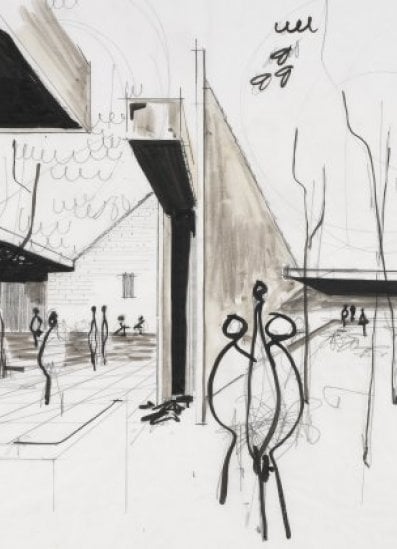
But when they’re good they’re very good. The best of all was “Manu Place”, by Monash Urban Lab with NMBW Architecture Studio, BoardGrove Architects, Bloxas, and Glas Landscape Architects, which won first prize in the regional category. As the most informed, careful and detailed of all the entries, it proposed a replicable pattern of small households gathered around a series of “cloister” and “courtyard” landscapes, each with carefully managed gradients of seclusion and social connection. Its celebration of the ability to be outdoors while maintaining privacy – to be in the garden in your pyjamas – is a response to the stunning fact that some nursing-home residents haven’t been outside in years. This scheme also interconnected effectively with the surrounding community – as architect Holly Board noted, “we wanted to show that a development like this didn’t have to be an island of old people within the town – it could be integrated”.
Interestingly, the quality of entries in this regional category was notably better than the urban category. Perhaps it was because the low-rise regional designs aligned with the innovative “dementia-friendly village” model already in use, for instance, at The Hogeweyk in the Netherlands or Hobart’s Korongee village. These kinds of protected sub-urban conglomerations include small-scale accommodation units alongside cafes, shops and other services accessed by residents and sometimes also the wider community, offering a high degree of freedom within a carefully-managed perimeter.
An excellent example of this is the second prize winner in the regional category, “All Together Now” by Other Architects, Openwork, Andy Fergus and Alicia Pozniak. Meanwhile the winning scheme in the urban category, “Scales Of Care” by LM2A with Super Natural, also uses landscape as a social mediator, creating a “front yard” with playground and shops, shared with the local community, while a secluded “backyard” is a shared space that brings residents together through gardening.
Many of the schemes proposed shared or co-located community facilities – in regional areas in particular, both aged care and childcare are hard to come by, and the benefits of bringing them together are manifold. Others included worker housing onsite, acknowledging the undervalued and underpaid nature of care work. There are so many other ideas, it’s impossible to cover them all here – in any case you should look and judge for yourself. The brief, winning designs and jury report, along with the guidelines, are all available online.
Right now, you’re still more likely to die on a waiting list than find yourself housed in a beautiful, enabling, humane dwelling such as we see in the winning competition entries. It might all seem like a cruel mirage. Also it’s not all about design – positive change will only come when the funding model, the care model and the spatial strategy all chime together. But I say design ideas competitions can be valuable instruments of change – they can catch the imagination, diversify thinking, offer fresh perspectives, act as instruments for advocacy and expand the art of the possible. The time is ripe.
ARTS DIARY
BALLET Jewels
Festival Theatre, Kaurna Yarta Country/Adelaide, July 12-18
FESTIVAL Mid-Winter Festival
Huonville, lutruwita/Tasmania, July 12-13
INSTALLATION TIME • RONE
Art Gallery of Western Australia, Whadjuk Nyoongar Boodjar/Perth, until September 30
MUSICAL Elegies: A Song Cycle
Fortyfivedownstairs, Naarm/Melbourne, July 10-21
MINATURES The Australian Society of Miniature Art (NSW) National Awards Exhibition 2024
Willoughby Arts Centre Ewart Gallery, Gadigal Country/Sydney, July 12-28
LAST CHANCE
MUSCIAL THEATRE Elvis: A Musical Revolution
Home of the Arts, Yugambeh Country/Gold Coast, until July 7
This article was first published in the print edition of The Saturday Paper on July 6, 2024 as "Living care".
For almost a decade, The Saturday Paper has published Australia’s leading writers and thinkers. We have pursued stories that are ignored elsewhere, covering them with sensitivity and depth. We have done this on refugee policy, on government integrity, on robo-debt, on aged care, on climate change, on the pandemic.
All our journalism is fiercely independent. It relies on the support of readers. By subscribing to The Saturday Paper, you are ensuring that we can continue to produce essential, issue-defining coverage, to dig out stories that take time, to doggedly hold to account politicians and the political class.
There are very few titles that have the freedom and the space to produce journalism like this. In a country with a concentration of media ownership unlike anything else in the world, it is vitally important. Your subscription helps make it possible.
Subscriber exclusive
Send this article to a friend for free.
Share this subscriber exclusive article with a friend or family member using share credits.