News
Sussan Ley hopes to lead the Liberals from the centre, but former MPs warn there is ‘nothing even remotely sensible or centrist mulling around in that party room right now’. By Karen Barlow.
Can Sussan Ley rebuild the Liberal Party?
As the Liberal party room gathered in a parliamentary corridor for the leadership vote this week, Alex Antic passed waiting media with his fingers cocked like two pistols. He mocked shooting at the assembled press: “Fake news! Fake news! Fake news!”
An unusually shy Angus Taylor cut through a back way and was seen struggling with a locked door. Eventually he was shown to the one through which his rival, Sussan Ley, had just passed.
Soon afterwards, Ley was appointed leader by the still-smarting parliamentary team, leaving its depleted numbers to spill out into the embrace of history. People either said the new leader was the right choice, smiled wordlessly or went out the back.
“This is a really important moment in time for our party to have our first female leader and I want it to be in no way tokenistic,” the member for Lindsay, Melissa McIntosh, tells The Saturday Paper.
“Sussan is very worthy of the job, but for it to be encouraging of young women who might want to join our party, who might want to go into politics, it’s just the first step in us appealing to women.”
https://www.youtube.com/watch?v=Ic9G6MvPtQM&ab_channel=TheSaturdayPaper
Returning a 29-25 vote, the margin between Ley and Taylor is as thin as in many of the electorates where the Liberals held on.
Her immediate job is to unify a party that comprises the likes of Antic, the rebuffed Taylor, and a dwindling number of moderates. There’s also the case of the new Liberal Jacinta Nampijinpa Price, who, failing to run for deputy leader after Taylor lost the leadership ballot, riffed on Sky News about the “lot of Australians” who would “love to see” her as prime minister.
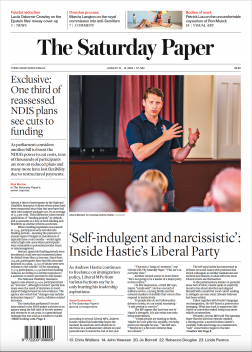
West Australian MP Andrew Hastie, too, is now talking about his “desire” to one day lead the Liberals but a young family, and tough commute between his Perth base and Canberra, has him biding his time.
“I’d be foolish to say I don’t have a desire to lead. I do have a desire to lead,” the former SAS captain told a podcast produced by the John Curtin Research Centre.
The numbers will get tighter for Ley and her new deputy Ted O’Brien. Two of the senators who voted for Ley, Hollie Hughes and Linda Reynolds, will leave parliament at the end of June. Taylor, Hastie and Dan Tehan are seen as ambitious and within reach of the leadership.
Ley insists she is no caretaker leader or suffering the experience of the “glass cliff” – a term given to the common promotion of women after the men before them have made a catastrophic mess.
“One hundred per cent I will be here in three years,” the new Liberal leader told reporters. “But more than that, we will be in a competitive position. We know that we can get there.
“We know that the vote for Labor was a very soft one and it is vital that we do not let down those people who stood there on polling booths and said to us, ‘You will get there, won’t you?’ ”
Later, in an opinion piece, Ley spoke of reconnecting and building trust with the many women who have “felt neglected” by the Liberal Party. She also gave a nod to the urban seats lost by the Liberals, saying she seeks to reach out beyond “the forgotten people” of Menzies and Howard’s suburban “battlers”. Her new demographic would be the young professionals and first-generation Australians in the major cities trying to get ahead and into their first home.
She set this marker:
“As leader of the opposition, I will fight for the values that the Liberal Party believes in.
“When the government makes decisions that contradict those values, expect fierce resistance. When they make decisions that we believe are in the national interest, my team will be supportive.
“Let’s get back to work.”
According to Senator Maria Kovacic, Ley’s ascension “really matters”.
“It’s a really significant moment for our party,” Kovacic tells The Saturday Paper.
“But the other stuff all really matters, too. I think our economic agenda really matters as well and the way we connect with Australians really matters. So, I don’t think that any of those things are mutually exclusive but the decision highlights that we’ve actually respected our most senior woman, and go ‘Yeah, we trust you to lead.’ ”
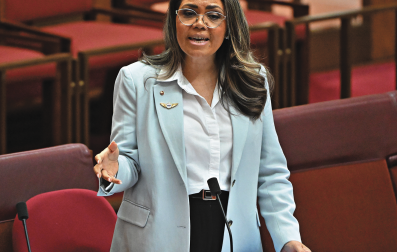
The new leader, who has reintroduced herself to the public with her backstory of being a migrant, a pilot, a shearer’s cook, a tax policy expert, a mother and a grandmother, is now tasked with rebuilding the Coalition from its historic defeat and facing down an emboldened Albanese Labor government.
All Liberal policy positions are open, even the settled net zero by 2050 position and the voter-rejected energy policy of a domestic nuclear power industry.
“I think you’ll see a vastly different approach to policy formation,” Scott Morrison’s former media chief, Andrew Carswell, tells The Saturday Paper.
“The issue with the Dutton three years was that they sacrificed policy on the altar of unity. They tried to keep the Coalition together by not talking about policy. And while that may be noble in its intentions, it led to policy atrophy.
“So what you will see this time around is the construction of a proper policy unit within the Coalition that will craft a policy based on its values.”
A new front bench with the confident Nationals must first be settled, however.
“We should remember that government has always formed in a sensible centre, but our Liberal Party reflects a range of views from all walks of life that are welcome in our party room and that is one of our great strengths,” Ley offered, after rejecting characterisations of “left,” “right” and “conservative”.
“But I do believe that government is ultimately formed in the sensible centre.”
Former Liberal MP Julia Banks, who quit the party after the Morrison leadership spill in 2018, says the woes of the Liberal Party are bigger than Ley suggests.
“I believe it’s a classic glass-cliff appointment,” she tells The Saturday Paper. “Now, calling it a glass-cliff appointment is not undermining Sussan Ley’s skills. It’s more a glass-cliff appointment is when an appointment is made of a woman to face a situation where the organisation is in some sort of crisis or turmoil or broken, and that is where the Liberal Party is at the moment.”
Others are sceptical about the suggestion Ley has been appointed only because the party is in such a dire state.
“I think she’s genuinely the next most senior person in line and it’s her opportunity now to have a real crack,” according to Australian National University political researcher Jill Sheppard. “She’s been around a long time. She’s the deputy leader. Let’s see what mark she leaves on the party.”
Monash politics lecturer Blair Williams, the author of a PhD thesis on the media coverage of Julia Gillard, says Ley is now leading a party that still has significant issues with gender.
“The Big Swinging Dicks club …” she tells The Saturday Paper. “Don’t know if that club is still going, but we’ve all heard about it and you know that can happen. And so, yeah, she had a difficult job to do.”
The self-identified “Big Swinging Dicks” club of male Liberal MPs was raised in 2021 by former Liberal deputy leader and former foreign affairs minister Julie Bishop. She recounted how the group tried to stymie her career.
“If their ambition was to thwart my aspirations, then they failed,” she told the ABC.
The Saturday Paper was told by a female Liberal figure this week that they still “absolutely exist”.
Bishop has passed on her “warmest congratulations” to Ley on her election as leader.
“It is an honour that brings great responsibility, and Sussan will bring her boundless energy and determination to meet the challenges ahead,” she tells The Saturday Paper. “I wish her every success.”
Blair Williams sees Ley’s appointment on a continuum that goes back to Bishop’s thwarted attempt to win the party leadership in 2018.
“I think, ideally, again, if you could turn back time, you would have elected Bishop as leader in 2018. Kate Chaney said that was a sliding doors moment for the Liberal Party regarding women’s place in it and how women in Australia perceive the party.
“I think it was always a poisoned chalice for whoever took it, but I think Ley is facing that added gender element as well.”
The party room is expecting a serious reassessment of policy and surviving personnel if the Coalition is to be competitive in 2028.
“I think she’ll run a more collegiate and less leader-centric party room,” Senator Dave Sharma tells The Saturday Paper.
“Any good leader needs to have the ability to self-reflect and learn lessons from mistakes and I think she’s got that ability to learn from the lessons of the last campaign and help us make the course correction we need to make.”
Sharma sees that the Liberal Party needs to have, at least, a competitive offering to women, the suburbs and the professionals classes.
“Firstly, we’ve had a near-death experience or a shock, right? And that forces you to re-examine a whole lot of things and often make changes that can be quite difficult or could be quite difficult in an ordinary course of events,” he says.
“I don’t think we made the changes or learnt the lessons we needed to after the 2022 election. I don’t think we have a choice this time, so that will force some of that important reckoning.
“The other thing I’d say is, I think the electorate’s quite volatile. And it’s not just true of Australia; it’s true across the globe. People do not feel a strong attachment or loyalty to any particular party brand. They’re quite prepared to vote on the merits of the offering before them, which gives us an opportunity to win that back.”
Julia Banks sees a party that has shifted too far to the right for Ley to succeed in reining it in.
A champion of gender quotas despite the party’s long-term opposition, Banks suffered a Liberal backlash for her shift to the cross bench before leaving politics to return to the corporate world.
“When you look at the closeness of that vote, there is nothing even remotely sensible or centrist mulling around in that party room right now, so I think it’s going to be a difficult call to say you’re going to lead from the sensible centre when you haven’t got people following that lead,” Banks says.
“I think they’ve gone too far away for the potential to be united. I think the direction to the right wing has gone so far and to such an extent, post the Morrison and Dutton shows, that the potential for any leader to unite that party room is … very limited.”
Varied views within the party can be healthy, according to the member for Casey, Aaron Violi.
“We need to be able to have healthy discussion, healthy disagreement as we set the course forward,” he tells The Saturday Paper.
“There’ll always be that when you’ve got a room of people with experiences that are different, opinions that are different, philosophical beliefs that are different. You will have that diversity of views. What is important is how we harness that into a collective policy space and a collective offering to the Australian people that acknowledges all the differences and comes together with one coherent narrative and one coherent policy offering to the Australian people.”
In uniting behind Ley, the Liberal party room is embracing the new leader’s initial positioning as someone who will be consultative and will eschew captain’s picks.
“There was a concern many people had that, potentially, views weren’t being listened to,” Violi says, referring to the past term of parliament.
“I think there’s an opportunity now, and Sussan has said this, to bring the talents together and to canvass all views and make sure that everyone has their voice heard.”
Still, it won’t be easy.
“There is a reason that Andrew Hastie and Dan Tehan had pulled out and it’s not because they think they need a soft face. It’s because this is going to be a slog,” the ANU’s Jill Sheppard says.
“They’ve been decimated. They don’t have a clear ideological direction. They’ve lost votes right and left. I don’t even know where they start. It’s not a job that many people in politics would want right now. On the upside, that might give Sussan Ley a little bit more breathing space.”
Ley is up for the job, according to Maria Kovacic, even though rebuilding the party after the election loss will be tough.
“I’ve spent weeks and weeks with Sussan on the campaign trail and obviously have been a colleague for a couple of years as well,” she says.
“She’s determined and she’s hardworking and I would suggest that anybody that may underestimate her may get somewhat of a surprise.”
This article was first published in the print edition of The Saturday Paper on May 17, 2025 as "Can Sussan Ley rebuild the Liberal Party?".
For almost a decade, The Saturday Paper has published Australia’s leading writers and thinkers. We have pursued stories that are ignored elsewhere, covering them with sensitivity and depth. We have done this on refugee policy, on government integrity, on robo-debt, on aged care, on climate change, on the pandemic.
All our journalism is fiercely independent. It relies on the support of readers. By subscribing to The Saturday Paper, you are ensuring that we can continue to produce essential, issue-defining coverage, to dig out stories that take time, to doggedly hold to account politicians and the political class.
There are very few titles that have the freedom and the space to produce journalism like this. In a country with a concentration of media ownership unlike anything else in the world, it is vitally important. Your subscription helps make it possible.
Subscriber exclusive
Send this article to a friend for free.
Share this subscriber exclusive article with a friend or family member using share credits.