Architecture
Its vaulting civic space makes Archer Office’s redevelopment of the Bondi Junction Boot Factory a building of aspiration. By Naomi Stead.
The Bondi Junction Boot Factory redevelopment
On the top level of the redeveloped Boot Factory in Bondi Junction, designed by Archer Office for Waverley Council, there’s a jaw-dropping new civic space known as the “cloud room”. Reached via a stair that’s itself a marvel of folded black plate steel, the room occupies the whole top floor, crowned with a magnificent raked ceiling of radial timber fins that converge on a large central sky window.
It’s a remarkable space, like being inside a hollow timber pyramid with its top lopped off. As I gawped I was thinking of architectural references: the oculus of the Pantheon, and the baroque tradition of illusionistic ceiling painting, all those piled clouds and fleshly angels and celestial shenanigans above you, like looking straight up the skirts of heaven.
The most interesting allusion here is to the work of the artist James Turrell. Architect Tomek Archer confirms the reference is deliberate. I can see clear commonalities with Turrell’s Skyspace series: a finely detailed central rectangular window to the sky, framing clouds, revealing changing light and colour, inviting the firmament into the room. Both have a similar presence – a vertical orientation, a meditative air, allusions to the myriad spiritual traditions that celebrate light from above.
There are also significant differences. For one thing the cloud room is maximalist – there’s a lot going on here, with the dramatic height and steep incline of the ceiling, the fretted timber rafters standing out like a sunburst against their painted black ground, the room itself still connected with everyday life through windows on every side, with views out to rooftops and trees and the world. Turrell’s work, conversely, finds its intensity from drawing the gaze inward, creating viewing chambers to human perception itself.
Turning all this over I finally realised the real connection is to Turrell’s work for Quaker meeting houses. Less well known than his blockbuster Skyspaces, they are places of gathering and contemplation, apprehension and quietness, an apt setting for the Religious Society of Friends’ process of “going inside to greet the light”.
Archer has the unusual distinction of having been famous – to varying degrees – in three separate fields: architecture, furniture design and music. The furniture started when, as a second-year architecture student, he designed the collectable “campfire table” and later founded the furniture studio Tomahawk. The Sydney electropop band Van She, of which he was a founding member, toured extensively for 10 years before it disbanded. At that point Archer returned to full-time architectural practice, starting Archer Office in 2014.
Perhaps because of the overlap between these phases – he describes feeling like “an architect masquerading as a musician” – he doesn’t see hard distinctions between the three fields, describing each as simply different constituent elements of performance. Music makes place wherever it’s performed, while architecture provides stage and setting. Furniture’s mobility is an invitation to arrange social interactions, moving items around “like props in a play”.
The three were fortuitously aligned in another recent commission: the refurbishment of Sydney’s City Recital Hall. The task was to reorient it as a venue for amplified music, refreshing what had been a weirdly corporate-feeling lobby and spaces around the main auditorium. Through the deft use of darkness and lighting, curtains and revelation, and greatly expanded bar facilities where the terrazzo almost steals the show, Angel Place now has a different vibe – one that punters may not immediately notice but will certainly feel.
Even before the Boot Factory, Waverley Council has kicked some architectural goals in recent years, including small works such as Lahznimmo’s Tamarama Beach Kiosk and larger heritage restoration projects such as Tonkin Zulaikha Greer’s subtly revolutionary revamp of the Bondi Pavilion. For the Boot Factory, council’s call was for a “knowledge and innovation hub” – an “innovative space for business incubation and knowledge transfer”, which would “nurture ideas to ... transform Waverley into a ‘smart city’ of the future”.
If this has you raising your eyebrows, you’re not alone. What does this kind of jingoistic neoliberal jargon actually mean? It doesn’t really matter – what the finished building offers is a series of well-appointed, flexible and bookable spaces for community use, allowing various forms of gathering from co-working to meetings to symposiums to performance.
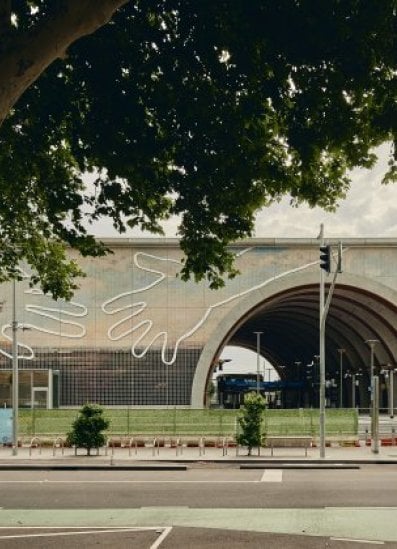
The original Boot Factory was a lovely little Victorian industrial nugget, once described as “the last 19th century building in Bondi Junction”. This is not a locale known for preserving its architectural history. Nor, frankly, for having much architectural distinction at all. But the Boot Factory, a slightly stretched cube with an almost Palladian geometric purity, is a happy exception. It’s a three-storey building where each floor and façade is made up of a grid of nine squarish bays. The order and proportion is so satisfying you could eat it, or shrink it and use it as a moneybox.
Many of the original’s fine qualities spring from being built before the advent of electricity, as Archer observes – it maximised natural light and ventilation through high ceilings, many windows and a surprisingly small floor plate. Archival photographs show the first-floor “clicking room”, where men in waistcoats cut hides at long wooden benches, and the second-floor stitching room, where women bend to sewing machines, piecing the parts together. Today the name is still right there on the parapet: Boot Factory, with a little heraldic shield noting the year of its construction – 1892. For 80-odd years the building passed through the hands of various shoemaking families and entrepreneurs, until in 1969 it ceased production and began to be used by community groups. Acquired by Waverley Council in 1984, it became part of the Mill Hill Community Centre complex, alongside the slightly odd neo-po-mo building constructed next door in 1992. Then things went downhill. The Boot Factory gradually fell into disrepair. Despite several bouts of structural remediation work, it was vacant and boarded up after 2007, brick walls slowly buckling and timbers rotting. Council voted in 2013 to demolish it, citing consultant assessments that it was too derelict to be saved. But it was rescued by an energetic community campaign, a council election, and an alternative engineering report with a differing view. Archer Office began work about seven years ago, with the finished work opening to the public in late 2024.
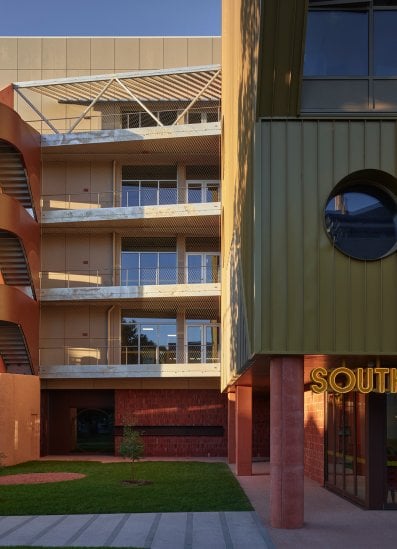
The building was seriously structurally degraded, meaning the only original fabric that remains is the brick perimeter wall. It’s hard to call it a heritage adaptation in a full sense, given that all of the internal structure, roof and floors are entirely new: it’s more like a new building occupying a thin shell of remnant fabric. Still, it ducks any charges of façadism by reproducing the original building’s spatial logic. Within that, each of the three storeys has been given a distinct spatial identity – the top floor open and expansive, the middle level cellular with sliding walls and flexible meeting spaces, the ground floor “grounded” – with new apertures so it now opens out on all four sides.
This strategy works a treat on the two upper levels, both of which now also connect through new bridge links to the Mill Hill Centre next door, which has also been extensively refurbished as part of the project. The ground floor is less successful, despite the pleasing symmetry and easy connections out to Aspect Studios’ redesigned forecourt. Four axial entry points in such a small space give the restless feeling of being in a crossroads thoroughfare. It’s a rare false note in an otherwise highly assured design.
Innovation hub or whatever, the building will outlast faddish labels because it’s both flexible and sturdy. It does things that are enduringly useful – allowing people to meet and work in various configurations, for various purposes, in well-appointed rooms that are light and pleasant to occupy.
The cloud room, though, is special. It does much more than effectively meeting functional or prosaic ends. It has a level of grandeur and beauty that’s frankly a surprise to find in this context, and with this brief. It offers some hint, some aspiration for how humans might be together in the world in troubled times: how they might commune and consult, engage in discourse, productively disagree, share experience, be companionable, gather, grieve, get along. It’s a room to enable society, writ large. It’s good when our buildings give us something to live up to.
ARTS DIARY
FASHION Australian Fashion Week
Carriageworks, Gadigal Country/Sydney, May 12-16
THEATRE Fair Punishment
Brown’s Mart Theatre, Gulumoerrgin/Darwin, May 13-24
FESTIVAL ECHO
Festival Venues throughout the east coast of lutruwita/Tasmania, March 14-16
MUSICAL Beauty and the Beast
Festival Theatre, Kaurna Yarta/Adelaide, until June 22
INSTALLATION Revivification
Art Gallery of Western Australia, Whadjuk Noongar Country/Perth, until August 3
LAST CHANCE
CULTURE We are the land we walk upon
Immigration Museum, Naarm/Melbourne, until May 11
CABARET Bernie Dieter’s Club Kabarett
Meat Market, Naarm/Melbourne, until May 11
This article was first published in the print edition of The Saturday Paper on May 10, 2025 as "Lofty ambitions".
For almost a decade, The Saturday Paper has published Australia’s leading writers and thinkers. We have pursued stories that are ignored elsewhere, covering them with sensitivity and depth. We have done this on refugee policy, on government integrity, on robo-debt, on aged care, on climate change, on the pandemic.
All our journalism is fiercely independent. It relies on the support of readers. By subscribing to The Saturday Paper, you are ensuring that we can continue to produce essential, issue-defining coverage, to dig out stories that take time, to doggedly hold to account politicians and the political class.
There are very few titles that have the freedom and the space to produce journalism like this. In a country with a concentration of media ownership unlike anything else in the world, it is vitally important. Your subscription helps make it possible.
Subscriber exclusive
Send this article to a friend for free.
Share this subscriber exclusive article with a friend or family member using share credits.