News
As Elon Musk guts the department overseeing America’s nuclear capabilities, concern is mounting about Australia’s AUKUS deal, with experts advising a turn back to Europe for procurement. By Karen Barlow.
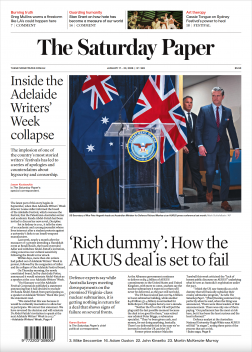
Will Trump upheaval force AUKUS rethink?
In July 2018, American and Australian defence forces gathered at the national cathedral in Canberra to celebrate their first 100 years of “mateship” on the battlefield. The event, which was marked by a twilight military tattoo, emphasised the shared vision of a second century.
Two months into the second Trump administration, Australia’s mate – a concept translated helpfully in a seven-year-old post on the United States Department of Defense’s website as “a person who shares the last drink of water or the last bit of food or the last beer in the six-pack” – appears to be missing in action.
The US president has already hit Australia with one set of tariffs, and another is expected within weeks. Global defence alliances are in disarray amid Donald Trump’s demands that his allies up their military spend, as the US steps back from supporting Ukraine and guts international aid programs. The strength of Australia’s pact with the US and United Kingdom under the AUKUS agreement, particularly the $368 billion deal to purchase at least three US Virginia-class nuclear submarines followed by the build of nuclear subs in Adelaide with British technology, is being called into serious question.
Trump’s pick for defence policy undersecretary Elbridge Colby has already expressed concerns that AUKUS commitments to delivering “crown jewel assets” could leave the US vulnerable in the event of a conflict with China.
Asked explicitly on ABC Radio on Thursday if he trusted Donald Trump, Anthony Albanese snapped back, “What sort of question is that?
“He’s elected as the president of the United States. I’m the prime minister for Australia,” he told host Raf Epstein. “He’s entitled to pursue his agenda, of course, but I’m entitled to defend Australia’s national interest, and that’s what we’re doing.”
Former ambassador to Russia and former defence deputy secretary Peter Tesch is more pointed. “We have a six-pack, and we certainly no longer have the plastic thingy that holds it together,” he told an Australian Strategic Policy Institute audience this week. “What we have is a set of bilateral relationships that we prosecute in the region, and America, to their degrees, has a similar set of formal alliance relationships.
“Now, the extent to which those givens can continue to be assumed, I think, is very much up for debate, because the US expectation that it’s about money, it’s about market, and it’s about military and it’s about the balance of hard power, changes that set of underpinning assumptions.
“I’m glad that we may never hear the words 100 years of mateship again, which I thought was always just an overblown, saccharine sort of view of things that clearly does not have any resonance in a world, in DC, which is focused on hard power.”
Security analysts are starting to use the phrase “post-alliance”, while Australia, still wanting its Virginia-class nuclear submarine delivery by the early 2030s under “pillar one” of AUKUS, may have to look outside the US for support.
For the Albanese government, in the midst of intensive lobbying in Washington against Trump’s tariffs, the US remains the “cornerstone of our national security”.
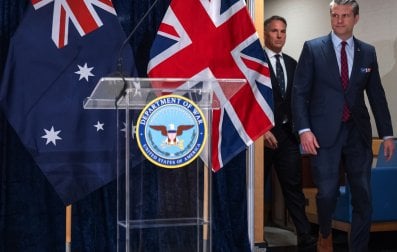
“We are working very closely with the Trump administration and we’ll continue to do that,” Deputy Prime Minister Richard Marles told the ABC this week. The defence minister delivered an $800 million downpayment on the AUKUS subs before meeting the US Secretary of Defense Pete Hegseth in February.
“In word and deed, in all that has been said and all that has been done and indeed underpinned by a legal treaty, AUKUS is there,” Marles says.
However, he concedes there is a “real challenge” for the US to increase its production rate of Virginia-class submarines. The government has been talking up Australian opportunities to assist in the supply chain, while building the industrial base in Australia and preparing for the planned construction and delivery of submarines at the Osborne Naval Shipyard in Adelaide by the early 2040s.
“It is a critical deal for Australia, because what it does is give us an evolving capacity, in terms of our long-range submarine capability,” Marles told reporters in Perth this week.
At the same time, anger over AUKUS is rising within his own party.
Rank-and-file efforts, backed by left-aligned unions, to raise anti-AUKUS motions at Labor national conferences have failed. Now with the Trump-led upheaval in US–Australia relations, the group Labor Against War has written to all party MPs and candidates demanding a rethink of the pact.
“The US cannot in any way, shape or form be considered a reliable ally for Australia,” Labor Against War’s national patron and former senator Doug Cameron tells The Saturday Paper.
“Things were complex, convoluted and uncertain, even before Trump became president; they are now impossible. If this, if we were a business, there is no way we would invest in such an unstable, unreliable supplier.”
As for Marles invoking the AUKUS treaty as evidence of delivery, Cameron scoffs. “Did anyone tell Richard Marles we also had a free trade agreement with the US?” he says.
“You can’t rely on a signed, negotiated, so-called free trade agreement. How can we rely on this pie in the sky that would leave Australia with three different types of nuclear-powered submarines, some of them not even designed, submarines that are attack-class submarines designed to sit off the coast of our biggest and most important trading partner? You couldn’t make this up.”
Also stretching credulity are developments in the US that directly impact the nuclear subs arrangement.
The regulatory agencies and institutional structures buttressing the superpower’s huge nuclear arsenal and power infrastructure have been cut by Elon Musk’s razor gang, the Department of Government Efficiency.
Probational staff at the National Nuclear Security Administration, the agency in charge of the US nuclear stockpile, were fired in mid February. The error of this move was quickly apparent, with officials soon trying to rehire critical workers after they were cut off from email and government systems.
Now The New York Times reports that key, specialised nuclear staff covering secure nuclear transport, nuclear submarines, nuclear science, engineering, safety and laws have been either fired or taken a buyout.
Among the core units losing highly specialised staff in the mass government firings and buyout offerings, according to the Times, is the one that builds reactors for nuclear submarines.
“Tampering with this is really, to me, it’s madness,” Greg Bourne, a former energy adviser to Britain’s Thatcher government and a councillor on the Climate Council, tells The Saturday Paper.
“Those sorts of regulatory agencies where the probability is low but the consequence is high – and that really becomes the key – therefore the risk level is really, really significant.
“If you strip out too many people, probably the probability is going up of an incident, and that’s the issue.”
The AUKUS deal nevertheless remains a bipartisan commitment. Peter Dutton firmly backs the nuclear subs arrangement – which was originally signed by his predecessor as Coalition leader, Scott Morrison – as a capability that will underpin Australia’s security for the next century.
In a speech to the Lowy Institute on Thursday, Dutton linked the submarines to what he sees as a need to be more self-reliant and resilient, warning that “Australia could be flat-footed in any uncertain time over the course of this century”.
“Nowhere is this more important than in developing our sovereign defence capabilities, reindustrialising parts of our economy, shoring up our energy security and fuel reserves.”
The opposition leader attempted to thread the difficult needle of reaffirming the US as Australia’s top alliance, while at the same time declaring it unreliable. “If our sovereign interests are threatened, Australia must never be in a position where we are totally relying on friendly cavalry to come over the hill. Sadly, that is the reality for our country today and it must change – and it must change urgently,” Dutton said, in an address that was disrupted by anti-nuclear protesters.
The loss of expertise in the US does not bode well for an Australian nuclear start-up, says Andrew Gregson, who is leading a rearguard action against the Coalition’s signature policy under the banner Liberals Against Nuclear.
“I think exactly the same thing has been seen in the United Kingdom, where they’ve had enormous delays in building reactors and electric infrastructure there in precisely the same way,” Gregson tells The Saturday Paper. “It’s why I say the assumptions in the current Liberal policy are heroic.”
Nuclear power analyst Dave Sweeney, of the Australian Conservation Foundation, predicts many US experts will take their fresh DOGE-induced redundancies and “go fishing”.
“That expertise and that pipeline will dry up,” he says.
However, Greg Bourne expects the top nuclear experts will quickly find jobs in the private sector and may want to come to Australia.
“There will be people, I’m sure in the Coalition, who will be thinking that ‘Oh, we can get some good people. We can build up our own civilian expertise very, very quickly now, because some great people are coming out of America.’ But basically, it seems to be madness, absolute madness.”
Opposition energy spokesman Ted O’Brien did not respond to questions from The Saturday Paper about plans to import nuclear expertise from the US. Nor did he respond to Liberals Against Nuclear’s charge that the policy, with its assumptions of extensive public subsidies, was against Liberal principles such as small government and cutting spending.
Instead, he attacked Labor’s “ideological obstruction” on the issue.
Former political leaders, meanwhile, continue to express contempt over the AUKUS deal. Scott Morrison’s predecessor as Liberal prime minister, Malcolm Turnbull, is a long-time critic of the agreement that ripped up the contract for conventionally powered submarines he had struck with France. He doesn’t think Australia will ever get the nuclear subs. Turnbull describes AUKUS as “unfair to Australia” and regards Trump as now holding the cards.
“He will be thinking, who are these dumb guys who agreed to this deal?” Turnbull told reporters in Canberra.
Former Labor foreign affairs minister Bob Carr describes AUKUS as a con to base US subs in Australia’s ports, leaving Australia without sovereign submarine capacity. He says Australia should go back to France for its “lethal and affordable” subs.
Peter Tesch also believes Australia must engage more with Europe. “Ultimately, our alliance with the United States will remain the bedrock of our national security posture. It is irreplaceable, but we must now look at where, how we forge greater capacity to shape the region.”
Topping the 2018 post lauding Australia’s concept of mateship on the US Department of Defense website today is the message: “You have accessed part of a historical collection on defense.gov. Some of the information contained within may be outdated.”
This article was first published in the print edition of The Saturday Paper on March 22, 2025 as "Rift widens over subs".
For almost a decade, The Saturday Paper has published Australia’s leading writers and thinkers. We have pursued stories that are ignored elsewhere, covering them with sensitivity and depth. We have done this on refugee policy, on government integrity, on robo-debt, on aged care, on climate change, on the pandemic.
All our journalism is fiercely independent. It relies on the support of readers. By subscribing to The Saturday Paper, you are ensuring that we can continue to produce essential, issue-defining coverage, to dig out stories that take time, to doggedly hold to account politicians and the political class.
There are very few titles that have the freedom and the space to produce journalism like this. In a country with a concentration of media ownership unlike anything else in the world, it is vitally important. Your subscription helps make it possible.
Subscriber exclusive
Send this article to a friend for free.
Share this subscriber exclusive article with a friend or family member using share credits.