News
Colleagues describe Ted O’Brien as nice and benign. He is also the architect of the Coalition’s controversial plan to build large nuclear reactors across the country – arguably to slow transition from coal. By Mike Seccombe.
‘The most beige person’: The man behind the Coalition’s nuclear plans
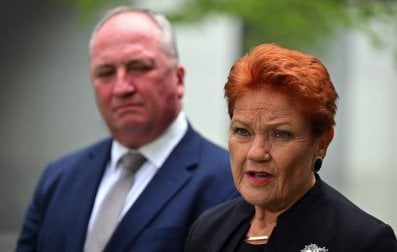
Just two months after the 2019 election, Barnaby Joyce was making trouble for the new Morrison government. The dumped Nationals leader was part of a group of maverick MPs pushing for nuclear power. He reckoned he knew a way to make such a policy saleable.
The Joyce plan, as articulated in The Sydney Morning Herald on July 21, was this: “If you can see the reactor [from your house], your power is for free. If you are within 50 kilometres of a reactor, you get power for half price.”
People living or working up to 75 kilometres away would get a 25 per cent reduction on their electricity bills, he told the paper. By his reckoning, communities across the country would be lining up to get reactors.
Scott Morrison didn’t want a bar of the idea, or of nuclear power. Inquiring media were assured the position taken by the Coalition to the election still held: there were no plans to build nuclear power plants and there would be none unless and until there was evidence they could stack up economically.
Still, the problem persisted. The split on energy policy was boiling over between moderates and right-wingers in the government’s ranks – the latter mostly from Queensland, mostly climate change sceptics and proponents of more coal-fired power as well as nuclear.
A number of the pro-nuclear members, prominently including Keith Pitt and James McGrath, had long been calling for a parliamentary inquiry into the prospect of taking Australia nuclear.
A few weeks later, Morrison gave them one, although technically the August referral to the Standing Committee on the Environment and Energy was from the then minister for energy and emissions reduction, Angus Taylor.
The chair of the committee was Ted O’Brien, the Liberal member for Fairfax on Queensland’s Sunshine Coast, a relative neophyte elected to the parliament only three years prior, on the slogan “Time for Ted”.
To him fell the difficult task of steering through a report that would pacify the pro-nuclear zealots without undermining the Coalition leadership’s “no nukes” policy.
In some respects, O’Brien is typical of Queensland’s conservative party, a unique amalgam of the Liberals and Nationals.
Like many in the Liberal National Party, he is the scion of a family business with agricultural links, Defiance Mills. He began his working life as a trainee baker, before moving into management.
In other ways, though, he differs from the norm.
He is neither part of the Queensland party’s dominant right faction nor the moderate wing and is unaligned. He is a former chairman of the Australian Republican Movement, now the Australian Republic Movement.
O’Brien is cosmopolitan. He has worked in various Asian countries, holds a BA from the University of Queensland, has studied Mandarin at the National Taiwan Normal University, has a Master of International Business from the University of Melbourne and a Master of Economics from the London School of Economics.
He spent more than a decade with the global consultancy firm Accenture, working with clients in the communications and high-tech sectors. While there, he rose to be director of growth and strategy for the Asia Pacific and emerging markets, based in Beijing. After that, and before being elected, he was engaged in politics through the lobbying firm Barton Deakin Government Relations.
Unlike others in the LNP, O’Brien is not, as they say, colourful.
When I interviewed him about his views on nuclear power last year, I found him to be informed, considered and unaffected. This modesty, however, is interpreted differently by different people.
“My initial impression of him was that he was about the most beige person I’d ever met,” says a Liberal colleague.
“When I first met him, like, he seemed just very nice and benign, and … polite. Just like, you know, a nice businessman type, not really the sort to set the world on fire.”
That assessment is not meant to be unkind. The colleague hastens to add that when they got to know O’Brien better, they realised he was not colourless but calm and considered and “very switched on” to realpolitik.
In short, he was just the person the Morrison government could rely on to take the heat out of a divisive debate and produce a suitably anodyne report.
That’s certainly the way the committee’s deputy chair, Labor member Josh Wilson, read the government’s decision to hold a “quickie” inquiry.
“We were told, ‘Go, guys. We want this inquiry and we want it done by Christmas,’ ” he says.
“It was a political solution, to stop Barnaby from making all kinds of hay. To the extent that Barnaby and a few others had whipped up that appetite for something to be done, it satisfied that appetite. Morrison was able to say, ‘Yep, sure, let’s have an inquiry. Let him [O’Brien] do it. He’s a good guy. And then let’s be done with it.’ ”
Both Wilson and another committee member, independent Zali Steggall, say throughout the hearing process O’Brien presented as the moderate conservative voice, in sharp contrast to other Coalition members.
Wilson says David Gillespie and Pitt were “gung-ho”.
“It was like, ‘C’mon you bloody greenies, you inner-city lefties, you don’t want nuclear, but it’s fine.’ That kind of thing. But Ted wasn’t like that. He was a serious person. And I think he knew he had a job to do.”
That job, says Steggall, was to “placate the Nats and come up with a report that was not canning nuclear outright, but acknowledging the difficulties”.
Some of what needed to be placated, particularly between the federal and state members of the LNP, is to be found in a submission to the inquiry from Michael Hart, the then shadow minister for energy in Queensland.
“Australia’s rich renewable energy sources are more affordable and bring less risk than the elevated cost and risk associated with nuclear energy,” it said.
“We would encourage the Committee to ensure an increased emphasis is placed on measures designed to encourage investment in renewable energy that creates green jobs and lowers electricity bills, both for consumers and industry, which does not include nuclear energy.”
The committee report, when it dropped in December, looked to have tiptoed a middle path. Its title, “Not without your approval”, acknowledged the need to build broad community support before nuclear power could be pursued.
It made only three carefully worded and highly conditional recommendations to government, summarised in O’Brien’s foreword:
“Firstly, that it consider the prospect of nuclear technology as part of its future energy mix; secondly, that it undertake a body of work to progress the understanding of nuclear technology in the Australian context; and thirdly, that it consider lifting the current moratorium on nuclear energy partially – that is, for new and emerging nuclear technologies only … subject to the results of a technology assessment and to a commitment to community consent for approving nuclear facilities.”
In other words, wait and see what happens with nuclear technology, particularly with so-called small modular reactors (SMRs), which were then in the very preliminary stages of development.
According to Steggall, this amounted to waiting for the “unicorn” to turn up. “The only viable option in nuclear was small modular reactors.”
Things have changed dramatically and repeatedly since then, however.
First, the Coalition lost the 2022 election and elected Peter Dutton, from the right of the Queensland LNP, as its new leader.
He did not share his predecessor’s caution when it came to nuclear power.
Second, O’Brien was elevated to the ministry as spokesman for climate change and energy. He travelled the world consulting on developments in nuclear technology, and began enthusiastically proselytising for SMRs.
One example often cited by O’Brien as the way ahead was an SMR to be built in Idaho – heavily subsidised by government – by NuScale Power Corp, a company that trumpets itself as “global leaders in SMR nuclear technology”.
There were, however, big problems with NuScale. O’Brien claimed a big advantage of SMRs was they could be built quickly, but the Idaho project was moving at a glacial pace. From site selection in 2016 to planned operation in 2029, the process was expected to take 13 years. This, bear in mind, was in a country with an established nuclear industry and regulatory framework.
Then at the end of last year, before construction had even begun, the whole project collapsed. In all it cost the American taxpayer US$600 million without operating for a single hour.
O’Brien was undaunted and shifted his focus to other projects. Recently he has been spruiking not just SMRs but traditional, large-scale nuclear plants.
On ABC TV this week, he cited the United Arab Emirates – “the most recent entrant in the civil nuclear program, globally” – as proof even large reactors could be built quickly.
It’s true: the UAE did build a large reactor in a little over eight years. Yet, as his interviewer, Sarah Ferguson, pointed out the UAE is an autocratic state.
According to the World Nuclear Industry Status Report 2023, the mean time from construction start to grid connection for the seven reactors that started up in 2022 was nine years. Over the three years 2020–2022, only two of 18 units connected to the grid in eight countries started up on time.
As of July 2023, 58 reactors were considered under construction. Of these, 80 per cent were being built in Asia or Eastern Europe; 40 per cent in China. Which is to say, either in countries with relatively permissive regulatory codes or command economies.
In countries comparable to Australia, it takes far longer.
Josh Wilson points to the example of the Hinkley Point C project in Britain, which has been in the works since 2008.
The most recent update on progress, he says, shows it “already three times over budget, so it’s going be £46 billion”.
The project is already nine years late and at best guess might generate the first watt of power in 2031.
“The whole project is based on a guaranteed 35-year offtake agreement whereby the British government will buy the energy at a fixed price that’s indexed,” says Wilson. “The price that they struck is already twice the price of wind power from the North Sea. And they haven’t generated any power yet.”
The other complications of nuclear are myriad, as businessman and nuclear physicist Ziggy Switkowski – who conducted another inquiry into nuclear power back in 2006 – told O’Brien’s committee.
No country had yet commissioned and completed a spent fuel or high-level nuclear waste facility, he said.
The costs of reactor decommissioning may be high and may be a potential burden on future generations for hundreds of years.
Wilson quoted Switkowski in his dissenting committee report. He noted Switkowski’s view that there was “no coherent business case to finance an Australian nuclear industry” and “one of the things that have changed over the last decade or so is that nuclear power has got more expensive rather than less expensive”.
A host of energy experts and analyses have concluded nuclear energy is by far the most expensive option for meeting Australia’s future energy needs while reducing greenhouse emissions.
So why has the federal Coalition run with the issue?
Zali Steggall says it’s a ploy to delay the transition to renewable energy.
“I actually, genuinely think under Peter Dutton’s leadership they are still doing what the Coalition has been focused on doing for 10 years,” she says, “which is trying desperately to keep more coal and gas in the system for as long as possible.”
When we spoke last year, O’Brien said he was not about delaying the energy transition and was not anti-renewables. Australia needed an “all-of-the-above strategy” – nuclear as well as other measures – to address climate change.
He may be genuine, but there is reason to suspect the same is not true of many of his party colleagues.
One answer he gave on 7.30 was telling.
He was asked if the uncertainty about the time it would take to build a nuclear plant might necessitate running coal-fired power stations for longer.
“So, our view is we should not be closing our coal-fired power stations prematurely,” he said.
Speaking to a business forum this week, Dutton said the opposition would soon announce about six locations across the country where reactors could be built. With shades of Barnaby Joyce, he foreshadowed measures to incentivise those communities to accept them.
“It’s worked elsewhere in the world,” he said.
Dutton did not specify where or what those incentives would be, but it is true many other countries, such as the United States and France, do give handouts to people living close to nuclear power stations.
Most commonly, it is potassium iodide, to protect them from thyroid cancer in the event of a nuclear accident.
This article was first published in the print edition of The Saturday Paper on March 16, 2024 as "‘The most beige person’: The man behind the Coalition’s nuclear plans".
For almost a decade, The Saturday Paper has published Australia’s leading writers and thinkers. We have pursued stories that are ignored elsewhere, covering them with sensitivity and depth. We have done this on refugee policy, on government integrity, on robo-debt, on aged care, on climate change, on the pandemic.
All our journalism is fiercely independent. It relies on the support of readers. By subscribing to The Saturday Paper, you are ensuring that we can continue to produce essential, issue-defining coverage, to dig out stories that take time, to doggedly hold to account politicians and the political class.
There are very few titles that have the freedom and the space to produce journalism like this. In a country with a concentration of media ownership unlike anything else in the world, it is vitally important. Your subscription helps make it possible.
Subscriber exclusive
Send this article to a friend for free.
Share this subscriber exclusive article with a friend or family member using share credits.