News
In an interview with The Saturday Paper, the Indigenous Affairs minister dismisses speculation about her political future and says the ‘fire is still raging’ to deliver change. By Karen Barlow.
Linda Burney on racism and the path to equity
It’s been almost eight months since the failure of the Indigenous Voice to Parliament referendum. A week of silence to help First Nations grieve and reflect has become a prolonged hiatus.
The 60-40 Voice rejection by the nation prompted Indigenous advocate Marcia Langton to declare the death of reconciliation and it is easy to see, even by a quick dive into social media sites, that much of the toxicity dredged up by the highly politicised campaign is still circulating.
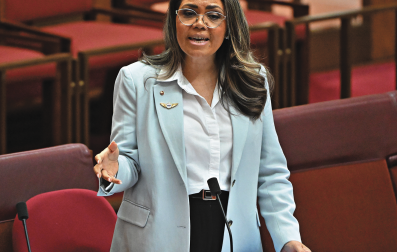
Minister for Indigenous Australians Linda Burney told The Saturday Paper this week she is on the hunt for a new post-Voice spirit of bipartisanship, and is seeking to dispel doubts about her political future.
“Certainly, the concentration that I’ve had since the outcome of the referendum is full speed ahead in trying to achieve equity for Aboriginal and Torres Strait Islander people through Closing the Gap,” Burney says.
“Obviously, I was one of the main people, from the government perspective, involved in the Voice campaign. Naturally, people saw a lot more of me, but we’re working very, very closely. Every state and territory has some sort of independent mechanism, Treaty, Truth-telling exercise under way.”
After the referendum, Burney says, she was respecting the period of mourning and doesn’t believe in talking “unless you have something to say”. She also had a much-delayed shoulder replacement straight after the referendum, so was in a “fair bit of pain”.
Burney last year responded to mounting speculation about her health by revealing she had suffered a minor stroke following heart surgery, and had been taking medication that she said had affected her speech.
Asked if Australians would see her as the minister for Indigenous Australians after the next election, she says, “That is absolutely my intention.”
Now, she says, “The fire is raging, and my health is perfect.”
The Voice campaigning and ultimate rejection of a constitutionally enshrined representative body was, according to one unnamed campaigner, an olive branch that was “lit on fire”. Many fear the result served as encouragement to racist elements in this country.
That tension hasn’t abated, as demonstrated by the national debate surrounding the opposition’s proposed cuts to immigration. This week it flared again with an appearance at the Sydney Writers’ Festival by high-profile ABC political journalist Laura Tingle, in which she observed, “We are a racist country, let’s face it. We always have been, and it’s very depressing.”
The Australian newspaper responded with a front-page headline declaring her “unbalanced”.
Tingle was counselled by ABC news management, and released a statement that said while she stood by her assessment, it lacked detailed context.
Burney says she does not believe Australia is a racist nation, but she accepts racism exists in Australian society as an everyday experience. Social media is littered with racial taunts in response to posts on Indigenous matters or prominent Indigenous figures – this online behaviour was especially pronounced throughout the referendum campaign and its aftermath.
“Those horrible comments that you’re referring to, sure, I’m aware of them,” Burney says. “But I choose to focus on what’s positive, what’s doable. Which is why we’re concentrating so much on Closing the Gap, on the partnership with the Coalition of the Peaks, and with academia.”
Burney insists reconciliation is not dead. A new generation of Indigenous leaders is emerging.
“The way that I think about it is, it’s not a destination, it’s actually the journey which is often windy and difficult,” the minister says.
“All change is hard fought, but the road for me is still very much there. I’ve spent most of my life in the pursuit of understanding between Aboriginal and non-Aboriginal Australians, but those things haven’t changed for me.”
If there can be a silver lining for Burney over the Voice defeat, it is that the needs and aspirations of Indigenous people are better known.
“I believe one of the really great outcomes of the referendum was it did put Aboriginal disadvantage at the centre of things, so people understand and want to see that change,” she says.
The minister points to the Albanese government’s $4 billion commitment in partnership with the Northern Territory government on housing in a bid to address overcrowding, health problems and safety concerns.
She also cites extensive investment in renal dialysis machines, a doubling of the Indigenous Rangers employment program by the end of the decade, increased spending to keep young Indigenous people out of the justice system and progress on clean water supply in remote areas.
There is a significant focus on the Northern Territory as a place of immense need. The Coalition’s efforts are similarly directed, but with an emphasis on law and order in Alice Springs. It is also highlighting government waste, citing $522 million spent on the referendum and calling for greater scrutiny on all federal Indigenous funding.
The Coalition, which dealt a possibly fatal blow to the referendum with its withdrawal of bipartisanship over the Voice, clearly sees potential in the success of its tactics. Riffs from the “No” campaign are evident in its recurring themes this year, of division, government waste, a lack of detail and Canberra bureaucrats.
Yet the face of the “No” campaign, Nationals Senator Jacinta Nampijinpa Price, has been relatively quiet since October 14. Her main presence is in the current Facebook and Instagram ads for right-wing lobby group Advance, in which she is smiling and wearing a “No” T-shirt.
Price rejects the notion that the campaign fuelled divisions in Australia. “The Voice campaign was divisive due to its design and in the way the Prime Minister orchestrated it,” she says in emailed responses to The Saturday Paper. “It’s time to move beyond the politics of division and separatism.
“The referendum result was a repudiation of Voice, Treaty, and Truth-telling. Moving beyond those policies in all their forms, is part and parcel of respecting the clear message sent by the Australian people.”
But what is coming?
“Australians will know our plan for Indigenous Australians before they vote at the next election,” she promises.
While the policies themselves are yet to come, Peter Dutton has flagged the timbre, tone and texture of the opposition’s next big campaign. His May budget reply, with a centrepiece featuring high migration as a cause of the housing crisis, shows he is ready to fight the next election on racial lines.
In the meantime, the opposition has renewed its call for an audit into spending on Indigenous programs. Price insists an audit is needed, or the government would be “doomed to commit the same mistakes”. It also maintains, despite the opposition of Indigenous health and child welfare groups and claims of politicisation, that it wants a royal commission into sexual abuse in remote Indigenous communities.
“This is a horrific tragedy unfolding out of sight and mind that needs to be brought into the light of day,” Price says.
There are known issues with how some money is spent on behalf of Indigenous Australians.
The independent Australian National Audit Office (ANAO), which reports to parliament rather than the executive government, audited a key department of the National Indigenous Australians Agency (NIAA) in the months before the referendum was held.
This leading First Nations agency funds more than $1 billion worth of grants to more than 1000 external providers, to deliver about 1500 activities aimed at improving the lives of Indigenous Australians.
Among other findings, the audit found the agency’s management of provider fraud and non-compliance risks was only “partly effective” and the frameworks it used were “not fully fit-for-purpose”.
Without intervention, it found, instances of fraud could keep happening.
“The ability for the NIAA to use lessons learned from provider fraud and non-compliance management to inform changes to systems and processes is reduced by insufficient identification of lessons learned, inadequate assignment of action owners and insufficient monitoring,” the audit report said.
The ANAO has also recently audited four land councils and last week conducted a fresh review related to the transition from the controversial Community Development Program to a new remote employment program. The result is delays, design issues, and trials that were still taking place when programs were due to start.
The agency is working on implementing all of the ANAO’s recommendations.
There’s a separate question of whether audits are too heavily focused on the money spent on Indigenous people.
Greens Senator Dorinda Cox put to acting auditor-general Rona Mellor in a Senate estimates hearing last week, “Why are we only picking off the Black money?”
Cox highlighted another ongoing hefty audit covering the “implementation of ANAO and parliamentary committee recommendations of the Indigenous Affairs portfolio”. It spans government from defence to arts to infrastructure to regional development and health.
“Why does the ANAO, in this space, although we’ve got a real breadth here in what you’re doing around making sure we’ve covered off the Indigenous persons portfolio, we’re not actually doing that for any other entities, are we?” she asked.
“Why aren’t we asking the local governments and other entities, where’s that money going?”
Mellor rejected the criticism of singling out Indigenous money, saying governance audits were conducted across all of the public sector, pointing to recent audits of major financial regulators, NBN Co Limited, and corporate planning in the Department of Climate Change.
“We really tried to get coverage across the whole of the Commonwealth funding sector,” she said.
Senator Price is not satisfied.
“It is evident that previous piecemeal audits have not provided the necessary clarity about which policies and programs are working well or those that are failing,” she says.
Burney says ultimately the concern is about the outcomes of better health, education, jobs and drinking water for Aboriginal and Torres Strait Islander people.
“They want accountability, of course,” she says.
“It is about outcomes, and I expect any organisation that is in receipt of federal funds – and through my portfolio I fund a lot of organisations – accountability and my expectations are very clear and very public.
“When you see communities that can’t drink the water because it’s got nitrate in it and when you see communities that find it hard to send their old people away for dialysis because they know that the next time I’ll see them they’ll be in a box. I mean, they are the things that are important to us, surely?
“And it is not just the tone of the country, but it’s the equity and the justice, and they are things that motivate the Albanese government.”
Burney remains hopeful about the prospects for a constructive debate with the opposition.
“I think bipartisanship, which has been so much a hallmark of Aboriginal affairs, is not as prominent as it used to be but I am hopeful we can get back to that sort of level of bipartisanship,” she tells The Saturday Paper.
Where to next after the nation voted for more of the same for Indigenous people is the big question facing First Nations people and Australia’s political leaders.
As it draws nearer, the federal election presents opportunity but likely yet another tough campaign.
This article was first published in the print edition of The Saturday Paper on June 1, 2024 as "Linda Burney on racism and the path to equity".
For almost a decade, The Saturday Paper has published Australia’s leading writers and thinkers. We have pursued stories that are ignored elsewhere, covering them with sensitivity and depth. We have done this on refugee policy, on government integrity, on robo-debt, on aged care, on climate change, on the pandemic.
All our journalism is fiercely independent. It relies on the support of readers. By subscribing to The Saturday Paper, you are ensuring that we can continue to produce essential, issue-defining coverage, to dig out stories that take time, to doggedly hold to account politicians and the political class.
There are very few titles that have the freedom and the space to produce journalism like this. In a country with a concentration of media ownership unlike anything else in the world, it is vitally important. Your subscription helps make it possible.
Subscriber exclusive
Send this article to a friend for free.
Share this subscriber exclusive article with a friend or family member using share credits.